MoRD official reviews skill development programmes in Haryana
To enhance employability and promote sustainable livelihoods in rural India, a comprehensive state-level review of skill development programmes was held here in Haryana.
For years, the standard way to check whether India’s vocational training system was getting fairer to women has been to look at one number: what share of trainees in a given scheme are female.




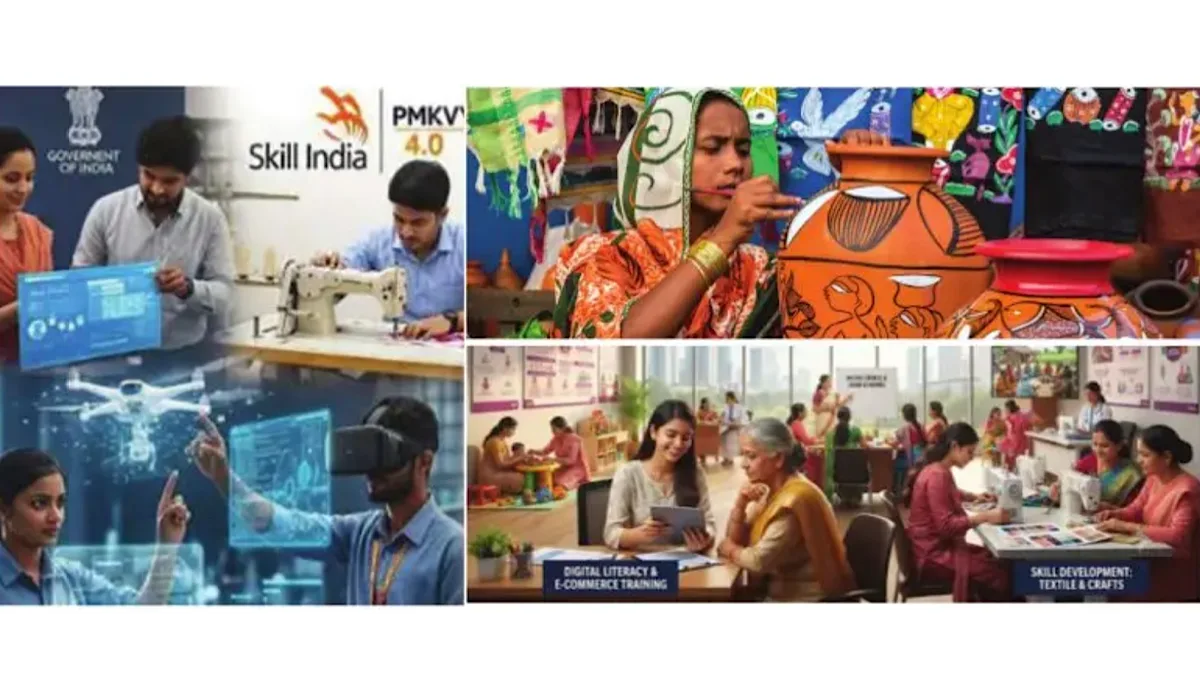
Photo:SNS
For years, the standard way to check whether India’s vocational training system was getting fairer to women has been to look at one number: what share of trainees in a given scheme are female. On that measure, the recent trend looks like good news. Women now make up 56 per cent of all candidates certified under PMKVY 4.0, the flagship short-term skilling scheme run by the Ministry of Skill Development and Entrepreneurship, and just over 60 per cent of those trained under DDU-GKY, the rural scheme linked to job placement run by the Ministry of Rural Development.
Read in isolation, these figures suggest the gender gap in India’s skilling system is closing, and closing fast. It isn’t, and the reason becomes obvious the moment you stop counting heads and start asking which trades those heads are sitting in. NITI Aayog’s Skill Development, Labour & Employment Division has, in passing, put out a working paper that makes this distinction unavoidable. Pulling together cumulative enrolment and certification data from Industrial Training Institutes (ITIs), PMKVY 4.0 and DDU-GKY, covering periods up to early 2026, the analysis shows that women’s apparent dominance in short term schemes sits on top of an almost total absence from technical and industrial trades.
Advertisement
The picture that emerges, examined trade by trade rather than scheme by scheme, is not one of closing gaps but of a skilling system efficiently sorting men and women into separate, unequal tracks. Start with ITIs, the backbone of India’s long term vocational training system, lasting one to two years, and the main pipeline into manufacturing, construction and engineering. Of the roughly 44.8 lakh candidates admitted between 2019 and 2024, only 12.65 per cent were women. Break that down further by stream, and the imbalance sharpens: women account for barely 5.5 per cent of all engineering trade admissions (electrician, fitter, welder, plumber, mechanic), even as they outnumber men in non-engineering streams such as fashion design, cosmetology and ecretarial practice.
Advertisement
Trade by trade, the engineering figures are stark: 2.7 per cent female participation in Motor Vehicle Mechanic, 2.9 per cent in Plumbing, 3.4 per cent in Fitter, 3.5 per cent in Welder, and 4.8 per cent as Electricians. Meanwhile, trades such as Embroidery, Fashion Design, Dressmaking and Cosmetology are 93 to 99 per cent female, not balanced participation but near total occupational sorting in the opposite direction. The short-term schemes tell a similar story once you look past the topline gender split.
Under PMKVY 4.0, women make up 65 to 95 per cent of certified candidates in Beauty and Wellness, Apparel, Handicrafts, Food Processing and Healthcare, but their share falls to 20 to 30 per cent or lower in Power, Automotive, Plumbing, Logistics and Mining, sectors that are precisely where India’s industrial growth and higher value jobs are concentrated. DDU-GKY mirrors this: women dominate Apparel Made-ups, Beauty and Wellness and Healthcare, but barely register in Construction, Capital Goods, Power, Rubber and Plumbing.
What this means is that the scheme-level gender ratio and the trade-level gender ratio are telling two different stories, and policymakers, journalists and even programme managers have largely been reporting the first one. A scheme can report rising, even majority, female enrolment every year while making no dent at all in the occupational segregation that actually determines whether women end up in stable, well-paid, future facing jobs or in the lowest paying corners of the services economy. The economic stakes of getting this distinction wrong are large. The IMF has estimated that removing barriers to female labour force participation in India could lift national welfare by 35 per cent and economic output by 12 per cent.
The World Bank separately estimates that raising female participation in manufacturing alone could add about 9 per cent to India’s output, and that if female labour force participation across South Asia matched that of men, regional GDP could grow by anywhere from 13 to 51 per cent, depending on whether women also gain access to the same high productivity roles and tools as existing workers. Both estimates are built on the assumption that women move into the trades and sectors men currently dominate, not simply that more women hold any skilling certificate at all. Counting heads without tracking trades risks declaring victory on a target that has not actually been met.
There is a second, less quantifiable cost. Occupational segregation isn’t a neutral sorting outcome; it is the product of pipelines that start narrowing long before a young woman ever applies to a training centre. Independent assessments of vocational provision under the National Education Policy 2020 have already flagged that the relatively few government schools offering certificate-based vocational courses to girls concentrate almost entirely on tailoring, embroidery and beauty-related trades, largely because of weak infrastructure, a shortage of trained faculty in technical subjects, and uneven rollout across states, not because girls lack the aptitude or interest in other fields.
By the time a young woman walks into an ITI, the menu of trades that feel “available” to her has often already been narrowed by what her school offered, what her family considers acceptable, and what training centres have built for her in terms of toilets, hostels, and transport. To its credit, the policy response in the past two years has started to target the trade-level problem directly, rather than chasing the aggregate number. The NAVYA pilot, launched in mid-2025 across 27 districts, equips adolescent girls aged 16 to 18 with skills in genuinely non-traditional and emerging trades (drone assembly, solar photovoltaic installation, cybersecurity, CCTV installation, smartphone repair), alongside a life-skills module covering safety, communication and financial literacy.
Recent amendments to the Occupational Safety and Health Code now permit women to work night shifts across all sectors, subject to consent and safety provisions, removing a long-standing legal constraint on women’s entry into manufacturing and logistics. And India’s vast Self Help Group network, which now mobilises close to 10 crore women, has begun anchoring enterprises in solar panel assembly, LED bulb production and sanitary pad manufacturing, unconventional sectors for SHGs a decade ago. State-level experiments offer the clearest evidence that trade level movement is achievable, not theoretical.
Odisha’s Sudakshya scheme, which pairs tuition waivers with a monthly stipend and hostel rent reimbursement, lifted girls’ enrolment in government ITIs from around 7 per cent in 2016- 2017 to over 22 per cent by 2022-2023, a near tripling achieved by removing financial and residential barriers, not through awareness campaigns alone. Madhya Pradesh has trained nearly 9,000 rural women as masons under the Pradhan Mantri Awas Yojana Gramin housing scheme (PMAY-G), putting them to work in a trade that remains almost entirely male nationally.
Kerala’s Kudumbashree network has pushed women into plumbing, electrical repair, waste management and facility management through its all-women construction and repair groups. None of these is a large share of India’s skilling universe yet, but each demonstrates that the binding constraint on women entering technical trades is rarely aptitude. It is infrastructure, stipends, safety, and whether a training pathway leads anywhere near an actual employer. If there is one practical takeaway from reading this data closely, it is that India’s skill-reporting architecture needs to change what it surfaces by default.
Dashboards such as the Skill India Digital Hub currently make it easy to find the overall split between men and women for a scheme and comparatively hard to find the trade-level breakdown that reveals where the real gap sits. Making trade-wise, gender disaggregated data a standard, public, default output, not something that requires digging through an annexure, would make it far harder for a scheme to claim progress on gender equity simply by enrolling more women into the same handful of feminised trades.
India’s demographic dividend has long been treated as self-evidently linked to its gender dividend: more skilled women, more growth. The data underlying this latest analysis suggests the link is real but conditional: it depends on which trades women are skilled in, not merely how many of them are skilled. Closing that distinction in how progress is measured may turn out to matter as much as any single new scheme aimed at getting more women into training in the first place.
(The writer is a tech and social entrepreneur and Programme Director (Eastern India) at WHEELS Global Foundation (WGF) and tweets at @ipravinkaushal)
Advertisement