Painting feelings, drawing silences
A Pranic healer and Reiki Grandmaster, Nidhi Sharma presents a series of landscapes at the India Habitat Centre foyer that are inspired by the Himalayas.
It was the usual school dispersal, and all the children were walking with their guardians who had come to pick them up, chattering away about their day’s happenings.




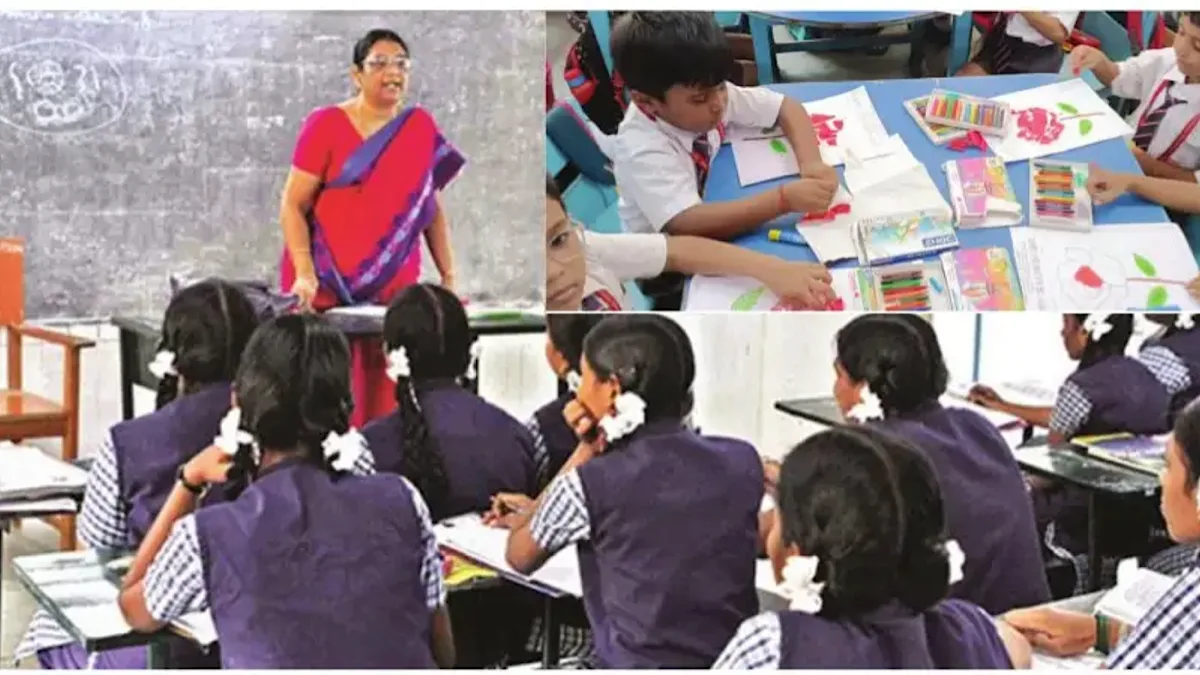
Photo:SNS
It was the usual school dispersal, and all the children were walking with their guardians who had come to pick them up, chattering away about their day’s happenings. I overheard one very short conversation between a mother and her daughter, who, I later learnt, was in class 3.
The mother said, “So… what happened in school today?”… and the daughter started excitedly, “You know in art…”… at which the mother stopped her and asked with a tinge of irritation, “No… I meant… what happened in subjects?” The girl innocently looked at her mother and asked, “Is art not a subject? Is it? Well, probably not in the sense in which English, Maths, Chemistry, Physics, Biology, Geography, History and Computers are. And that is the fundamental flaw in our inherently burdensome education system which leaves absolutely no space for nurturing of creativity. Instead of letting our children grow into artistic creativity, it more often than not, stifles any spark of originality and creativity that children intrinsically possess. Albert Einstein had said, “The intuitive mind is a sacred gift and the rational mind is the faithful servant.
Advertisement
We have created a society that honours the servant and has forgotten the gift.” Indeed, how did we create such a society? Sir Ken Robinson, British author, speaker and international advisor on education, whose TED Talk “Do sch – ools kill creativity?” was the most watched TED talk of all time, with 66.3 million views and was translated into 62 languages, argued as follows: “Our education system is predicated on the idea of academic ability. And there’s a reason. Around the world, there were no public systems of education, really, before the 19th century. They all came into being to meet the needs of industrialism.
Advertisement
So the hierarchy is rooted on two ideas. “Number one, that the most useful subjects for work are at the top. So you were probably steered benignly away from things at school when you were a kid, things you liked, on the grounds that you would never get a job doing that. … Don’t do music, you’re not going to be a musician; don’t do art, you won’t be an artist. “And the second is academic ability, which has really come to dominate our view of intelligence, because the universities designed the system in their image. If you think of it, the whole system of public education around the world is a protracted process of university entrance. And the consequence is that many highly-talented, brilliant, creative people think they’re not, because the thing they were good at in school wasn’t valued, or was actually stigmatized. And I think we can’t afford to go on that way.”
In terms of what Einstein rued and Sir Ken Robinson explained, human history has ended up creating a system that honours and churns out excellent exam takers, excellent clerks, excellent data collectors, excellent bookkeepers, but there’s literally no recognition and appreciation for creative talents and skills like art, music and dance. We, in India, are encumbered in an education system that’s mired in an outdated colonial legacy wholly geared towards churning out excellent clerks (who would presumably help the British run revenue collection and administrative duties smoothly). In a typical ICSE board school, with higher classes and increasing academic pressure, most creative classes are dispensed with ~ (in my own experience at one of the schools) art period was discontinued from class 6, music class from class 7, and even the music room in the school has now been converted into an AI lab.
We indeed are stuck in a very wrong kind of society where people who are the least creative earn the most and have all the limelight, whereas writers and poets and artists languish away in poverty and deprivation. And basically the message we learn right from school is that… ‘if you do AI you have a bright future, but if you draw…’ The principal, of course, says she is helpless ~ they have to accommodate 11 subjects, with fixed number of periods for English, Maths, Bengali etc. And as Robinson says, no school in the world teaches dance every day of the week the way they teach maths. He asks, why not?
Because children actually dance around quite a bit. He goes on to give the example of Gillian Lynne who was an English ballerina, dancer, choreographer, actress, and theatre-television director, noted for her theatre choreography associated with two of the longest-running shows in Broadway history, Cats and The Phantom of the Opera. When Gillian was at school in the 1930s she really underperformed, and the school wrote to her parents, “We think Gillian has a learning disorder.” She couldn’t concentrate; she was fidgeting. So her mother took her to a doctor. “In the end, the doctor went and sat next to Gillian, and said, ‘I’ve listened to all these things your mother’s told me, I need to speak to her privately. Wait here. We’ll be back; we won’t be very long,’ and they went and left her.” But as they went out of the room, he turned on the radio that was sitting on his desk. And when they got out, he said to her mother, “Just stand and watch her.”
And the minute they left the room, she was on her feet, moving to the music. And they watched for a few minutes and he turned to her mother and said, “Mrs. Lynne, Gillian isn’t sick; she’s a dancer. Take her to a dance school.” “She was eventually auditioned for the Royal Ballet School; she became a soloist; she had a wonderful career at the Royal Ballet. She eventually graduated from the Royal Ballet School, founded the Gillian Lynne Dance Company. She’s been responsible for some of the most successful musical theatre productions in history, she’s given pleasure to millions, and she’s a multi-millionaire. Somebody else might have put her on medication and told her to calm down.” (Do Schools Kill Creativity? Ken Robinson)
How many dancers, especially in our country, would be as fortunate as Gillian? Let us think of our very own Tagore, for example. He was home schooled, and his account of his childhood days (chhelebyala) is strewn with references to his hatred for school (in the few years he attended it). He in fact compares his hours in school to being imprisoned in cellular jail in Andaman and Nicobar Islands. Instead, he spent all his time travelling to various places, meeting all kinds of people, reading and writing of course. Imagine what Tagore would have grown up into had he been in one of today’s schools.
(The writer is Associate Professor, Economic Research Unit, Indian Statistical Institute, Kolkata)
Advertisement