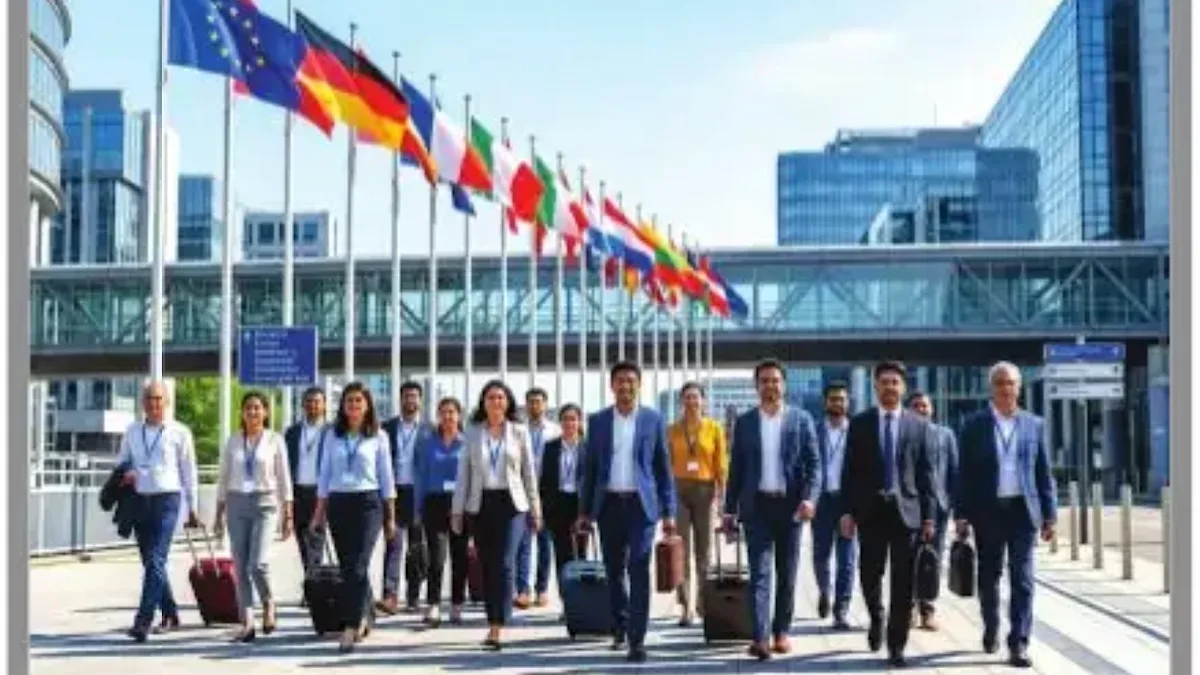
Europe is currently facing an unprecedented demographic crisis. Across the continent, falling birth rates and rapidly aging populations are creating massive labour shortages that threaten economic stability, healthcare systems, and industrial productivity. Concurrently, India is navigating its own unique demographic phase, boasting the world’s largest youth population with over 65 per cent of its citizens under the age of 35. This stark contrast presents a compelling economic synergy, raising a critical question: Can India effectively supply the manpower that Europe desperately needs?
While India possesses the raw numbers to fill Europe’s demographic deficits, transforming this potential into a seamless labour supply chain requires overcoming significant structural, linguistic, and regulatory barriers. The European Union’s labour market is under severe strain. According to Eurostat data, the working-age population in the EU is projected to shrink by millions over the coming decades, while the dependency ratio continues to climb.
Advertisement
Germany, Italy, and several Central European nations are already experiencing acute deficits in highly skilled sectors like Information Technology, engineering , and healthcare, as well as essential service sectors like hospitality, logistics, and eldercare. To maintain its global competitiveness and sustain its social welfare systems, Europe cannot rely solely on internal automation or shifting retirement ages; it must aggressively source external talent.
India stands out as the most logical partner to address this deficit. The country adds approximately 12 million people to its workforce annually. This demographic dividend means India has a surplus of both white-collar professionals – such as software developers, doctors, and financial analysts – and blue-collar or grey-collar workers, including construction specialists, nurses, and hospitality staff. Furthermore, India’s education system pro duces millions of English-speaking graduates every year, giving Indian labour a distinct communication advantage in the global market over competitors from other regions.
While the United States (now tightening visa regimes) used to be the default destination, the EU has stepped in as an attractive alternative by offering important benefits: Work-Life Balance: Professionals note that while financial savings might not match the US, Europe provides superior job security, healthcare, and an improved work-life balance. Low-Cost Education: Countries like Germany and the Netherlands offer high-quality, low-cost higher education, leading Indians to account for the highest share (20.8 per cent) of EU student residence permits.
But there are barriers to seamless mobility. Despite the clear alignment of supply and demand, India cannot automatically fill Europe’s talent gap without addressing several entrenched challenges. The Skills and Language Gap: While English proficiency is high among India’s elite white-collar professionals, it is less prevalent among vocational and blue-collar workers. Furthermore, many European nations, such as Germany, France, and Japan, require proficiency in their native languages (e.g., German, French) for safety and integration, particularly in healthcare and public-facing roles.
Additionally, Indian vocational certifications do not always align with strict European industry standards, necessitating extensive retraining. Regulatory and Visa Hurdles: Historically, European immigration policies have been fragmented, bureaucratic, and cautious. Obtaining work visas, navigating complex point-based systems, and securing the mutual recognition of professional qualifications remain slow and cumbersome processes for Indian applicants.
Geopolitical and Social Dynamics: Immigration is a highly sensitive political issue within the European Union. Balancing the economic need for foreign labour with domestic political pressures regarding cultural integration and border control often leads to hesitant policy implementation. The Government of India is taking several actionable steps to increase safe and regulated labour mobility to Europe. These include:
Comprehensive Mobility Pacts: Implementing the landmark India-EU Comprehensive Mobility Framework and bilateral agreements with specific EU nations (such as Italy, Austria, Germany, and Romania) to guarantee structured quotas, fair pay, and safe migration routes. Skill Harmonization: Aligning Indian vocational and professional qualifications with EU standards so that degrees, especially in healthcare, IT, and engineering, are recognized across member states. Institutional Facilitation: Utilizing the India Centre for Migration (ICM) to manage legal migration, prevent human trafficking, and support European employers seeking Indian manpower.
Pre-Departure Training: Expanding skill development and European language training across Indian states to ensure workers meet specific host- country requirements before departure. India has the undeniable capacity to serve as the primary engine of manpower for an aging Europe. The raw demographic alignment is a historical certainty. Approximately 2.8 to 3 million overseas Indians reside in the European Union and in the UK, with the annual flow heavily leaning towards skilled professionals, STEM experts (Science, Technology, Engineering, and Mathematics), and students. Though historically overshadowed by Gulf and North American movements, Europe has emerged as a top target for Indian labour.
However, numbers alone will not suffice. For India to truly satisfy Europe’s labour demands, both sides must treat human capital as a shared strategic asset. This requires deep investments in language skills, the standardization of technical certifications, and the political will to create agile, legal migration pathways. If these structural bridges are successfully built, the Indo-European labour partnership could become a defining pillar of global economic stability in the twenty-first century.
(The writer, a retired IFS officer, served as India’s Ambassador to Kuwait and Morocco and as Consul-General in New York.)