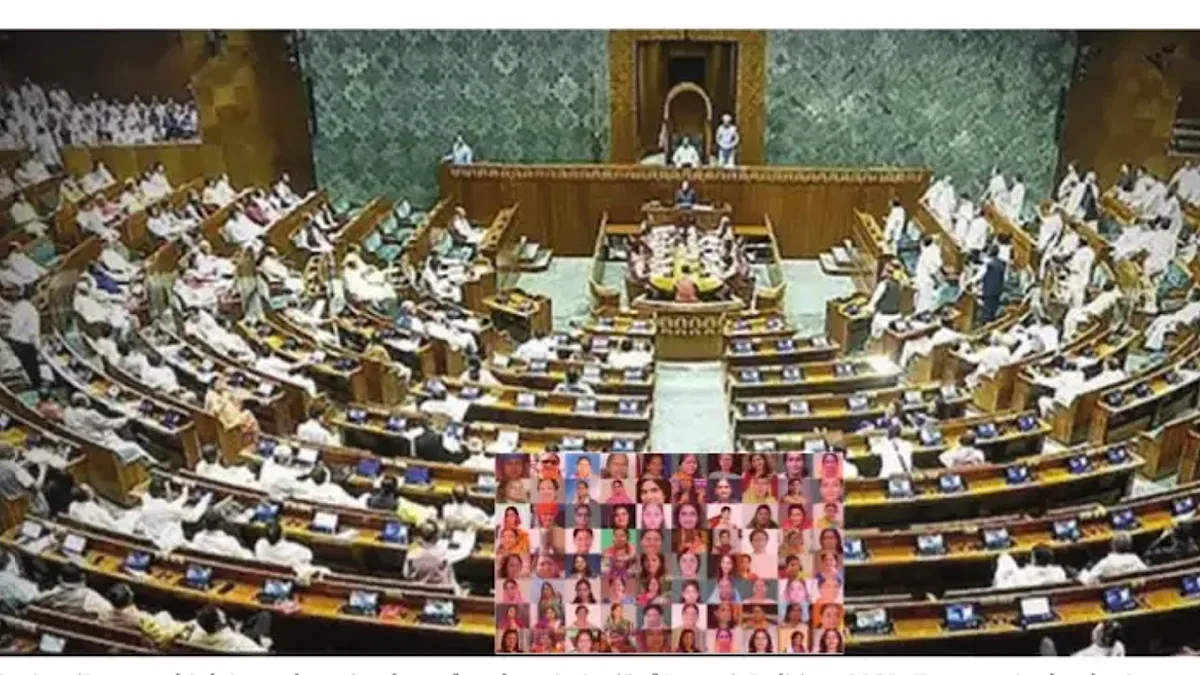
The Government of India is reportedly planning a special session of Parliament to expedite the implementation of the Constitution (One Hundred and Sixth Amendment) Act, 2023, for the 2029 general elections. The law mandates 33 per cent reservation for women in the Lok Sabha and state Assemblies, promising a historic leap in strengthening women’s leadership in governance. An anticipated expansion of the Lok Sabha to 816 seats would raise women’s representation from 74 (13.6 per cent) to 273 (33 per cent).
At the state level, increasing Assembly strength from 3,997 to about 6,000 would require nearly 2,000 women legislators, up from just 390 today. Women hold just 27.2 per cent of seats in national parliaments globally; India now has a chance to surpass this. However, the sheer scale of India’s transformation creates an immediate leadership vacuum: where will so many women leaders come from? Currently, parliamentary selection is largely governed by caste arithmetic and money power rather than governance experience. Individuals who have never managed a public institution, supervised a welfare scheme, or answered to a constituent body are routinely selected over those who have done so for years at the grassroots level.
Advertisement
The result is a legislature that is largely detached from the actual realities of governance. Laws are made by people who have never implemented any. Budgets are voted on by people who have never administered public funds. The answer lies in a talent pool India has already spent over three decades cultivating: the Panchayati Raj system. Under the Constitution (Seventy-third Amendment) Act, 1992, there are now over 1.4 million elected women representatives across India’s 2.68 lakh Gram Panchayats and rural bodies. These Sarpanches, Panchayat Samiti Presidents, and Zilla Parishad Chairpersons currently constitute 46 per cent of all local elected representatives.
They are the ideal group to create the next generation of MPs and MLAs; they have a proven record of governance. Identifying the talent pool is not enough; they must be actively trained and mentored to transition to the national stage. Women face many structural barriers: time poverty, fewer mentoring opportunities, limited access to campaign funding, and disproportionately targeted online harassment. If independent women leaders are not supported through structural reform, the reserved seats may simply be occupied by seasoned political families or business groups sponsoring proxy candidates. To prevent this, comprehensive capacity-building is essential, focusing on public leadership, legislative procedure, negotiation, and media engagement.
Mentorship and advocacy networks must connect grassroots leaders with experienced legislators. State-level support hubs offering training in regional languages can further empower leaders early in their political journeys. Global examples of gender quotas offer valuable lessons. Argentina, the first country to legislate a gender quota through its 1991 ‘Ley de Cupos,’ saw initial gains evaporate as parties systematically placed women in unwinnable list positions ~ a practice the Electoral Chamber had to prohibit later. Mexico’s constitutional mandate of ‘Paridad en Todo’ (parity in everything) extends gender parity across the executive and judiciary.
Women now hold 20-40 per cent of judicial posts, and the Supreme Court has a female majority (5 of 9 seats). India’s Supreme Court has just one woman among 34 judges. Rwanda leads the world, with women holding over 61 per cent of parliamentary seats. It institutionalised leadership training through the National Women’s Council, which identifies, trains, and mentors women with leadership potential. Women enter at the cell level, build governance experience, and rise through the system ~ ensuring reserved seats are filled by candidates with genuine civic participation rather than family proxies. Bolivia, too, achieved gender parity only after it invested in indigenous women’s leadership networks at the community level.
Sweden’s ‘zipper system’ alternates male and female candidates on party lists. Strong internal women’s federations have helped women consistently hold over 45 per cent of seats in the Riksdag ~ making it one of the world’s most gender-equal legislatures without formal quota laws. In Ireland, NGOs like ‘Women for Election’ have tried to dismantle the “Five C’s” that deter women from running: Cash, Childcare, Confidence, Culture, and Candidate Selection, by teaching skills in media, fundraising, and canvassing. Not all experiences have been successful. In Jordan, reserved seats were for years dominated by women from prominent political families, effectively turning the quota into an extension of elite capture rather than independent women’s leadership.
India has Rwanda’s pipeline, Jordan’s risk, and Ireland’s barriers ~ the question is whether it will learn from all three before 2029. Encouragingly, the journey from Panchayat to Parliament has proven possible. President Droupadi Murmu rose from a tribal village council to become India’s President. Union Minister Savitri Thakur began in a district panchayat, and Raksha Nikhil Khadse served as a village sarpanch before entering the national cabinet. Many more such success stories can be written in the near future. The Nari Shakti Vandan Adhiniyam has opened a historic door, forcing us to ask exactly who will lead us. To answer this, we should look at how India constitutes its High Court benches.
Two-thirds of appointees are advocates from the Bar, while one-third are elevated from trial courts, judges who have managed real dockets and delivered justice under resource constraints. Both streams are legitimate and necessary. A legislature that selects almost exclusively for political connections, while ignoring proven governance records, appears far less rationally designed than the judiciary. To fix this, Parliament must institutionalise a universal Grassroots Leadership quota.
An amendment to the Representation of the People Act, 1951 can mandate that a substantial proportion of all parliamentary and assembly seats, for both men and women alike, be contested only by candidates who have successfully completed a full elected term in a local self-government body. The precise proportion of seats designated under the quota is a matter for parliamentary deliberation. In addition, a statutory electoral empowerment fund, modelled on Sweden’s publicly financed election systems, should be considered to support first-time grassroots candidates. Sweden’s partistöd provides grants at the municipal and county levels, meaning funding reaches well below the national tier. It is time to insist that a guaranteed, considerable share of those entering national leadership are leaders tested at the grassroots level.
(The writer is a transparency and equality advocate and founder member, 51ABI Foundation)