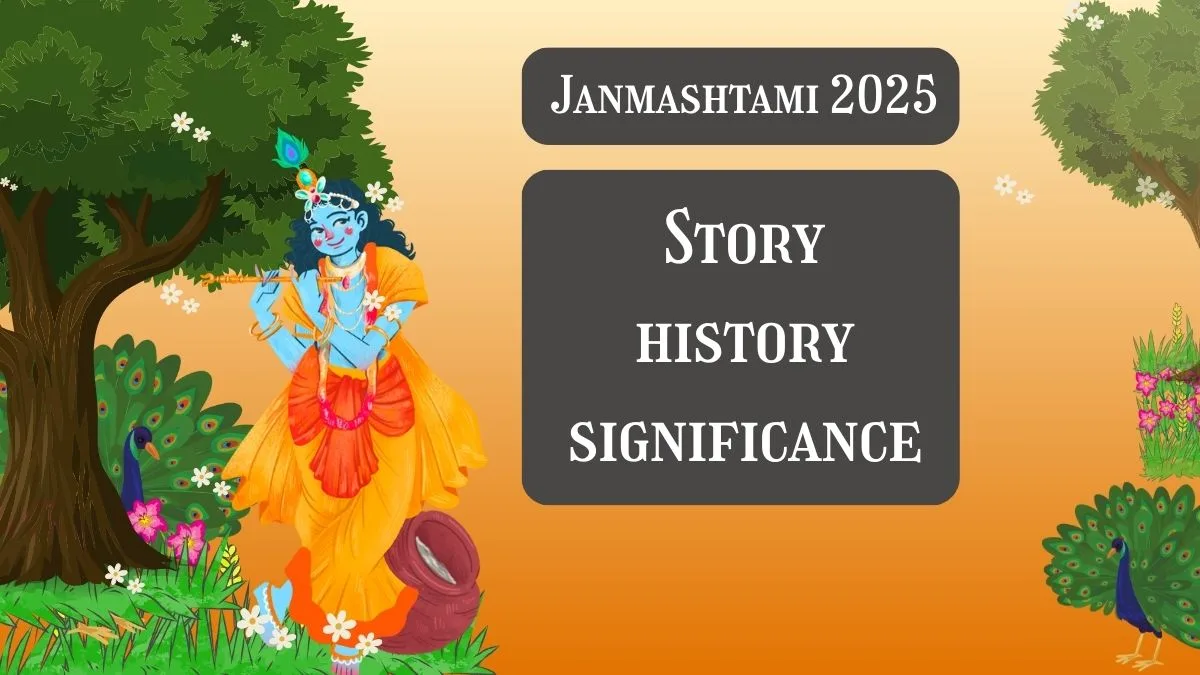
Janmashtami 2025: Janmashtami is one of the most loved festivals in India. It commemorates the birthday of Lord Krishna, one of the most revered and popular deities in Hinduism. Everyone looks forward to this day with hope each year. Janmashtami will once again bring happiness, faith, and celebrations to millions of homes, temples, and streets across the nation in 2025. This year, it falls on August 16.
But why do we celebrate Janmashtami? What is the history behind it? And how did it become so colourfully a part of Indian life and culture?
Advertisement
As Janmashtami 2025 is here on August 16, let’s look at the meaning, history, and customs of this beautiful festival in simple terms.
The birth story of Krishna
There was a king named Kansa in Mathura a long time ago. His sister Devaki was married to Vasudeva. A heavenly voice predicted that when Devaki was being married, Kansa was told that her eighth child would be the one who would end his evil rule.
Kansa was afraid, so he jailed Devaki and Vasudeva. He also decided to kill all their children as soon as they were born. Sadly, he killed the first seven babies one by one.
When the eighth child gave birth, something supernatural happened. Lord Krishna was born in the middle of the night in the jail. The soldiers slept, the chains opened themselves, and the gates of the jail swung open.
Vasudeva put the baby Krishna in a basket and traveled across the Yamuna River to reach the village of Gokul. There, he deposited Krishna at the doorstep of Nanda and Yashoda and brought back their newborn daughter to the prison.
When the baby girl was attempted to be killed by Kansa, she turned into the goddess Durga and informed him that his adversary, Krishna, was already secure and would come back to put an end to his wicked rule.
Why Janmashtami is celebrated in the middle of the night
Krishna’s birth took place at midnight, and hence the main puja (worship) is held late in the night. The devotees observe the whole day’s fasting, and when midnight approaches, they sing bhajans (devotional songs) and read from the Bhagavad Gita and Bhagavata Purana.
At midnight, the idol of baby Krishna is placed in an ornamented cradle, and conch shells and bells are rung all around. It is thought that this is the exact moment when Krishna was born.
The life and teachings of Krishna
Krishna is not only well known for his childhood stories but also for his wisdom. As a child, he was celebrated for stealing butter and playing with the gopis (milkmaids) in Vrindavan. Those naughty acts are remembered with affection and smiles during Janmashtami.
As he grew older, Krishna evolved as a righteous guide and protector. The pinnacle of his existence is the role that he played in the Mahabharata, where he shared the Bhagavad Gita philosophy with Arjuna. His guidance on serving one’s duty, living without greed, and staying close to God continues to be an encouragement for individuals across the world.
The History of Janmashtami celebrations
Janmashtami has been celebrated for centuries. Ancient books like the Harivamsa, Vishnu Purana, and Bhagavata Purana provide descriptions of Krishna’s birth and how it pleased the people of Vrindavan and Mathura.
As time went by, Janmashtami lost its totally religious connotation and turned into a cultural one too. Kings, saints, and poets promoted worship of Krishna through temples, poetry, and painting.
In North India, especially in Mathura, Vrindavan, and Dwarka, Janmashtami is celebrated with flamboyance. In Maharashtra, Dahi Handi processions are a highlight, while in South India, people follow small footprints of Krishna into their houses to welcome him.
The festival of Janmashtami can seem diverse in various regions, but the faith remains the same throughout.
The cultural significance of Janmashtami
Janmashtami is one of the Indian cultural life traditions. It combines worship, family time, art, and food.
Food plays an important role in the festival. Foods like panjiri, butter, makhan-mishri, kheer, and laddoos are presented as bhog (offering) to Krishna. Families make sattvik (pure) food without onion and garlic for the day.
Even the clothing is celebratory in nature. Women dress up in colored sarees or lehengas, echoing the traditional outfit of Radha. Boys and men dress up as Krishna, wearing yellow dhotis, peacock feather headgear, and playing flutes.
Creativity and craft reach its peak during the festival. Handicraft decorations are prepared, clay pots are colored, and small scenes of Gokul and Vrindavan are designed within homes.
Most importantly, Janmashtami brings people together. Family members come together for midnight prayers, neighbours come together to sing, and cities have festivals. Even in the big cities, where life is so busy, Janmashtami offers a break for a day of prayer and festivity.
In life today, when stress and busy schedules are the norm, a festival like Janmashtami offers a chance to relax, look inwards, and relate to one’s roots. The story of Krishna’s birth suggests that no matter how powerful negativity may be, virtue and truth will ultimately triumph.