UP assembly: Bureaucracy dominating public representatives, alleges Opposition; Speaker takes cognisance
Leader of the Opposition Mata Prasad Pandey alleged that officials do not even answer calls from public representatives and are busy brokering.
They reiterated the Yogi government’s commitment to making Uttar Pradesh the nation’s most developed state by 2047, with targets including zero poverty, world-class infrastructure, and advanced technology adoption.




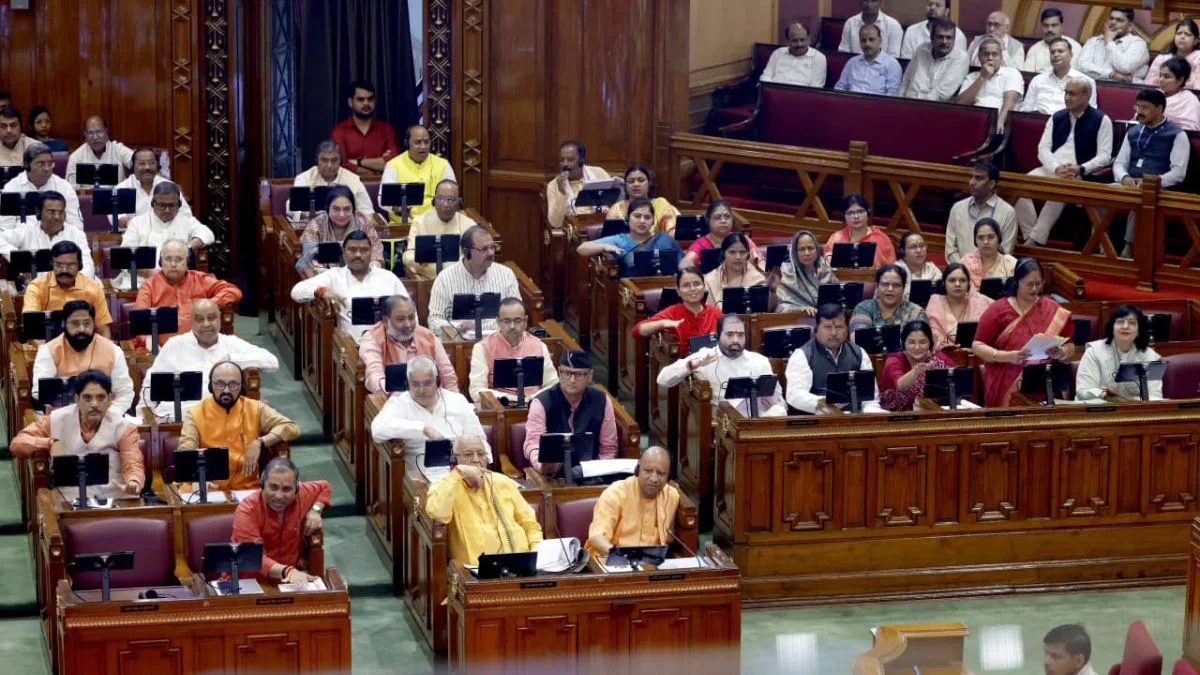
Photo: UP Govt
On the third day of the Uttar Pradesh Assembly’s Monsoon Session, a historic 24-hour debate on Vision 2047 began on Wednesday, with senior ministers presenting plans for economic growth, social justice, environmental sustainability, and infrastructure development.
They reiterated the Yogi government’s commitment to making Uttar Pradesh the nation’s most developed state by 2047, with targets including zero poverty, world-class infrastructure, and advanced technology adoption.
Advertisement
Deputy Chief Minister Brajesh Pathak said that before 2017, UP’s infrastructure and law-and-order situation were in disarray, with serious crimes enjoying political protection.
Advertisement
Today, he noted, the state has the highest number of expressways in the country, four-lane road links to all 75 districts, and improved power supply in every region, compared to just five districts earlier.
Pathak also highlighted that Uttar Pradesh leads the country in wheat, milk, and sugar production. Healthcare has seen remarkable improvements, with 80 medical colleges, AIIMS in Raebareli and Gorakhpur, and over 5,250 MBBS seats.
“Under the Ayushman Bharat scheme, 5.5 crore health cards have been issued. Mosquito-borne diseases have been brought under control, and our target is to completely eradicate TB, malaria, and waterborne diseases by 2047,” he said.
He added that super-specialty hospitals and trauma centres will be established in every division, supported by disease surveillance systems to tackle diabetes, hypertension, and cancer, alongside awareness campaigns on health risks from climate change.
Finance Minister Suresh Khanna told the Assembly that in the past eight years, Uttar Pradesh has made unprecedented economic progress. The state’s Gross State Domestic Product (GSDP) has reached ₹29.87 lakh crore, with a target of ₹35 lakh crore for the current financial year.
He said the state has received investment proposals worth over ₹40 lakh crore, with industries coming up in Purvanchal and Bundelkhand.
Khanna outlined the vision for 2047—zero poverty, top-ranking investment destinations, world-class infrastructure, and hubs for space technology and IT. He also stressed rural cottage industry promotion, plantation of 242 crore trees, river channelisation, solar energy research, and stronger international border security.
“Research will be promoted in advanced agricultural technology and improved seeds to equip farmers with technical skills and access to global markets. The state plans to use AI to curb tax evasion, empower half the population to be self-reliant, instill duty and patriotism in children, and promote healthy lifestyles through yoga,” Khanna said.
State Jal Shakti Minister Swatantra Dev Singh said that before 2017, UP was considered a BIMARU state, but today it has won the Rashtriya Jal Puraskar. Irrigation now covers 1.04 crore hectares via 76,527 km of canals.
The Ken–Betwa link project has begun for Bundelkhand, and flood protection spans 523 embankments. With 8 major and 58 minor rivers stretching 15,225 km, plans include dam modernisation, flood forecasting, pollution-free rivers, and large-scale canal-side tree plantations.
Urban Development and Energy Minister AK Sharma said UP is rapidly advancing towards the Prime Minister’s vision of a developed India. Recalling the poor power situation before 2017, he said many villages lacked poles and wires, and billing was plagued by scams. Today, the state meets a peak power demand of 32,000 MW, up from 13,000 MW between 2012 and 2017.
“In seven decades, only 8.5 lakh farmers received tube wells, while the Yogi government has provided 15 lakh in just eight years. Electrification has reached 1.5 lakh hamlets, thermal power generation stands at 9,120 MW, and in the last three years, 29 lakh poles have been replaced, with 38,000 transformers repaired each month. Smart meters have reduced power complaints, and solar energy promotion has been intensified,” Sharma said.
He added that UP’s power system will be made the best in the world, while urban development has progressed to the point where Lucknow ranks among India’s top three cleanest cities and six UP cities are in the top 20. By 2047, the state aims to achieve the ideal of Ram Rajya in power and urban infrastructure.
Advertisement