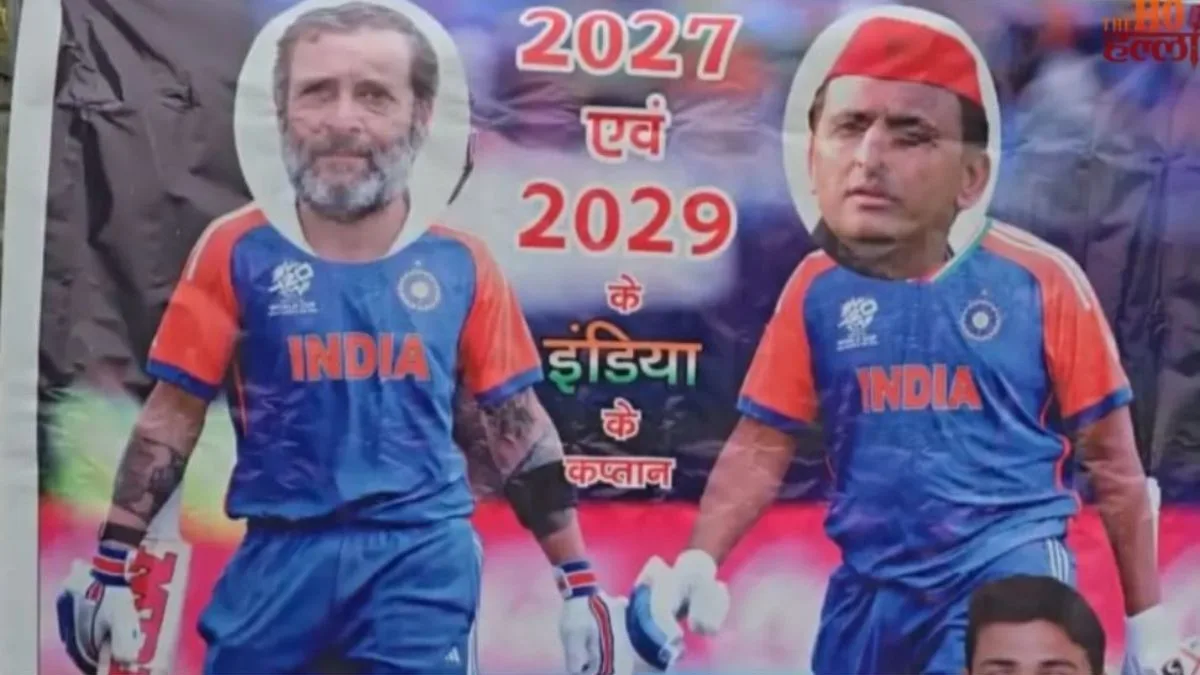
An unusual and much-discussed poster put up during Congress leader Rahul Gandhi’s visit to Rae Bareli has created a stir in political circles.
The poster depicts Rahul Gandhi and Samajwadi Party president Akhilesh Yadav dressed as cricket players, walking together towards the pavilion. Both leaders are shown wearing T-shirts with “INDIA” written on them and holding cricket bats.
Advertisement
The poster also carries a message about protecting the PDA —Backward Classes, Dalits and Minorities—and refers to the two leaders as the “captains of 2029.” The Samajwadi Party chief has coined the abbreviation PDA for pichde (backward classes), Dalits, and alpsankhyak (minorities), and has been using the expression as a political plank to gain votes.
According to sources, the poster was installed by Congress leader Rahul Nirmal. The imagery and message have attracted widespread attention and are being seen as carrying a strong political signal.
Rahul Gandhi, the Member of Parliament from Rae Bareli and Leader of the Opposition in the Lok Sabha, is currently on a visit to his parliamentary constituency. He reached Rae Bareli late last night by road from Lucknow. His arrival generated considerable enthusiasm among party workers and residents of the district.
On Tuesday, the Congress leader held meetings at the Bhueamau Guest House with public representatives, party workers and delegations from various social organisations. Discussions focused on local issues, development works, and matters related to public welfare.
He also inaugurated development projects worth several crores of rupees. Later, he reached the Rajiv Gandhi Stadium at the ITI campus and inaugurated the Rae Bareli Premier League cricket tournament. His presence at the stadium has generated special excitement among local youth.
After the stadium programme, Rahul Gandhi visited the residence of the Municipal Council Chairman to convey his best wishes for a previously held auspicious family function. He then proceeded to Umran village in Rohania block, where he will chair a “MNREGA Bachao Chaupal” and interact with villagers and labourers, listening to their concerns and issues.
Gandhi’s visit has remained in the spotlight not only for development, sports, and employment-related programmes, but also for the strong political messaging associated with it.