Deterrence Revisited
For more than two decades, India’s nuclear doctrine has been treated as a settled matter.
The Indian Air Force Chief was speaking at the Annual General Meeting (AGM) organised by the Air Force Association (ASA), here today.




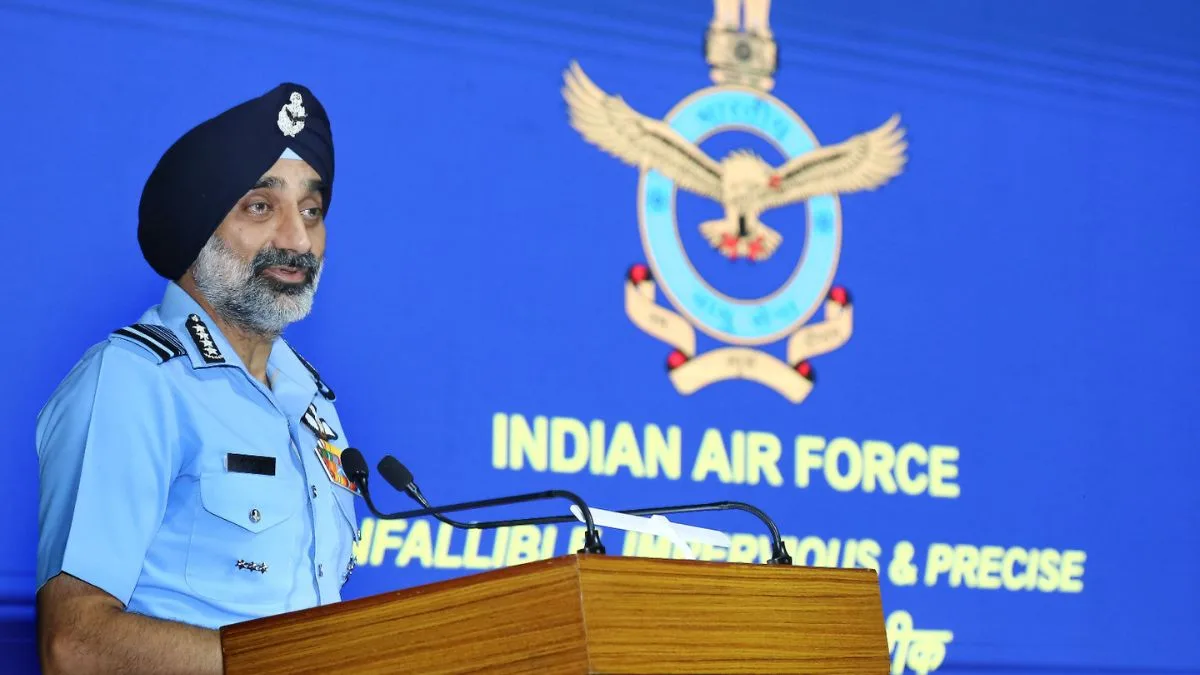
Photo: SNS
Mocking Pakistan’s failed bid to strike Indian military bases and assets, Air Chief Marshal AP Singh, Chief of the Air Staff, remarked that the intended targets lay beyond the range of Pakistan’s weapon systems. He further asserted that Pakistan could not even approach weapon release range without coming under the threat of India’s S-400 air defence system.
The Indian Air Force Chief was speaking at the Annual General Meeting (AGM) organised by the Air Force Association (ASA), here today.
Advertisement
“The long-range LR-SAM that we had bought, S-400, they turned out to be a game changer in this. Their long-range radars and missile systems could threaten the enemy aircraft well inside their own territory. So, we were able to do something such that they could not operate even in their own territory. Their range was more than the range of their weapons, so they could never even come up to the weapon release range without being threatened and those who came had to face damage. So, this was a game-changer,” said the Air Chief.
Advertisement
Stating that Pakistan was struck “nice and hard” after it refused to stop the war and tried to attack India, during Operation Sindoor, the CAS said, “We were given terrorist targets. We accurately struck them. When our enemies refused to stop the war and tried to attack us, then we struck them nice and hard. Many of their bases were damaged. A lot of their infrastructure, radars, control and coordination centres, their hangars, and aircraft suffered a lot of damage.”
He also stressed the importance of halting a conflict once its objectives have been met, adding that “the world must take a lesson from India.”
The statement comes in the wake of the reports about the terror outfits Jaish-e-Mohammed (JeM) and Hizbul Mujahideen (HM) moving to shift their bases to Pakistan’s Khyber Pakhtunkhwa province following the air strikes by India on Markaz Subhanallah in Bahawalpur and Markaz Taiba near Muridke, along with seven other sites on May 7.
Referring to conflicts in the world, he said they are continuing as no one is thinking about conflict termination. “The main wars that are going on today, be it Russia, Ukraine or the Israel war. They are going on, years have passed, because no one is thinking about conflict termination.”
“We stopped the war very quickly. Yes, they were on the back foot, no doubt, but what were our objectives? Our objective was anti-terrorism. We had to strike them. We had done that. So, if our objectives have been met, then why should we not terminate a conflict? Why should we carry on? Because any conflict has a lot of price which has to be paid. It will affect our preparedness for the next one. It will affect our economy,” he said.
He warned that prolonged wars hamper a nation’s progress, noting that shifting goals and ego clashes often prolong conflicts. He said the world should learn from India on how to begin and end a conflict swiftly. He also praised the political leadership for giving clear directions and complete freedom.
“I think one of the best things that happened was that there was political will. Our leadership gave us clear directions, and no restrictions were imposed. Full freedom was given to us to plan, and there was jointness; all three services were sitting together, discussing together, planning together, along with the CDS, other agencies, and NSA was a big part of doing that,” he said.
Advertisement