CM Yogi gives children the message of self-discipline and hard work through Japan’s example
Uttar Pradesh Chief Minister Yogi Adityanath gave students the mantra of self-discipline and hard work by citing the example of Japan.
Sardar Vallabhbhai Patel was born on October 31, 1875 into a humble farmer’s family in Karamsad, Gujarat. Through sheer determination and hard work, he pursued higher education.




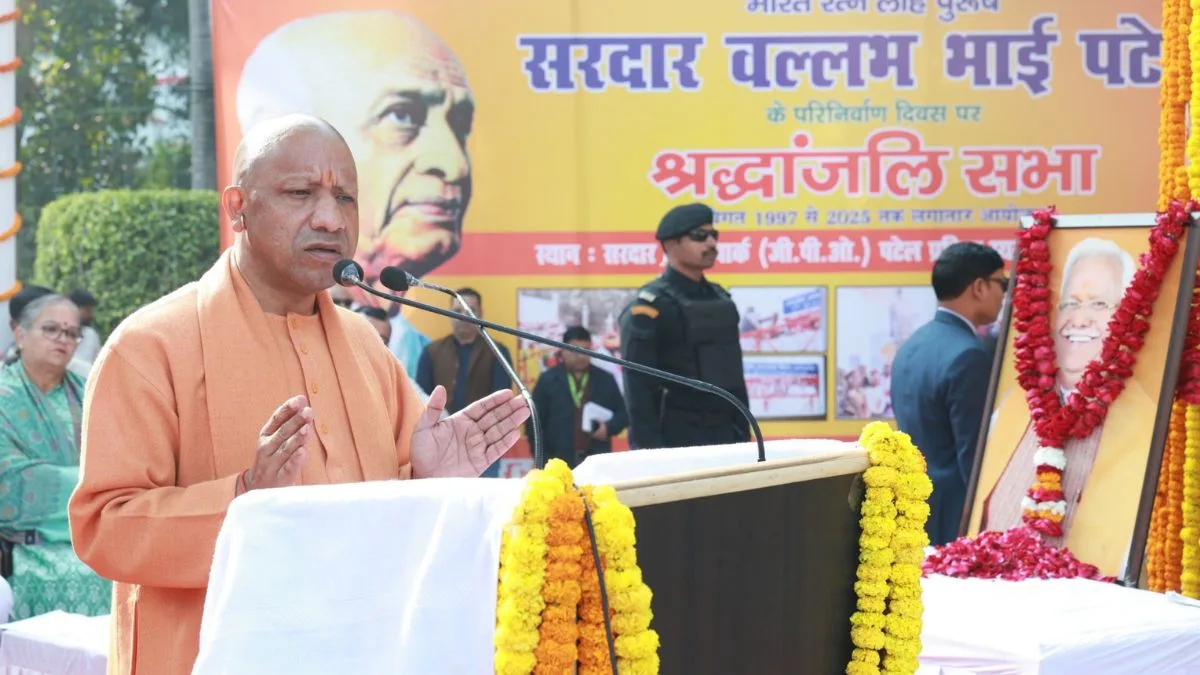
Photo: SNS
Chief Minister Yogi Adityanath paid heartfelt tribute to the architect of modern India, the Iron Man Sardar Vallabhbhai Patel, on his death anniversary.
Offering floral tributes at Sardar Patel’s statue and recalled his extraordinary personality and historic contributions, he said that visionary leadership of the Bharat Ratna could have guided the nation for many more years, but it was the country’s misfortune that he passed away on December 15, 1950. “His life, service, and dedication to the nation have become an indelible chapter in India’s history. The country will always remember its Iron Man as the chief architect of modern India,” he added.
Advertisement
Sardar Vallabhbhai Patel was born on October 31, 1875 into a humble farmer’s family in Karamsad, Gujarat. Through sheer determination and hard work, he pursued higher education. His goal was not to serve foreign rulers for personal gain, but to understand the nation and the world and dedicate his abilities to the service of Mother India.
Advertisement
He played a leading role in India’s freedom struggle, enduring imprisonment and severe hardships multiple times without wavering from his commitment. At the time of independence, he firmly opposed the partition of India and went on to unify the nation by integrating 567 princely states into the Indian Union.
The chief minister noted that the Nawab of Junagadh and the Nizam of Hyderabad were reluctant to accede to the Republic of India. Under the British Two-Nation Theory, princely states were given the choice to join India, join Pakistan, or remain independent. While all Hindu princely states chose to become part of India, Junagadh and Hyderabad refused to do so. Owing to Sardar Patel’s wisdom and decisive leadership, both states were integrated into India through peaceful and bloodless means.”
CM Yogi further said that confusion prevailed over the accession of Jammu and Kashmir, and the responsibility was taken up by Jawaharlal Nehru. “However, the manner in which the issue was handled turned it into a persistent challenge for India since independence,” he contended.
He said, “Kashmir became a center of extremism and separatism due to those decisions.”
The chief minister expressed gratitude to Prime Minister Narendra Modi for fulfilling the vision of Sardar Patel and Dr. Syama Prasad Mukherjee by abrogating Article 370, thereby fully integrating Jammu and Kashmir into India and advancing the principle of ‘EK Desh, Ek Pradhan, Ek Vidhan, Ek Nishan”.
He also highlighted that as home minister, Sardar Patel played a pivotal role in the reconstruction of the Somnath Temple, in establishing effective mechanisms for dispute resolution, and in shaping the Indian Administrative Service in its present form. He reiterated that Sardar Patel’s illustrious leadership could have continued much longer, but the nation lost him on December 15, 1950. His memories, service, and contributions remain a source of inspiration for generations. Every Indian, he said, bows with deep respect and gratitude to this great son of Mother India, the Iron Man Sardar Vallabhbhai Patel.
Advertisement