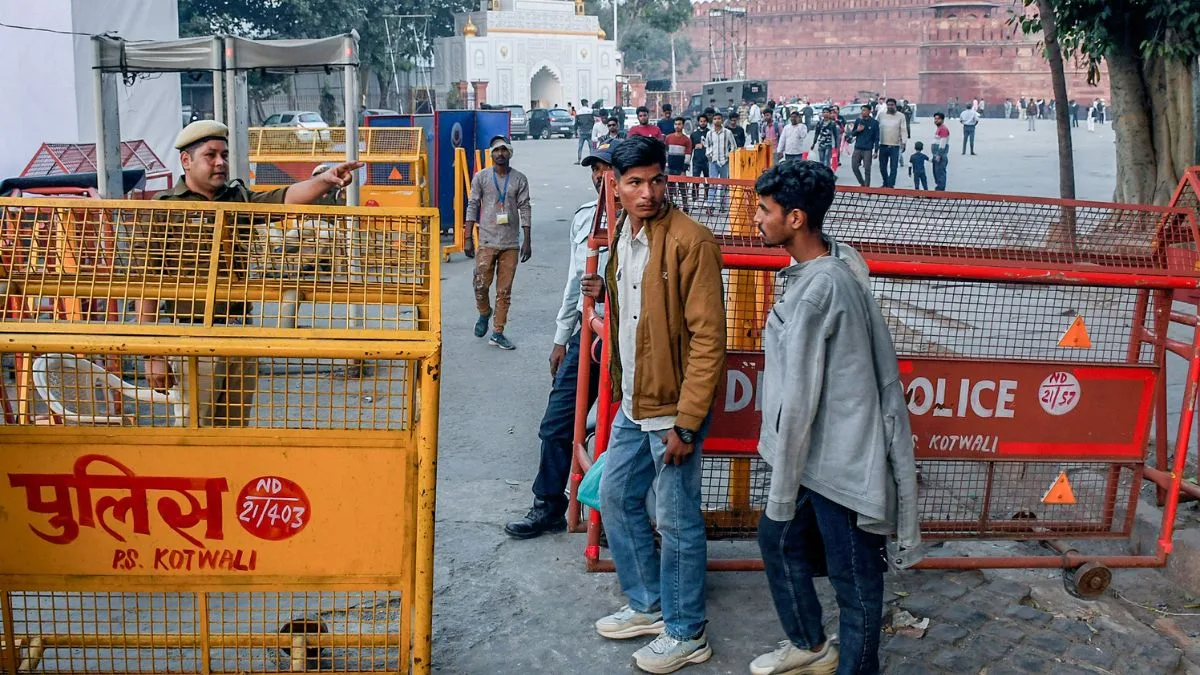
Intelligence agencies say the network once built by the Indian Mujahideen (IM) may be quietly resurfacing in a new and far more complex form. A report prepared by the Intelligence Bureau (IB) in October 2025 had already warned that the Islamic State was attempting to repurpose remnants of the IM’s organisational structure, which largely fell apart after the arrest of Yasin Bhatkal. The latest probe into the Red Fort blast, which killed 15 people, appears to lend weight to that assessment.
Investigators have not yet found a direct operational link between IM and the Faridabad-based module of the Jaish-e-Mohammad (JeM). However, officers working on the case say the JeM seems to have accessed dormant IM channels to source explosives and supplies. These “defunct modules”, as agencies often described them over the past decade, were never fully dismantled and may now be serving as convenient backdoors for other extremist groups, reported news agency IANS.
Advertisement
Also Read: Red Fort blast probe reveals JeM link; module planned 200 coordinated explosions across North India
Rise of overlapping terror networks
One IB official said several IM cadres went underground after the leadership was arrested and ‘are still lurking around and pose a huge risk to the system’. Some became inactive, while others dispersed to foreign theatres. Among the most prominent was Shafi Armar, who moved to Syria and joined the Islamic State. He then became a ‘dangerous operative’ and is believed to have set up the outfit’s India operations before being killed in an air strike. His wife, Rabiya, known by the alias Umm Osama, is alleged to have continued the India network from Oman, with Maharashtra ATS earlier determining that she supervised recruitment efforts.
The Red Fort investigation has now placed a spotlight on how these fragmented networks may be overlapping. Nearly 2,900 kilograms of ammonium nitrate were recovered from the accused linked to the Faridabad module. Officials have also revived their focus on Mirza Shahdab Baig, a former IM operative who fled to Saudi Arabia and is now suspected to be in Afghanistan. Baig handled the procurement of ammonium nitrate during his time with IM and was considered a skilled bomb-maker.
Focus shifts to Afghan handlers and former IM operatives
A dossier prepared by the IB notes that Baig would be an “obvious choice” for any group seeking to revive such infrastructure, particularly because the JeM established a module in Afghanistan in 2021. Police had earlier learnt that the Faridabad module was being coordinated by handlers based in Afghanistan.
Another worrying element emerging in the investigation is the possible role of the Islamic State Khorasan Province (ISKP). The Faridabad operatives used a combination of TATP and ammonium nitrate, a formula ISKP commonly employs because it is easier for inexperienced bomb-makers to work with. Officials say the JeM may have drawn on both Baig’s expertise and ISKP’s techniques to assemble the explosives.
Local links and university trail under scrutiny
There is also a local link investigators are revisiting. Several doctors from Al-Falah University were arrested in connection with the module. Baig had studied and taught at the same university before joining IM, and police say he maintained contact with students even after leaving India. This connection is now being examined as part of the bigger picture.
Security agencies caution that the IM’s earlier influence, especially in parts of South India, Uttar Pradesh and Bihar, created deep-rooted modules capable of carrying out strikes. While the outfit was dismantled over the years, its old networks, contacts and logistical capabilities may once again be acting as active conduits.
In the absence of a fully dismantled structure, several groups appear to be exploring ways to repurpose IM’s old infrastructure for a renewed homegrown terror architecture.