Jharkhand horror: Father allegedly hacks three minor daughters to death in Giridih
Police are investigating the motive behind the deaths of three sisters in Giridih after their father was arrested. A forensic team has joined the probe.
The programme, organised by the Forest Department in a remote forest village of Koderma, saw participants tying sacred threads to trees after performing rituals at a forest altar




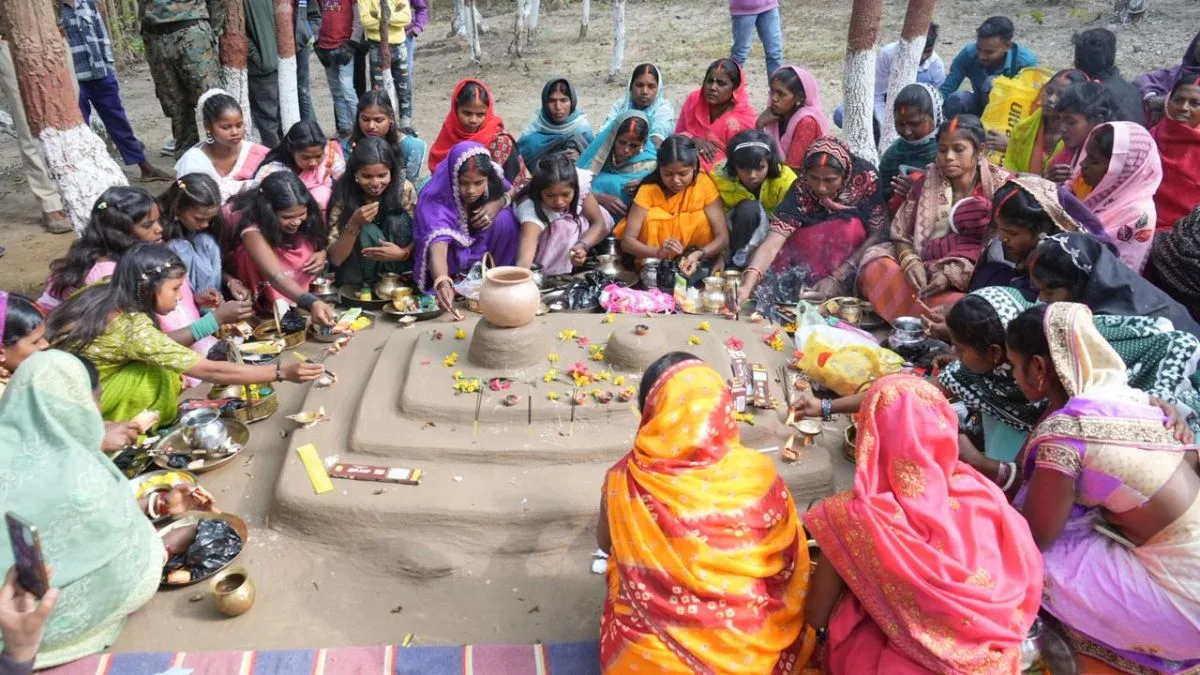
Photo: SNS
In the dense Simarkundi forest under Markaccho block, Raksha Bandhan became more than a symbolic festival. Villagers, forest officials and district administrators came together to turn a traditional ritual into a collective pledge for forest protection, signalling a growing shift towards community-led conservation in rural Jharkhand.
The programme, organised by the Forest Department in a remote forest village of Koderma, saw participants tying sacred threads to trees after performing rituals at a forest altar. The demonstration was rooted in the idea of protection and mutual responsibility, drawing a direct parallel between familial bonds and the relationship between people and forests.
Advertisement
Addressing villagers, Rituraj, Deputy Commissioner of Koderma, said that such community-driven commitments were essential for ensuring the long-term safety of forests. He underlined that conservation efforts are most effective when local people see forests as their own responsibility rather than as assets guarded only by the state. He appealed to villagers to mark Raksha Bandhan every year in a similar manner and to back symbolic gestures with sustained action through plantation and protection of saplings.
Advertisement
Forest officials present at the event stressed that preventing deforestation requires more than surveillance and enforcement. According to them, programmes rooted in cultural traditions help nurture a sense of belonging and ownership, making local communities natural allies in forest governance. They noted that emotional attachment to forests often proves a stronger deterrent against illegal felling than punitive measures alone.
Environmental experts interacted with villagers during the programme, explaining how forest degradation affects soil fertility, groundwater recharge and agricultural productivity. They emphasised that forest conservation is closely linked to everyday livelihoods and climate resilience, particularly in ecologically sensitive regions.
While the act of tying rakhis to trees is symbolic, officials acknowledged that symbolism alone cannot protect forests. However, they argued that such rituals play a crucial role in shaping attitudes and collective behaviour. When combined with regular engagement, awareness and community monitoring, these initiatives can help translate sentiment into sustained conservation on the ground.
The visible participation of villagers, including women and elders, gave the event particular significance. Many saw the ritual not as an external campaign but as a natural extension of their traditional relationship with forests. Their involvement highlighted the potential of people-centric approaches to strengthen forest protection.
As Jharkhand grapples with competing pressures of development and environmental stress, the Simarkundi initiative offers a glimpse of an alternative model. By blending tradition, community participation and administrative support, it presents forest conservation not as an imposed duty, but as a shared moral commitment rooted in local life.
Advertisement