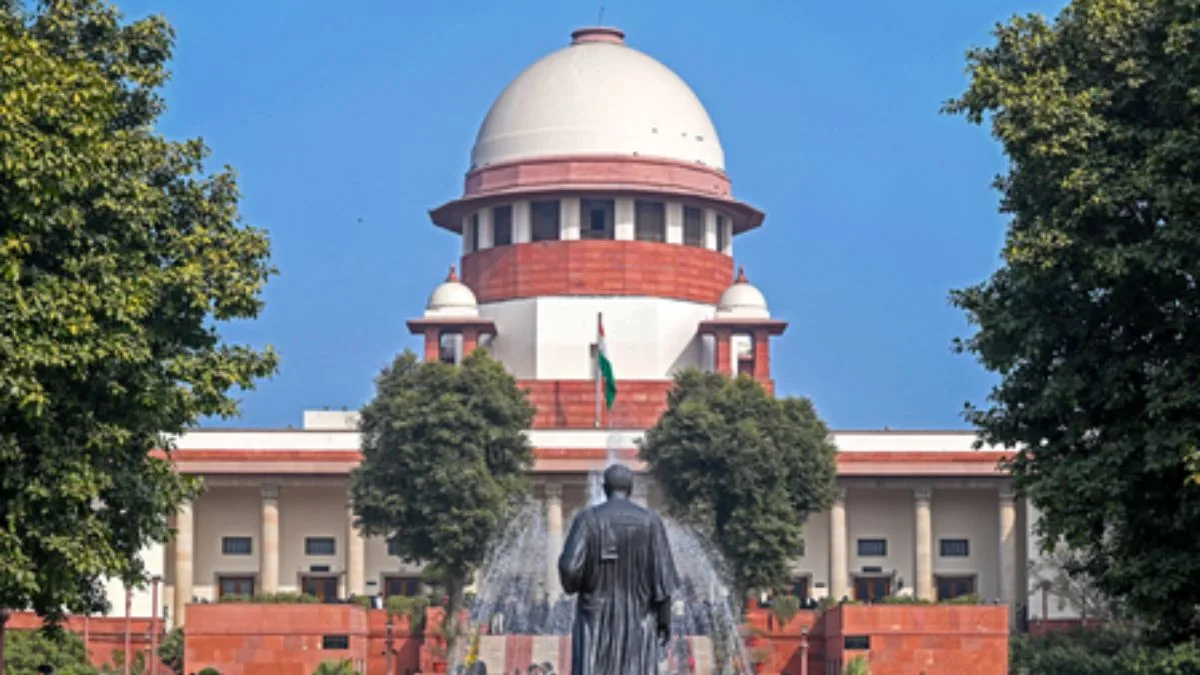
The Supreme Court on Monday acquitted a man convicted under stringent POCSO act after he married the victim on attaining majority age.
Taking note of the developments, including their marriage, the court invoked extraordinary powers under Article 142 of the Constitution to ensure “complete justice”.
Advertisement
A bench of Justices JK Maheshwari and Atul S Chandurkar allowed the appeal filed by Tamil Nadu resident Maruthupandi against his conviction under Section 5(1) read with Section 6 of the POCSO Act and acquitted him of the charge.
However, the apex court clarified that the relief was being granted in the peculiar facts and circumstances of the case and would not serve as a precedent.
“Therefore, at this stage, without entering into the merits of the case, in the peculiar facts, as narrated above, we deem it appropriate to exercise our plenary power under Article 142 of the Constitution for setting aside the judgment of conviction and sentence of the appellant,” the Justice Maheshwari-led Bench said.
The case stemmed from a complaint lodged by the victim alleging that the accused had repeatedly engaged in sexual intercourse with her on a promise of marriage when she was a minor.
Following the trial, a Fast Track Mahila Court in Dharmapuri convicted Maruthupandi in April 2019 and sentenced him to 10 years’ imprisonment along with a fine. During the pendency of the appeal before the Madras High Court, the victim sought permission to adduce additional evidence, claiming that she and the accused had settled their differences and wished to live together.
The plea was rejected by the Madras High Court, prompting the accused to approach the Supreme Court.
The top court subsequently directed that the victim’s statement be recorded before a magistrate under Section 164 of the Code of Criminal Procedure. In her statement recorded in December 2022, the victim reiterated that the accused had sexual relations with her when she was a minor and that she had lodged the complaint after he refused to marry her. However, in a subsequent statement recorded in February 2025, she disclosed that after a failed marriage with another person, she had married the appellant on December 5, 2024, and was living with him.
The Supreme Court also noted that the accused paid Rs 10 lakh to the victim towards securing her future and family life.
The victim informed the apex court that she had received the entire amount and did not wish to pursue the litigation any further.
“She has specifically admitted that she has received the amount of Rs 10,00,000/- and she wishes to put a quietus to this litigation. It is specifically stated by her that in case the conviction of the appellant is set aside, she has no objection,” the Justice Maheshwari-led Bench recorded.
The Tamil Nadu government also informed the top court that it had no objection to setting aside the conviction in view of the peculiar factual scenario, while requesting that the order should not be treated as a precedent.
Taking note of the victim’s statements, the subsequent marriage between the parties after attaining majority, and the compensation paid by the accused, the Supreme Court exercised its powers under Article 142 and acquitted him.
“Accordingly, the appeals are allowed, and on the basis of subsequent events, the conviction and sentence as directed by the Sessions Court, confirmed by the High Court, stand set aside. The appellant and the victim are left free to live their life peacefully in society as spouses,” the order said.
The SC bench also clarified: “We make it clear that the present order has been passed in the peculiar facts of the case, therefore, it will not be treated as a precedent for any other purpose.”
Since the appellant’s sentence had already been suspended by the Madras High Court in 2019, the Supreme Court said he need not surrender and discharged his bail bonds.
(With inputs from IANS)