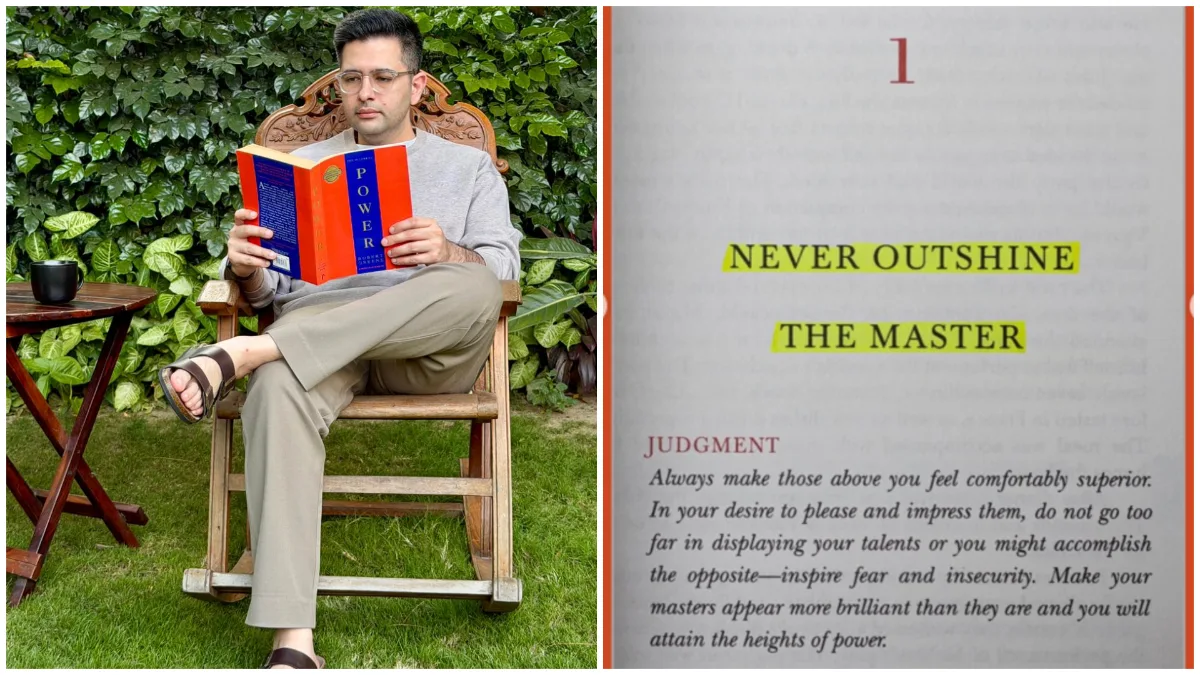
Amid an ongoing internal churn and controversy within the Aam Aadmi Party (AAP) over his recent removal from a key parliamentary post, Rajya Sabha MP Raghav Chadha on Monday shared photos on social media featuring him reading ‘The 48 Laws of Power’ by American author Robert Greene, a widely discussed book on strategy, influence, and power dynamics.
Chadha wrote that he had been gifted the book recently, adding that “some books arrive exactly when they are meant to,” a remark that drew attention for its timing and tone.
Advertisement
He added that the timing of receiving the book was “hard to ignore.”
Focus on ‘Never Outshine the Master’
In his post, Chadha highlighted the opening chapter of the book, titled “Never Outshine the Master.” He quoted its central idea, which advises against overshadowing those in positions of authority, suggesting that doing so may trigger insecurity rather than admiration.
“I turned to chapter 1,” Chadha wrote, before sharing the passage that emphasises making superiors feel “comfortably superior” to maintain influence and avoid conflict.
While Chadha did not directly reference any political development, the post comes at a time amid a recent decision by the Aam Aadmi Party (AAP) to remove him as Deputy Leader in the Rajya Sabha. The party had also signalled that the MP would no longer be given speaking time in the Upper House from its quota.
The AAP leadership has accused him of indulging in “soft PR” and not taking a strong line against Prime Minister Narendra Modi and the BJP on key issues such as the Election Commission, SIR, and other matters routinely raised by the Opposition.
Denying the allegations, Chadha responded through a series of social media posts, invoking popular Hindi film lines like “Ghayal hu, isliye ghatak hu” and “Picture abhi baaki hai” to underline his position.
He termed the charges “baseless” and “politically motivated,” asserting that his track record in Parliament does not support such claims.
The 48 Laws of Power
Authored by Robert Greene, The 48 Laws of Power is known for its controversial take on power strategies, often drawing from historical examples to outline rules for gaining and maintaining influence. The book has frequently found mention in political and corporate discussions for its blunt approach to real-world power structures.
For now, Chadha’s post remains open to interpretation, adding another layer of intrigue amid an already charged political atmosphere.