The cancellation of the NEET-UG 2026 examination has pushed India’s already embattled examination system into an unprecedented crisis, raising serious questions about the credibility of the country’s centralised testing framework and intensifying concerns over organised paper leak networks, institutional failure and the growing erosion of public trust in merit-based competitive examinations.
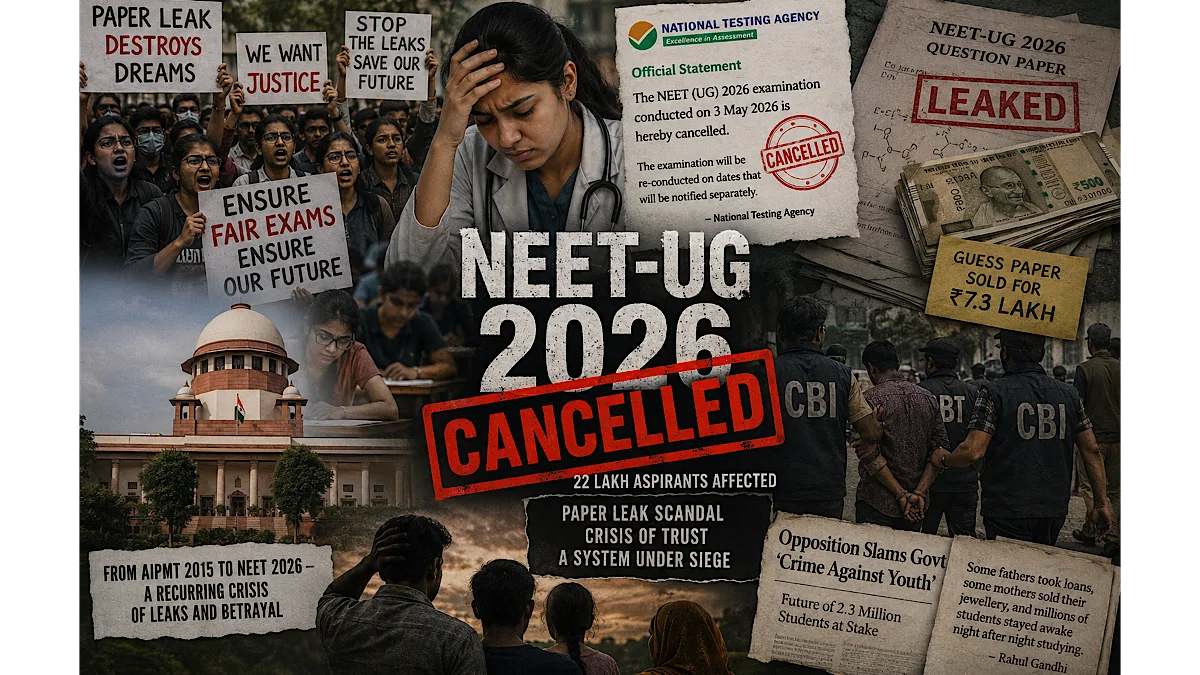
In a decision affecting more than 22 lakh medical aspirants nationwide, the National Testing Agency (NTA) on Tuesday cancelled the NEET-UG 2026 examination conducted on May 3 after investigative agencies flagged evidence suggesting that substantial portions of the question paper had been leaked and circulated before the test. The move marks the first nationwide cancellation of the medical entrance examination since NEET replaced the All India Pre-Medical/Pre-Dental Test (AIPMT) in 2016.
Advertisement
The NTA said the decision was taken after examining inputs received from central agencies and findings shared by law enforcement authorities, concluding that the sanctity of the examination process had been compromised.
“On the basis of the inputs subsequently examined by NTA in coordination with the central agencies, and the investigative findings shared by the law enforcement agencies… the National Testing Agency, with the approval of the Government of India, has decided to cancel the NEET (UG) 2026 examination conducted on 3 May 2026, and to re-conduct the examination on dates that will be notified separately,” the agency said in a statement.
The controversy erupted after reports surfaced that a so-called “guess paper” circulating in Rajasthan’s Sikar district weeks before the examination closely matched the actual question paper. Investigators suspect that nearly 120 Chemistry questions and significant sections of the Biology paper overlapped with the final examination. The material was allegedly sold through organised networks for amounts reaching Rs 7.3 lakh and reportedly reached candidates through coaching institutes, hostel operators and intermediaries operating across several states.
What initially appeared to be another isolated allegation of malpractice quickly escalated into a nationwide scandal. The Rajasthan Special Operations Group conducted raids and detained multiple individuals, while the Centre subsequently transferred the investigation to the Central Bureau of Investigation. The CBI has now registered an FIR under provisions of the Prevention of Corruption Act and begun taking over the probe from Rajasthan Police.
Investigators are examining whether the leak originated from a printing-related supply chain linked to Nashik in Maharashtra before being routed through intermediaries in Rajasthan and elsewhere. More than 45 people have reportedly been detained so far, and agencies are probing the possible involvement of organised coaching and counselling networks operating within India’s highly commercialised examination ecosystem.
The developments have revived memories of the NEET-UG 2024 controversy, which had already severely damaged public confidence in the examination system. Last year, allegations of paper leaks in Bihar and Jharkhand triggered nationwide protests after investigators alleged that candidates had accessed solved question papers shortly before the examination. The controversy deepened when an unusually high number of students secured perfect scores, prompting demands for a complete re-test and judicial intervention.
Although the Supreme Court acknowledged in 2024 that a leak had occurred, it declined to cancel the examination, observing that available evidence did not conclusively establish a systemic breach extensive enough to justify scrapping the entire test. A limited re-examination was later conducted for 1,563 candidates who had received grace marks due to loss of time during the exam.
The turbulence was not confined to NEET alone. The same year saw UGC-NET cancelled within a day of being conducted over suspected leaks, while CSIR-UGC NET and NEET-PG were postponed amid allegations of irregularities and security concerns. Collectively, the controversies strengthened public perception that India’s centralised examination system had become increasingly vulnerable to organised leak rackets and administrative lapses.
India’s medical entrance examination system has confronted similar crises before. In 2015, the Supreme Court ordered the cancellation of the AIPMT examination after investigators uncovered a sophisticated cheating racket involving Bluetooth-enabled devices and micro-SIM fitted vests used to transmit answers to candidates during the test. Haryana Police had informed the court that at least 44 candidates benefited from the fraud, leading to a complete re-test.
However, the scale and political fallout of the NEET-UG 2026 controversy appear significantly larger. Unlike previous incidents confined to specific centres or groups of candidates, the latest allegations have cast doubt over the legitimacy of the entire examination process, with the government itself conceding that the integrity of the exam could no longer be guaranteed.
The cancellation has also triggered a fierce political confrontation, with opposition parties accusing the BJP-led Centre of presiding over a deeply compromised education system.
Rahul Gandhi described the cancellation as “a crime against the future of the youth” and accused the government of allowing “paper leaks, government negligence and organised corruption in education” to flourish unchecked.
“The hard work, sacrifice, and dreams of more than 2.2 million students have been crushed by this corrupt BJP-backed system,” Gandhi wrote on social media platform X. “Some fathers took loans, some mothers sold their jewellery, and millions of students stayed awake night after night studying.”
The Congress leader alleged that repeated paper leak scandals had exposed structural failures in the country’s examination framework. “Every time, the paper leak mafia escapes, while honest students are made to suffer,” he said, adding that repeated cancellations and delays had imposed enormous financial and emotional strain on families.
In another strongly worded post, Gandhi questioned the government over the appointment of a former senior National Testing Agency official linked by critics to the 2024 controversy. “This is how the BJP rewards and protects those who play with the future of lakhs of hardworking students,” he said. “The market where your hard work and your dreams are being auctioned has only one rule — the bigger the theft, the bigger the reward.”
Samajwadi Party chief Akhilesh Yadav also intensified attacks on the Centre, arguing that repeated leaks had destroyed public confidence in competitive examinations.
“What guarantee is there that the examination will not be leaked again when it is reconducted?” Yadav asked, alleging that the country’s examination system had begun functioning “on a trail of leaks.”
The former Uttar Pradesh chief minister said the latest controversy had generated “immense anger and despair among millions of students and their crores of family members,” while accusing the BJP government of failing to protect the future of students despite repeated scandals involving national-level recruitment and entrance examinations.
Rashtriya Janata Dal Nation Working President Tejashwi Yadav also targeted the ruling party, accusing the BJP of “ruining the future of 2.3 million students” through repeated failures in conducting transparent examinations.
The RJD leader said repeated paper leak incidents had raised serious concerns about the government’s intent and competence. He pointed out that nearly 2.3 million candidates would now have to travel again to examination centres spread across 552 cities, placing an additional financial burden on students and their families.
Tejashwi Yadav further argued that the re-examination process would increase fuel consumption and subject lakhs of students to renewed mental and physical stress. He said merely ordering investigations would not solve the deeper problem and called for serious introspection within the government. He also questioned whether Prime Minister Narendra Modi had assessed the broader social and economic consequences of the controversy.
The BJP and the Centre, however, have defended the government’s response, asserting that strict action is being taken against those responsible and that the cancellation itself reflects the administration’s commitment to preserving the integrity of examinations. Officials have assured students that existing applications will remain valid and that fresh examination dates will be announced after consultations with investigative and security agencies.
Yet for lakhs of aspirants, the damage extends beyond the inconvenience of a postponed test. For many students and families, NEET represents years of relentless preparation, financial sacrifice and emotional investment. Another round of examinations means renewed uncertainty, additional coaching expenses and prolonged psychological pressure in an already intensely competitive environment.
The crisis has now revived a larger national debate over whether India’s heavily centralised examination architecture — where the futures of millions hinge on a handful of high-stakes tests — can continue to command public confidence amid recurring allegations of leaks and organised malpractice.
For a system originally designed to standardise merit and eliminate arbitrariness, the repeated controversies surrounding NEET have instead exposed the vulnerabilities of an ecosystem increasingly shaped by commercial coaching networks, criminal rackets and institutional fragility. The cancellation of NEET-UG 2026 may ultimately come to be seen not merely as another examination controversy, but as a defining moment in India’s growing crisis of trust in its education and recruitment systems.