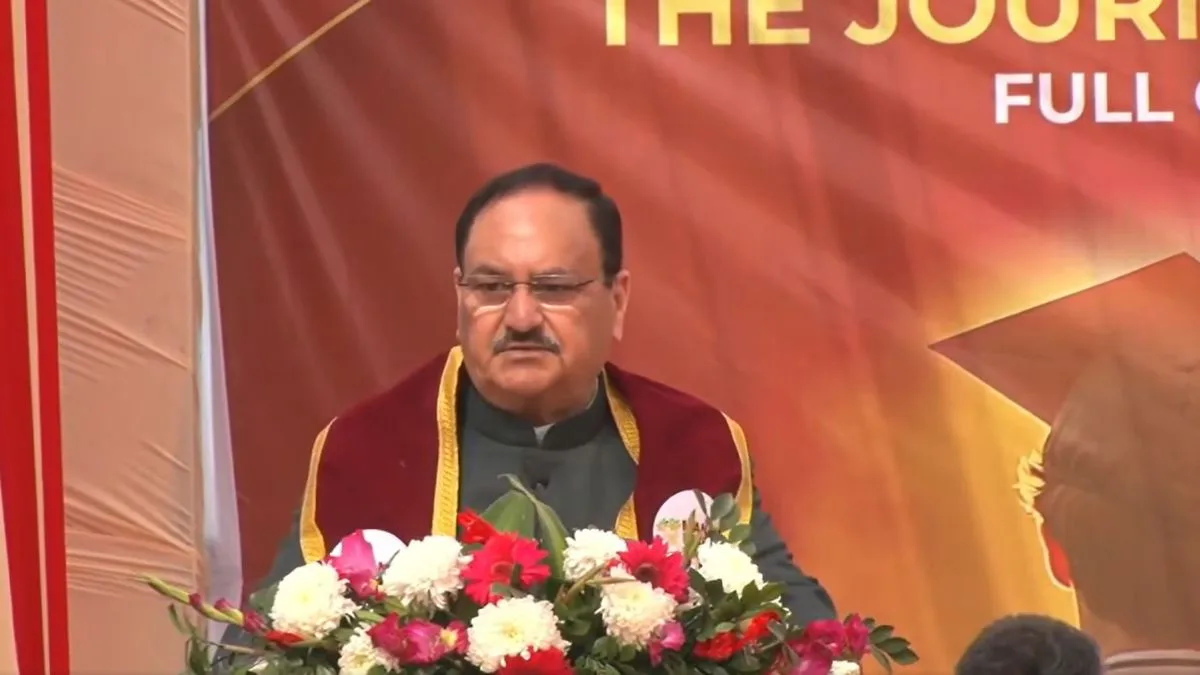
Union Minister for Health & Family Welfare Jagat Prakash Nadda on Saturday claimed that the out-of-pocket healthcare expenditure in India has declined sharply from 62 per cent to 39.4 per cent, driven by initiatives such as Ayushman Bharat, Ayushman Arogya Mandirs, and large-scale population screening programmes, making healthcare more accessible and affordable.
He was addressing the Convocation Ceremony 2025–26 of Manav Rachna Educational Institutions (MREI), held with academic grandeur and enthusiasm.
Advertisement
Highlighting the transformative progress achieved under the leadership of Prime Minister Narendra Modi over the last 11 years, Nadda noted that 23 AIIMS have been established, up from just six earlier, creating a robust network of state-of-the-art healthcare institutions across the country. He further stated that India has made remarkable advances across healthcare indicators, ranging from maternal and child health to communicable and non-communicable diseases.
He pointed out that institutional deliveries have increased from 78 per cent to 89 per cent, while Maternal Mortality Ratio (MMR) and Infant Mortality Rate (IMR) have declined at nearly three times the global average rate. Referring to tuberculosis control efforts,
Nadda highlighted that the World Health Organisation (WHO) has acknowledged India’s significant progress, with TB notification increasing substantially and the decline rate being twice the global average. He also noted that malaria-related death prevalence has reduced to 0.6 per cent despite India accounting for nearly one-sixth of the world’s population.
Underscoring the challenges ahead, he urged students to maintain both quality and scale in service delivery while addressing the needs of India’s vast population. He also acknowledged the collective contribution of parents, faculty members, institutional leadership, and support staff in shaping the students’ academic success.
Nadda exhorted graduates to always carry the sentiment that society has enabled their success and, in return, they must strive to give back by serving society selflessly and meaningfully.