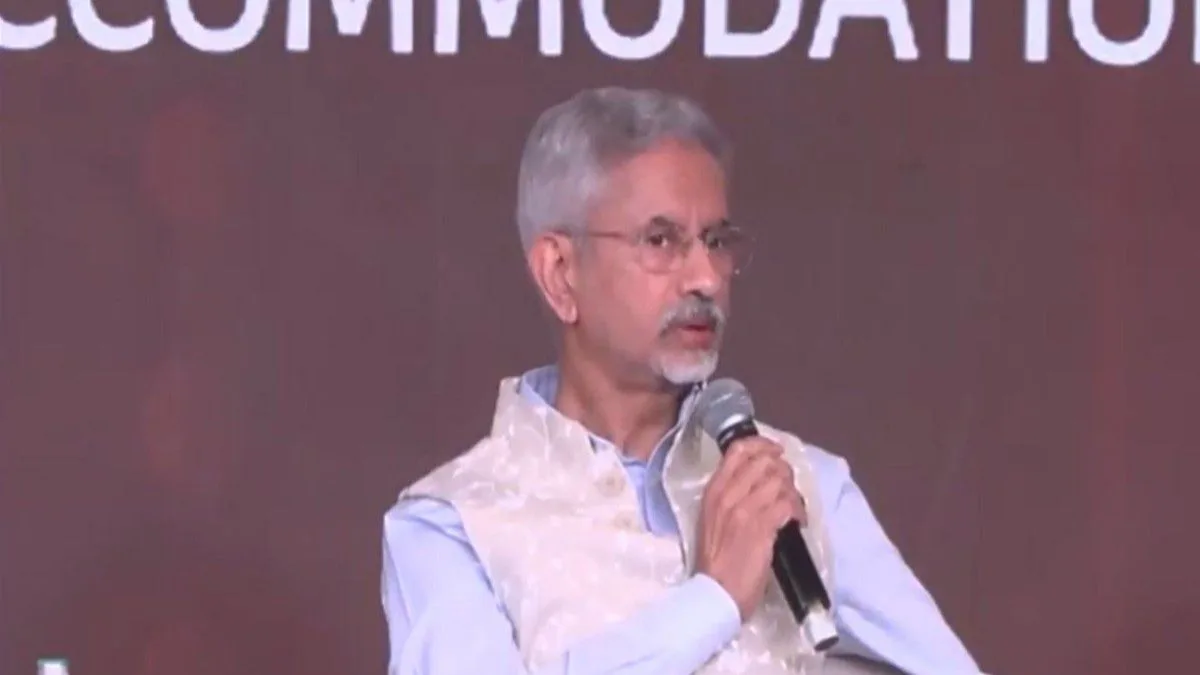
External Affairs Minister S Jaishankar on Friday said the time when a handful of powerful nations could decide global affairs through sweeping agreements has passed, arguing that the world is moving steadily toward a multipolar order.
Speaking at the Raisina Dialogue 2026 in New Delhi, the minister said international power is now more widely distributed than before, making it unlikely that major countries will be able to impose broad geopolitical settlements on the rest of the world.
Advertisement
Jaishankar said that while large nations may still cooperate on specific issues, the idea of a few dominant powers determining global outcomes through comprehensive agreements no longer reflects reality.
“Multipolarity is here to stay. What we will have, which we are already seeing, is to some extent that some of the bigger countries will make temporary compacts on limited issues. I’m not saying they are insincere about it, maybe they are, but structurally, there’s not going to be some big deal between powers, and the rest of the world has to put up with it. That era is over,” he said.
The minister also emphasised that the growing influence of the Global South is rooted in shared historical experiences rather than political rhetoric.
“When Covid happened, the fact that a country like India, which was still undergoing its vaccination, was willing to send out vaccines to countries of the global south. Means global south is for real because it meant something for us. So there is an emotion, and I would argue to some degree a culture, where the global West is concerned. So the global south emanates from shared historical experiences,” Jaishankar said.
Global power structures are shifting
Jaishankar also pointed to visible changes within Western alliances, saying the once unified idea of a “Global West” is now showing internal differences.
“I think Global West was probably a more unified term, very cultural, very political, very strategic, till recently. Now there is a differentiation in the global west,” he observed.
“When we look back at these 70 years, I think the expectation that we can freeze a 1945 or a 1989 forever was a very unrealistic one. In fact, look back at the 70 years. These 70 years, we debate, how did we do, why didn’t it last, 70 years is 1 per cent of Indian history. Why would 1 per cent of Indian history last? Life moves on,” he said.
Technology and demographics shaping the next phase
Jaishankar said the coming decade will be defined by two powerful forces – technological transformation and demographic shifts – both of which are likely to reshape global influence.
He noted that much of the current geopolitical debate continues to focus heavily on developments in the United States, but the broader trend suggests a diffusion of power across multiple regions and sectors.
“No country today has hegemony over so many domains that it is an overall hegemon,” he said.
The minister explained that influence in the modern world is no longer measured only through traditional indicators like economic output or military strength.
“It’s not just a distribution of GDP and capabilities. I think in different domains, different parts of the world will contribute more or will have more capabilities. So the power in its different dimensions has spread out much more,” he added.