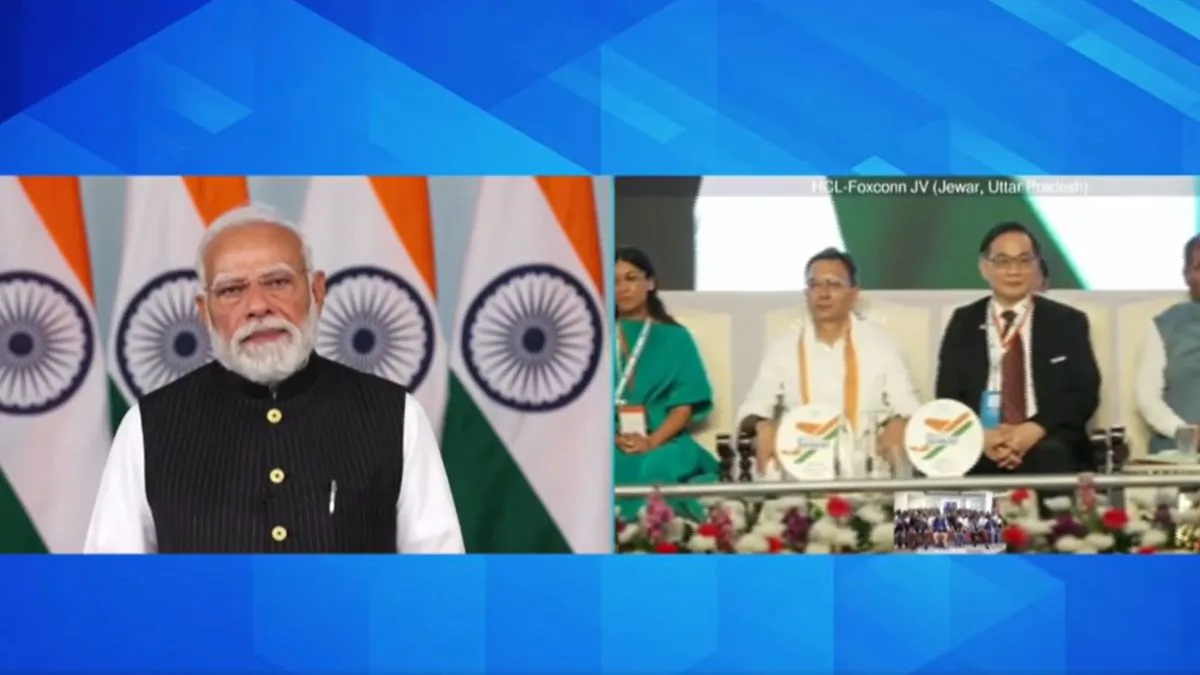
Prime Minister Narendra Modi on Saturday laid the foundation stone for a semiconductor plant being set up by a joint venture between HCL Group and Foxconn in Jewar, Uttar Pradesh, terming it a decisive push toward technological self-reliance and a stronger foothold in the global chip ecosystem.
The Prime Minister virtually participated in the groundbreaking ceremony of the HCL–Foxconn joint venture project, India Chip Pvt. Ltd., at the Yamuna Expressway Industrial Development Authority (YEIDA), addressing industry leaders and officials at the event.
Advertisement
Describing the facility as a milestone in India’s semiconductor ambitions, Modi said, “The establishment of the HCL-Foxconn semiconductor facility in Uttar Pradesh is a step towards technological self-reliance. It will boost India’s presence in the global chip ecosystem.”
The upcoming unit will operate as an Outsourced Semiconductor Assembly and Test (OSAT) facility under the Modified Scheme for Semiconductor Assembly, Testing, Marking and Packaging (ATMP), with an investment exceeding Rs 3,700 crore. Located strategically in the YEIDA region near the upcoming Jewar airport, the plant is expected to reduce dependence on semiconductor imports while strengthening domestic manufacturing capacity.
Emphasising India’s broader technology roadmap, Modi said, “India is working simultaneously on both software and hardware aspects. It is a matter of pride for all of us that Uttar Pradesh is also going to become a major center of India’s semiconductor ecosystem.”
He added that the facility would “further strengthen Uttar Pradesh’s new identity as a technology powerhouse.”
“This decade is India’s ‘Techade’,” the Prime Minister said. “What India is doing in the field of technology during this decade will form the foundation of our strength in the 21st century.”
Stressing the strategic importance of chip production, Modi asserted, “India must become self-reliant in chip manufacturing. For this, we need to build a semiconductor ecosystem within the country.” He also highlighted the importance of rare earth minerals for semiconductor manufacturing, noting that India is taking strong measures to secure critical resources.
The plant is expected to cater to sectors such as mobile phones, laptops, tablets, automotive electronics and consumer devices. Industry experts say the OSAT facility will play a key role in packaging and testing chips—critical stages in the semiconductor value chain.
The project is projected to generate thousands of direct and indirect jobs for engineers, technicians and skilled professionals, while stimulating growth in ancillary and support industries across the region.
Highlighting India’s expanding role in global supply chains, Modi said, “A democratic country like India is a trusted partner for the world. India’s growing participation in any value chain will only enhance that value chain’s resilience.”
“Today, the world is looking at India as the center of the tech future,” he added.
The HCL–Foxconn partnership is being viewed as a significant step in advancing India’s ambition to become a global hub for high-end electronics and semiconductor manufacturing. With the Jewar facility, Uttar Pradesh joins India’s emerging semiconductor map, reinforcing the Centre’s push to build a resilient, self-reliant electronics ecosystem as part of its broader vision of a developed India.