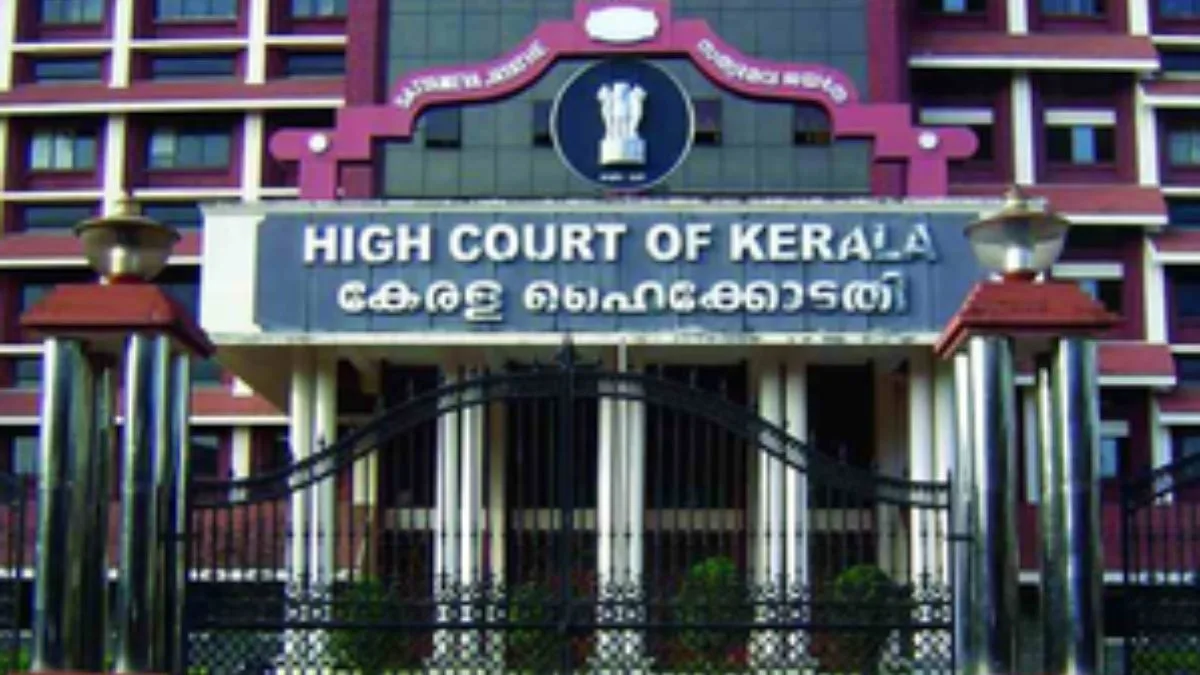
The Kerala High Court on Wednesday restrained the Kerala State Waqf Board from making any major decisions, incurring capital expenditure or making policy decisions until the legal challenges against its composition are decided.
A Division Bench comprising Chief Justice Soumen Sen and Justice Syam Kumar VM passed the interim order on Wednesday while considering the Public Interest Litigation (PIL) petitions challenging the constitution of the present Board.
Advertisement
The Bench observed that the board’s existing composition prima facie appeared to be contrary to Section 14 of the 2025 Waqf Amendment Act, which mandates the inclusion of at least two non-Muslim members in every State Waqf Board.
“In view of the fact that, admittedly, two non-Muslim members have not been included in the Waqf Board and also, as urged by some of the writ petitioners, that one Shia member should also be included, we hold that the constitution of the Board prima facie appears to be not in conformity with Section 14 of the said Act. Hence, the present Board shall not take any major decisions or incur any capital expenditure or take any policy decision without the express leave of this Court,” the court said.
The court further directed that, for the time being, the Board shall function under the administration and supervision of the Joint Secretary to the State government who deals with Waqf matters.
Kerala Advocate General Jaju Babu, representing the State, admitted that the Board’s constitution has certain flaws. The Court noted this admission in its order.
“The state government, in its affidavit affirmed on July 14, submitted that there is a requirement to reconstitute the Board in compliance with the mandate of Section 14 of the Waqf Act,” the court said.
The order stems from PILs filed by parties, including Shone George and the Assembly of Christian Trust Services (ACTS).
The petitioners contend that the Board is continuing to function and issue orders despite the alleged defects in its constitution. They argue that the amended law mandates the inclusion of two non-Muslim members, who have not yet been nominated.
The petition filed by BJP leader Shone George highlights that a February 2026 government order appointed nine members—all of whom are Muslim—failing to comply with Section 14(1) of the amended Act, which strictly mandates the inclusion of at least two non-Muslim members.
The petition filed by the Assembly of Christian Trust Services (ACTS) also challenges the uploading of details of the disputed Munambam land on the Centre’s UMEED (Unified Waqf Management, Empowerment, Efficiency and Development) portal. The organisation argues that the entry affects Hindu and Christian residents in the area and that only the mutawalli is authorised under the Act to upload such details.
The ACTS petition points out that the Board lacks required representation from the Shia, Bohra, and Aghakhani communities as required under the amended law and seeks a direction to the state to reconstitute the Board.