MP Governor pays homage to Mahatma Gandhi on his death anniversary
After paying tributes to the Mahatama at the Governor House ‘Lok Bhavan’ in Bhopal, the Governor observed two-minute silence.
Omar was joined by his father and NC President Dr. Farooq Abdullah, Deputy CM Surinder Kumar Choudhary, Advisor Nasir Aslam Wani, ministers Javed Dar and Sakina Itoo, party spokesperson Tanvir Sadiq, and several legislators. They offered floral tributes at the graveyard near the Naqshband Sahib shrine, amid tight security.




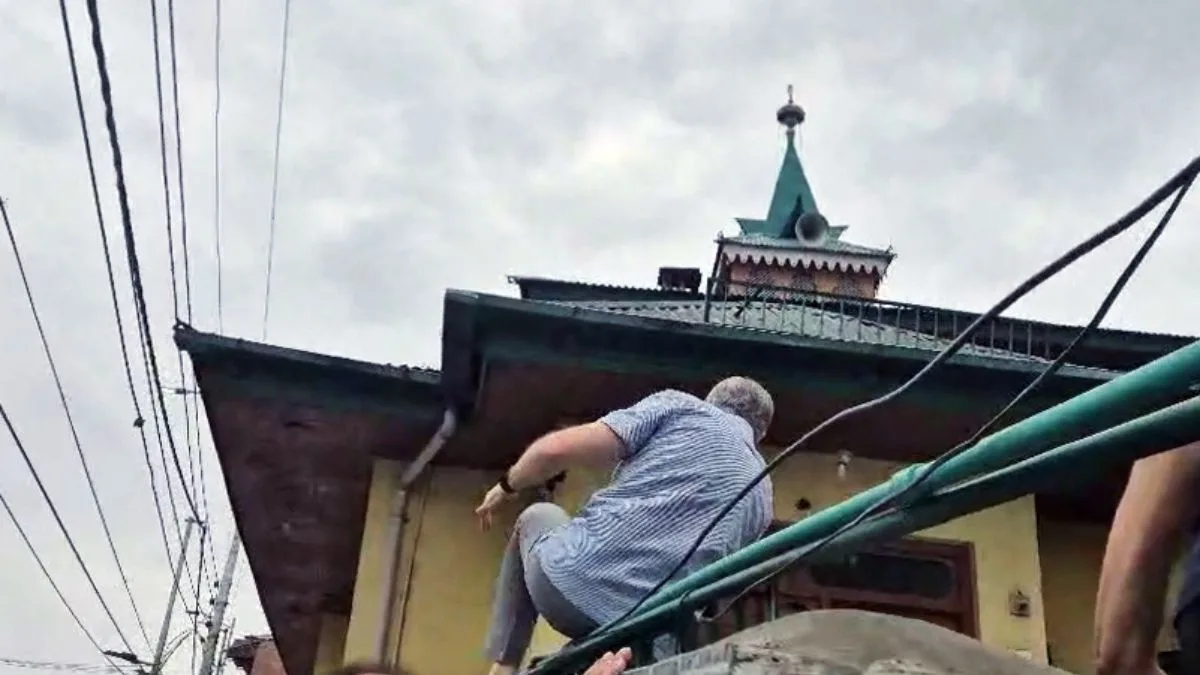
Photo: ANI
A day after being barred from visiting the Martyrs’ Graveyard, Jammu and Kashmir Chief Minister Omar Abdullah, accompanied by ministers and senior National Conference (NC) leaders, on Monday scaled a wall at the heavily barricaded graveyard in downtown Srinagar to pay homage to the 22 Kashmiris killed in firing on July 13, 1931.
Omar was joined by his father and NC President Dr. Farooq Abdullah, Deputy CM Surinder Kumar Choudhary, Advisor Nasir Aslam Wani, ministers Javed Dar and Sakina Itoo, party spokesperson Tanvir Sadiq, and several legislators. They offered floral tributes at the graveyard near the Naqshband Sahib shrine, amid tight security.
Advertisement
Their visit came a day after Omar, his ministers, and leaders from PDP, People’s Conference, and J&K Apni Party were placed under house arrest — the first such instance where an elected CM was barred from marking Martyrs’ Day.
Advertisement
In a dramatic moment widely shared on social media, Omar climbed a wall to enter the graveyard. “We are not their slaves; we are the servants of the people of Jammu and Kashmir,” he told reporters and added, “A security vehicle blocked our way at Nowhatta Chowk. What law allows them to stop elected representatives from paying respects? Is this democracy or dictatorship?”
Omar alleged police tried to stop them and even tear the party flag. “They failed. We paid our respects and will continue to honour our martyrs,” he said.
He posted a video in which policemen are seen grappling with him to prevent the leaders from proceeding further towards the graveyard. Omar wrote on X, “This is the physical grappling I was subjected to but I am made of sterner stuff & was not to be stopped. I was doing nothing unlawful or illegal. In fact these “protectors of the law” need to explain under what law they were trying to stop us from offering Fatiha. They tried to physically grapple me but I was not going to be stopped today”.
West Bengal CM Mamta Banerjee came to Omar’s support by writing on X, “What is wrong in visiting the graveyard of martyrs? This is not only unfortunate, it also snatches the democratic right of a citizen. What happened this morning to an elected Chief Minister @OmarAbdullah is unacceptable. Shocking. Shameful”.
On X (formerly Twitter), Omar wrote, “Paid my respects & offered Fatiha at the graves of the martyrs of 13th July 1931. The unelected government tried to block my way, forcing me to walk from Nowhatta Chowk and scale a wall. They even tried to physically grapple me, but I was not going to be stopped today.”
“An unelected government locked up the elected government,” Omar wrote on X, referring to the detentions made on the anniversary of the July 13, 1931 massacre.
Omar also slammed local media for ‘blacking out’ the house arrests. “An unelected government locked up the elected one,” he wrote. “Shame on the sellouts who buried the story — I hope the size of the envelope was worth it.”
The administration, under LG Manoj Sinha, had denied permission for gatherings on Martyrs’ Day, warning of “strict action” against anyone attempting to visit the graveyard.
Echoing his criticism of Delhi’s control, Omar said, “Democracy in J&K is a tyranny of the unelected. The nominees of New Delhi locked up the elected representatives of the people of J&K.”
He wrote, “To borrow from the late Arun Jaitley Sb — democracy in J&K is a tyranny of the unelected”. He added, “To put it in terms you will all understand — the unelected nominees of New Delhi locked up the elected representatives of the people of J&K”.
The events surrounding Martyrs’ Day have reignited a wider debate over democratic freedoms and press independence in the Union Territory.
Advertisement