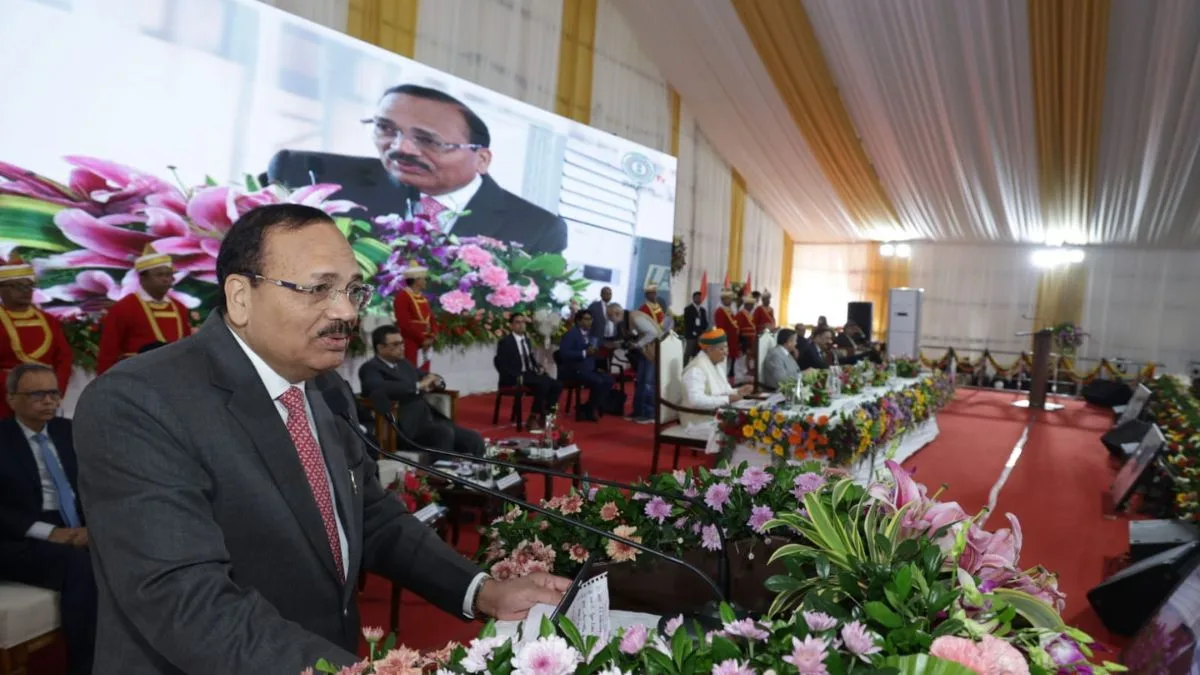
The Jharkhand High Court celebrated its 25th Foundation Day on Saturday with a ceremony that focused on judicial reform, technological readiness, and the widening responsibilities of the courts in a constitutional democracy. Supreme Court judge and Chief Justice-designate Surya Kant attended as the chief guest, along with Union Law Minister Arjun Ram Meghwal, several Chief Justices, judges, and senior officials.
The event began with a tribute to Bhagwan Birsa Munda on his 150th birth anniversary. Justice Surya Kant urged everyone to take inspiration from his life of truth and courage, saying that justice must always be anchored in honesty and fairness. Addressing the gathering, he said High Courts should function with the same urgency and precision as a hospital emergency ward. According to him, courts must be equipped to offer swift, coordinated, and effective relief the moment a crisis arises. He called this approach essential for the next stage of access-to-justice reforms, which should include stronger technology systems, simplified procedures, specialised expertise, and the capacity to adapt quickly to emerging challenges.
Advertisement
Justice Surya Kant recalled his first case as a judge, a cross-border custody dispute involving two children. What stayed with him, he said, was not the legal complexity but the distress of the children caught between countries and courts. That experience taught him that judging is not only about doctrine but also about ensuring that the law protects those who are most vulnerable.
He described High Courts as engines of social reform because of their unique position between district courts and the Supreme Court. Their jurisdiction under Article 226 allows them to protect both fundamental and other legal rights, making them central to the delivery of timely and meaningful relief. He said High Courts bring a human touch to constitutional justice because their decisions are shaped by local realities and social contexts.
Justice Surya Kant praised the Jharkhand High Court’s journey over the past twenty-five years, noting its landmark work on tribal rights, environmental protection, workers’ dignity, and inter-generational equity in mineral extraction. He said the Court has shown resilience and innovation from its early days and has strengthened its processes through the adoption of e-filing, real-time case tracking, searchable databases, and accessibility tools for visually challenged litigants. He underlined that technology is now essential for transparent and efficient courts.
Union Law Minister Arjun Ram Meghwal commended the new High Court building for its design, solar power systems, and other green energy features. He said the wider use of AI in judicial work can help improve efficiency and promised to consider the state’s request for a bench of a central tribunal.
The Chief Justice of the Jharkhand High Court spoke about the growing challenges before the judiciary and said that constitutional awareness and technological capability are now essential for judges and lawyers. Plans for a new building for the High Court were also outlined, with an emphasis on better facilities for litigants and legal professionals.
The ceremony concluded with a renewed commitment to integrity, transparency, and judicial independence. The gathering affirmed that the High Court will continue to stand firmly against injustice and strengthen public trust in the coming years. Justice Surya Kant said he hopes the institution’s legacy will guide Jharkhand for generations.