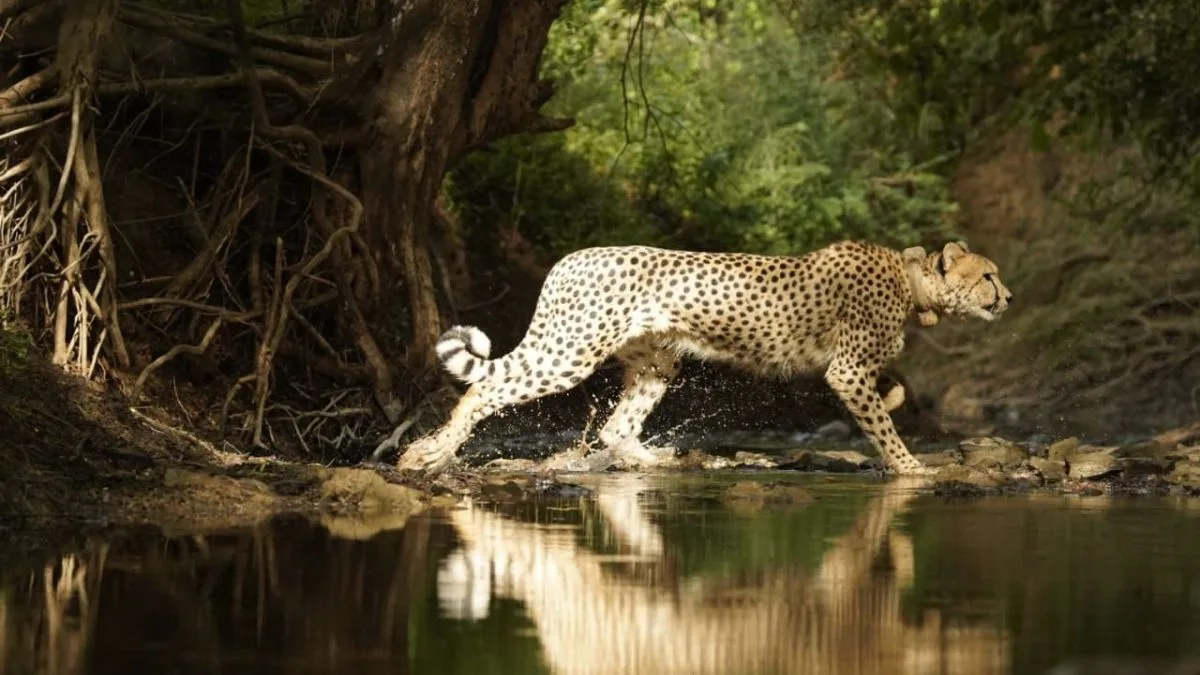
Marking International Cheetah Day, Prime Minister Narendra Modi on Thursday shared photographs of what he called “one of the most remarkable creatures” and reiterated the government’s commitment to protecting the species. He noted that Project Cheetah, launched three years ago, aimed not only to save the animal but also to revive India’s lost ecological heritage and strengthen biodiversity.
Launched in September 2022 amid much skepticism, Project Cheetah faced several ups and downs in the past three years. Currently, there are around 32 cheetahs, including 21 born on Indian soil, across major sanctuaries. Yet, in the early phase, several big cats brought from Namibia and South Africa also died due to various reasons.
Advertisement
Intended to reintroduce a species that went extinct in India in 1952, the ambitious project spearheaded by PM Modi began with the relocation of African cheetahs to Kuno National Park in Madhya Pradesh. Eight cheetahs arrived from Namibia in September 2022, followed by 12 from South Africa in February 2023, marking the world’s first intercontinental movement of a large carnivore for re-wilding.
According to officials, 21 cubs were born in India, and the survival rate of above 61 per cent (higher than global averages) despite challenges such as enclosure-related stress and conflicts with other predators, is significant.
The significant boost came in November 2025 with the birth of five second-generation cubs to Mukhi, one of the first cheetahs born in India. Born in March 2023 to Jwala—one of the Namibia transplants—Mukhi was the sole survivor of her litter during a harsh summer and was abandoned shortly after birth.
On December 3, three more cheetahs were released into the wild in Kuno, bringing the free-ranging population to 16. The government is planning to import another eight to ten cheetahs from Botswana or Namibia by the end of the year, and discussions with Kenya are also underway.
The project also suffered several setbacks in the initial stages. Since the beginning of the project, as many as 24 cheetahs have died.
Between September 2022 and January 2024, 10 translocated adults and early-born cubs died due to issues like kidney ailments, heart failure, and infections. By September 2024, total deaths had increased to 13 adults and 11 cubs. Recently, a female cheetah was killed by a leopard.
Officials maintain that the long-term goal is to build a stable cheetah population, restore the species’ role as a top predator, expand its range, and contribute to global conservation.
Survival rates are improving, the free-roaming population is growing, and upcoming translocations will help enhance genetic diversity and open new habitats—signs that the project is gradually stabilising and showing that it is working, they add.