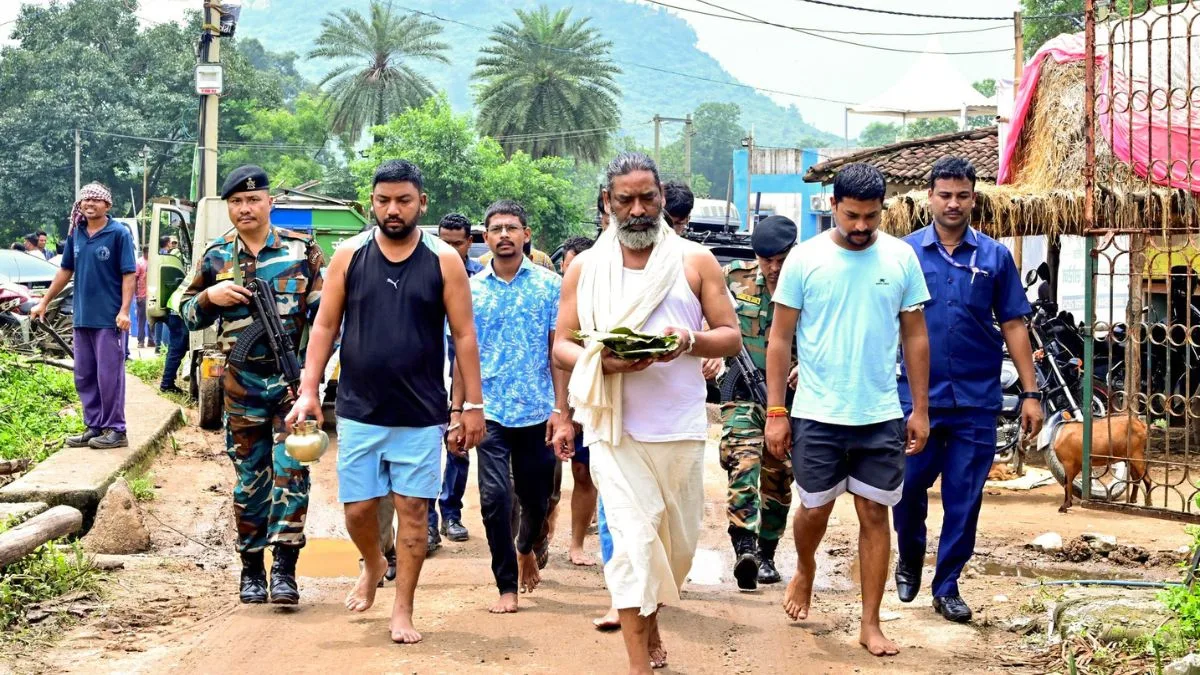
The ancestral courtyard of Nemra is steeped in silence. Incense drifts from the prayer space where rituals for the late Dishom Guru Shibu Soren enter their fifth day, and yet, just a few steps away, Jharkhand Chief Minister Hemant Soren sits at a modest desk, clearing files and speaking to senior officials over the phone.
It is the most difficult week of his life — the loss of a father who was also his political mentor. Hemant’s eyes still brim with unspent tears, his voice at times faltering. Yet, as he tells his aides, “The work of the state cannot stop.” In the same home where condolence visitors arrive in a steady stream, instructions for governance are being issued without pause.
Advertisement
Hemant acknowledges this as a test of will. “The state’s people stood with my family in this moment of grief. That gave me the courage to keep serving, even in these circumstances.” His days in Nemra are divided between performing the rites for his father and attending to urgent matters of administration — signing papers, reviewing reports, and giving clear directions to officers.
“No work should slow down. People’s problems must be addressed immediately,” he has instructed.
In public remarks, the Chief Minister often returns to his father’s guidance: to stand for the common people, never bend before injustice, and place the state’s interests above personal gain.
“Jharkhand exists because of Dishom Guru’s struggle. He took many promises from me for this state, and I will strive to fulfill every one of them.” The memory of Shibu Soren’s decades-long fight — from Parliament to protest grounds — is now the moral compass by which Hemant navigates these days.
The calendar may mark only five days since the passing, but each has felt like a lifetime. The CM’s mornings begin with ritual prayers; afternoons are reserved for governance briefings. Nights are quieter, marked by the absence of the man whose presence defined Nemra’s life for decades. The home is both a space of mourning and a temporary command centre for the state.
Officials confirm that routine administration in Ranchi remains uninterrupted. Hemant is in constant touch with senior bureaucrats, demanding real-time updates and timely execution of public welfare schemes. “Even in grief, the CM is more engaged than usual,” said one official, noting his insistence on immediate resolution of citizens’ grievances.
If there is one source of resilience, it is the people of Jharkhand. Hemant recalls the solidarity shown during this period — from political rivals attending the funeral to villagers standing silently outside the gates of Nemra. “This is what gives me the strength to serve,” he says, voice thick with emotion.
As the evening lamps are lit in memory of Baba, the Chief Minister’s desk lamp also burns late. In Nemra today, mourning and governance share the same roof — the rites of a son and the duties of a leader performed side by side, in honour of a father whose life was devoted to the very state his son now serves.