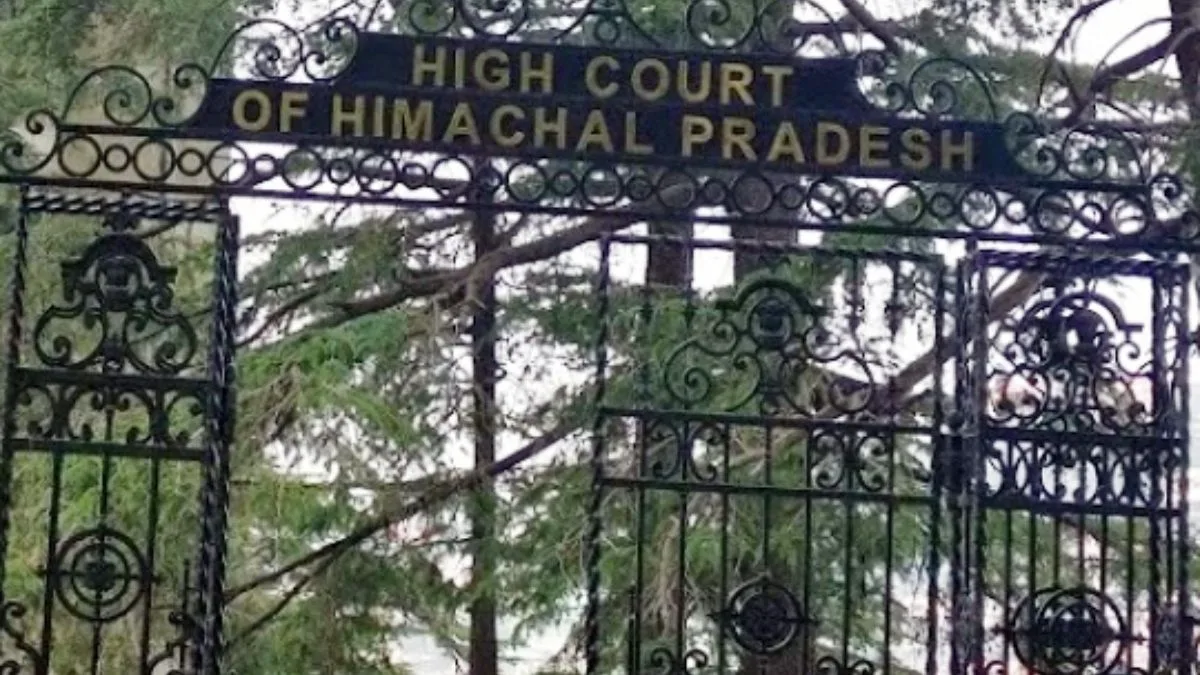
In a landmark judgment, the Himachal Pradesh High Court has struck down Section 163-A of the Himachal Pradesh Land Revenue Act, 1954 that allows the regularisation of encroached government land.
A division bench of the court, on Tuesday, while delivering its verdict on August 5, declared the provision unconstitutional, stating it violated Article 14 of the Indian Constitution, which guarantees equality before the law.
Advertisement
Section 163-A, introduced through an amendment in 2002 during former Chief Minister Prem Kumar Dhumal, to enable the government to regularise encroachments of up to five bighas for landless individuals and up to twenty bighas in exceptional circumstances.
The provision attracted over 1.67 lakh applications from individuals seeking ownership rights on encroached government land. However, the court observed that the policy incentivised illegal occupation and was being misused by influential encroachers under the guise of providing relief to the landless.
The Court, in its 44-page judgement, stated that the state cannot reward illegality and that allowing the regularisation of public land encroached unlawfully not only undermines the law but also encourages more illegal occupation.
It added that the state has a constitutional and moral obligation to protect public land and natural resources under the public trust doctrine.
The court pointed at the contradictory nature of Sections 163 and 163-A — the former mandates strict action against encroachments while the latter offered a path to legalise them. The bench termed this legislative inconsistency “mutually destructive” and said it led to confusion in governance and enforcement.
The judgment came at a time when encroachments on forest and government land have become a pressing issue in the hill state. Government records submitted in court revealed that over 1.23 lakh hectares of public land are under illegal occupation. The court noted that such widespread encroachments pose a serious threat to environmental sustainability and the rights of future generations.
Rejecting the argument that the law was framed to help the poor, the court stated that the state already has adequate schemes for the rehabilitation and welfare of genuinely landless and economically weaker sections. The provision, it noted, had opened the floodgates for exploitation by vested interests.
As part of the ruling, the high court directed the state government and concerned departments to initiate eviction proceedings against all illegal occupants covered under the now-defunct Section 163-A. Authorities have been given a deadline of February 28, 2026, to ensure the removal of all encroachments as per existing laws, by initiating suitable proceedings against encroachers and taking such proceedings to its logical end as expeditiously as possible.
The judgment is expected to have far-reaching implications, especially for those who were banking on the provision to retain possession of encroached land.
Legal experts have hailed the verdict as a significant step in upholding the rule of law and protecting public resources.