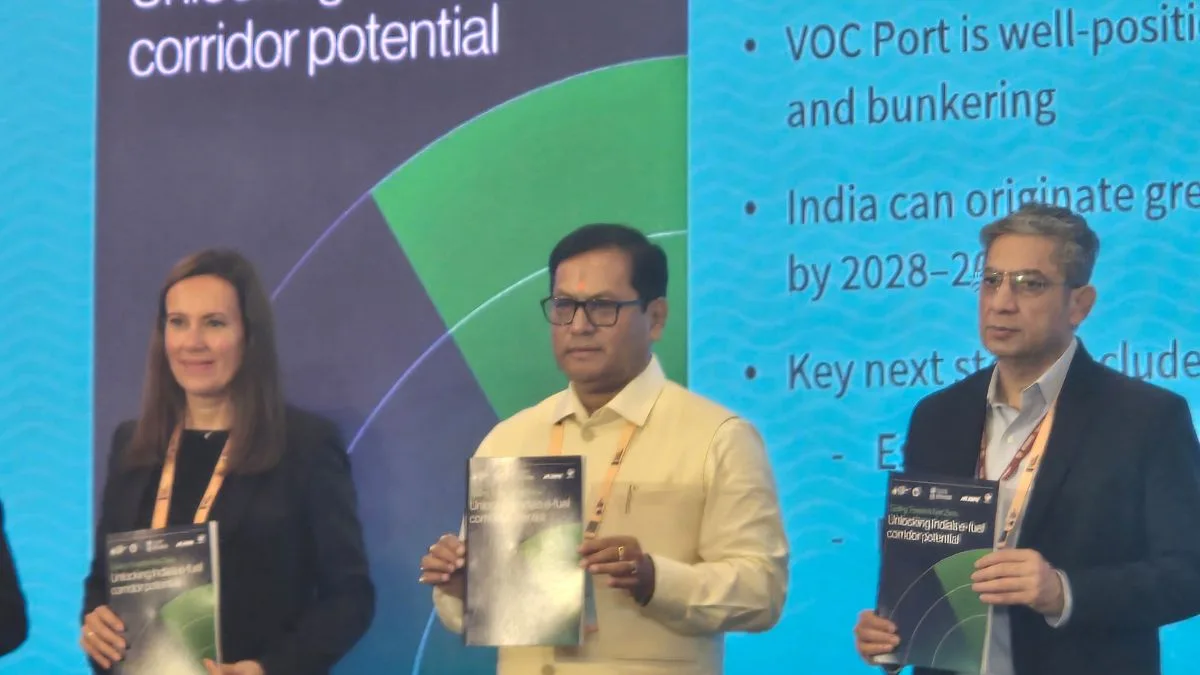
On the occasion of Green Maritime Day, Minister for Ports, Shipping and Waterways Sarbananda Sonowal on Tuesday said that the goal is not just to expand the maritime capacity of the country, but to make it greener, smarter, and more resilient.
Speaking at the second day of the India Maritime Week 2025 in Mumbai, the minister said guided by the vision of Net Zero by 2070, the country is determined to reduce carbon emission per ton of the cargo up to 30 per cent by the year 2030, and 70 per cent by 2047.
Advertisement
He emphasized that flagship initiatives like the Sagarmala program, Maritime India vision 2030, Harit Sagar guidelines, and maritime Amritkal vision 2047 are leading the transformation with sustainability, innovation, and climate responsibility at the core of the country’s overall maritime development.
Sonowal shared that ports like Jawaharlal Nehru Port Authority (JNPA) in Mumbai are already leading by example, where Battery-swapping electric trucks are replacing diesel vehicles, moving toward zero-emission logistics and last-mile electrification.
He mentioned that under the Harit Sagar Guidelines, all ports are working toward zero-discharge operations, better waste management, and pollution control to protect marine ecosystems. According to the minister, the country’s ports are evolving into centres of green hydrogen production, creating jobs and driving industrial growth.
He said through the National Green Hydrogen Mission, and the designation of VOC, Paradip, and Deendayal Ports as green hydrogen hubs in 2023, the country is laying the foundation for a clean-fuel economy. India is well placed to become a hub of green shipping corridor connecting domestic and international market through clean energy trade due to the unique geography along the global trade route.
He added that in a bid to harness this opportunity, the country has launched Green and Digital Shipping Corridors (GDSCs) with Singapore and Rotterdam in 2025.
These partnerships will help scale investments and strengthen India’s position as a bridge between global trade and sustainable growth, the minister said.
He emphasized that the economy should not be at the cost of ecology and environment, therefore, several initiatives are underway to create the right balance.
Speaking on the occasion, Secretary to the Ministry of Ports and Shipping Vijay Kumar said that the ministry has been working hard with a clear focus on sustainable, green maritime future. Several substantial targeted steps have been taken in this direction.
He informed that under the harit sagar guidelines the ports have been given a complete action plan and targets regarding clean energy and equipment electrification, waste management along with rigorous audits. There is a clear target that 60 per cent of power at major ports should come from renewable sources by 2030, and the country is already on a roadmap to achieve it.
Major ports have been told to electrify more than 50 per cent of their vehicles and equipment by 2030, and over 90 per cent by 2047.