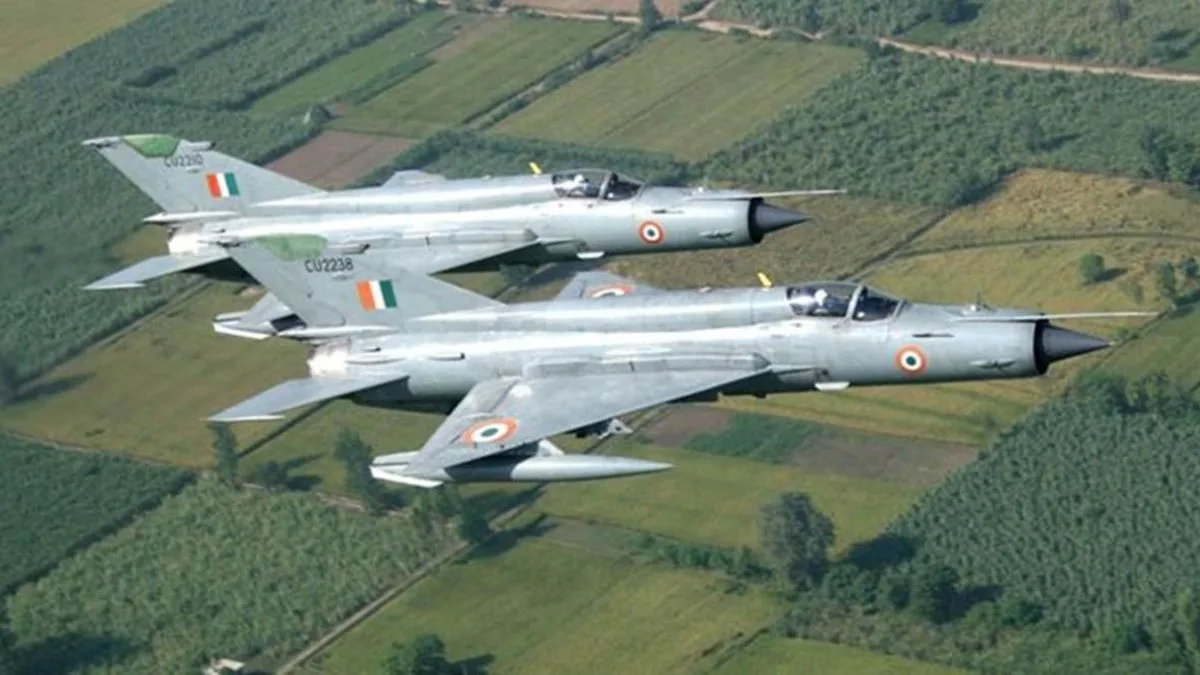
After more than six decades of illustrious service, the legendary MiG-21—long hailed as the backbone of the Indian Air Force—is preparing to take its final bow. A special ceremony will be held at Air Force Station, Chandigarh, on September 26 to mark the retirement of the iconic supersonic jet. Once a thunderous presence in the skies, defending the nation with unmatched grit and power, the MiG-21 will forever remain etched in the memories of generations of air warriors and citizens alike.
As the MiG-21 retires with honour, its proud legacy will be carried forward by the indigenously built Tejas LCA Mark 1A, a symbol of India’s self-reliance and the dawn of a new chapter in the country’s aviation history.
Advertisement
Inducted into the IAF in 1963, the MiG-21 was India’s first supersonic fighter jet and saw extensive action during the 1971 war against Pakistan. In a symbolic farewell, Chief of the Air Staff, Air Marshal A.P. Singh, recently flew the aircraft in its last operational mission from the Nal Air Force Station near Bikaner, Rajasthan.
Reflecting on the Russian-origin fighter, the IAF Chief described it as the force’s true workhorse. Sharing his personal memories, he said, “My first experience with the MiG-21 was in 1985, when I flew the Type-77 variant at Tezpur. It was a revelation—agile, highly maneuverable, and simple in design, though it required some initial training. It’s an amazing aircraft to fly. It will be missed by all who had the privilege of flying it.”
On the MiG-21’s successor, the CAS noted that Tejas was originally conceived as its replacement. “It was designed around the MiG-21, with some inspiration from the Mirage. Tejas will replace the MiG-21 well, though it must continue to evolve. We must equip it with newer weapons. In the initial training role, Tejas is well suited. With contracts for 83 aircraft already signed and more in the pipeline, I expect Tejas, in its various versions, to gradually assume the fleet’s role.”
Echoing the sentiment, IAF spokesperson Wing Commander Jaideep Singh highlighted the MiG-21’s pivotal role in key conflicts.
“The aircraft participated in the 1965 war and played a stellar role in the 1971 conflict, most notably during the strike on the Governor’s House in Dhaka on December 14. The governor resigned the next day, and Pakistan surrendered on December 16, with 93,000 troops laying down arms. The MiG-21 later saw action in Kargil during Operation Safed Sagar in 1999, when it shot down a Pakistani Atlantic aircraft intruding into Indian territory. In 2019, it again made headlines by downing an F-16.”