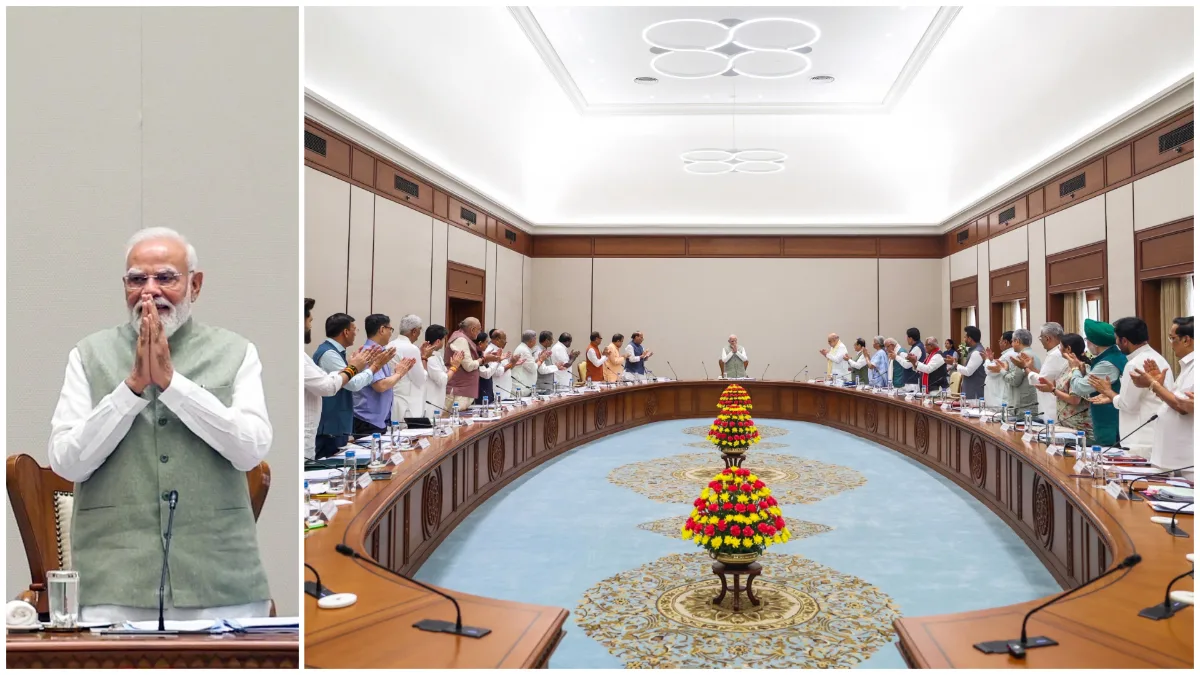
A political war of words erupted on Wednesday as the Congress sought to challenge the narrative surrounding Prime Minister Narendra Modi becoming India’s longest-serving Prime Minister in consecutive terms. Senior party leader Jairam Ramesh accused him of attempting to erase the legacy of independent India’s first prime minister Jawaharlal Nehru while weakening the democratic institutions built during the country’s formative years.
In a strongly-worded post on social media platform X, Ramesh used Modi surpassing Nehru’s tenure record to spotlight what he described as the extraordinary achievements under Nehru’s leadership between 1947 and 1952 and to contrast them with the current political environment. “Jawaharlal Nehru became Prime Minister of India on August 15, 1947, presiding over a stellar Cabinet — the likes of which have rarely been seen in the world. Over the next five years, modern India came into being,” Ramesh said.
Advertisement
Highlighting the accomplishments of the early years of Independence, the Congress general secretary cited the integration of more than 560 princely states into the Indian Union, the framing and adoption of the Constitution, the abolition of the zamindari system, the introduction of reservations for Scheduled Castes and Scheduled Tribes, and the launch of major infrastructure projects, including dams and power stations. He also pointed to the establishment of India’s scientific and technological foundations and the beginnings of the country’s nuclear programme.
He recalled India’s growing international stature during that period and the massive exercise of preparing electoral rolls for nearly 170 million voters ahead of the first general elections held between October 1951 and February 1952.
Arguing that these achievements were the result of collective nation-building efforts, he credited several national leaders alongside Nehru. “The 1947-52 record of achievements of India with Nehru as PM and in which stalwarts like Sardar Patel, Dr. Ambedkar, Dr. Rajendra Prasad, C. Rajagopalachari, and Maulana Abul Kalam Azad played such a pivotal role is now sought to be erased by Mr. Modi who has a pathological fixation on Nehru,” he alleged.
Stepping up his criticism, Ramesh claimed that institutions central to India’s democratic framework were under strain during Modi’s tenure. Referring to the Prime Minister’s latest milestone, he said, “The very same establishments of democracy — an independent Election Commission and a sacrosanct voter list — are now threatened.”
He also accused the government of weakening educational and scientific institutions, citing recent controversies over examinations. “Scientific temper has been erased through the destruction of our educational institutions — as exposed most recently by the NEET-CBSE scandals,” he said.
The Congress leader further alleged that reservations for Scheduled Castes, Scheduled Tribes and Other Backward Classes had been diluted through privatisation and administrative practices, including the use of the “Not Found Suitable” provision in recruitment processes.
Drawing a comparison between Nehru’s electoral record and Modi’s current mandate, Ramesh noted that Nehru secured emphatic victories in the 1952, 1957 and 1962 general elections. In contrast, he argued, the BJP fell short of an outright majority in the 2024 Lok Sabha elections and relied on its National Democratic Alliance allies to form the government.
“Mr. Modi did NOT secure even a simple majority by a considerable margin in 2024 and had to hurriedly convene an NDA meeting bypassing the BJP Parliamentary Party to anoint himself as PM. 2024 was most certainly not a mandate for Him,” Ramesh said.
The Congress attack came on a day when the BJP and the government celebrated Modi’s achievement of overtaking Nehru as the longest-serving Prime Minister in consecutive terms, projecting it as a reflection of enduring public trust in his leadership. The opposition, however, used the occasion to renew comparisons with Nehru and revisit debates over India’s political, institutional and developmental legacy, setting the stage for a fresh ideological contest between the ruling party and the Congress.