The Congress on Saturday mounted a strong offensive against the Centre over the proposed India–US trade deal, branding it an “economic surrender” allegedly signed under pressure and cautioning that it could inflict serious damage on Indian farmers, small and medium enterprises (SMEs) and the middle class.
Addressing a press conference, Congress spokesperson and Chairman of the AICC Media and Publicity Department, Pawan Khera, accused the Narendra Modi government of compromising national interests and withholding critical details of the agreement from the public.
Advertisement
“This is not a deal; it is a surrender,” Khera said. “Deals are negotiated across the table, not at gunpoint and through blackmail.” He alleged that the government was effectively operating “in the American time zone,” suggesting that recent decisions reflected coercion rather than genuine negotiation.
Khera claimed the proposed arrangement would dramatically alter India’s trade balance with the United States, pushing annual imports from the current USD 40–42 billion to nearly USD 500 billion over the next five years. “What will India import at such a massive scale?” he asked, warning that agriculture would be the most vulnerable sector and that such an influx could “wreck the country’s economy.”
Warning that India risked becoming a dumping ground for American goods, the Congress leader noted that over 40 per cent of India’s exports to the US were already duty-free even before the deal, particularly in sectors such as electronics, pharmaceuticals, petroleum products, tea, coffee, and spices. “If import tariffs on US agricultural and food products are slashed, it will break the backbone of Indian farmers,” Khera said, arguing that American farmers would benefit at the expense of Indian agriculture.
He also took an aim at Commerce Minister Piyush Goyal’s public briefing on the deal, alleging that the minister was “hiding more than he is revealing.” According to Khera, contradictory statements from the Commerce Minister, Finance Minister Nirmala Sitharaman, and National Security Adviser Ajit Doval pointed to confusion and a lack of accountability within the government.
“The Commerce Minister passes the buck to the External Affairs Minister, the External Affairs Minister pushes it back, and in between Ajit Doval joins in to claim credit,” Khera said. “This visible lack of coordination on issues of such magnitude offers little confidence to the Indian public.”
Khera further alleged that the agreement undermined India’s self-respect and sovereignty, claiming that the country was being portrayed internationally as a “thief” under monitoring mechanisms, including scrutiny of India’s oil purchases. He said the US had threatened a 25 per cent penalty tariff if India was found importing oil from Russia.
Questioning the government’s call to celebrate the deal, Khera said India was still facing higher tariffs than before. “Earlier, India paid around 3 per cent tariffs. These went up to 50 per cent and have now come down to 18 per cent,” he said. “That still means India is paying 15 per cent more than earlier.”
“It is like feeling happy that your friend is now slapping you once a day instead of twice and thinking it is a great relief,” he added.
The Congress leader also alleged that corporate interests were being prioritised over national interest, naming large industrial groups and asking whether their concerns were being protected at the cost of farmers, SMEs and the middle class.
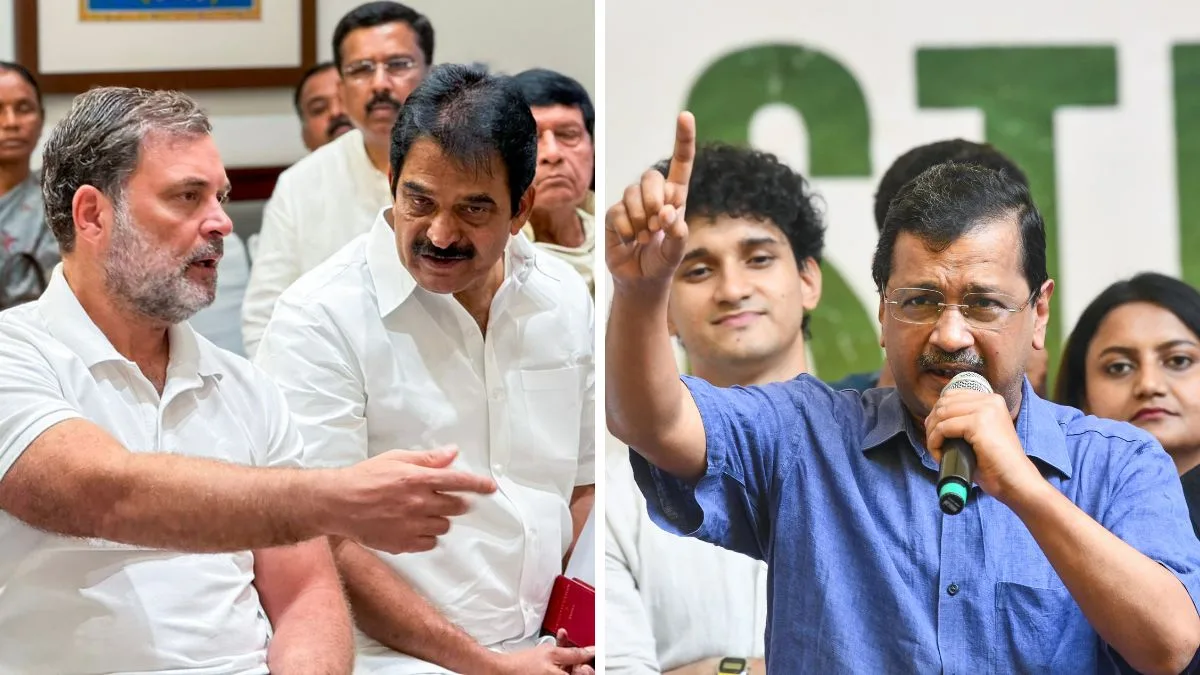
Referring to developments in Parliament, Khera claimed that the Leader of the Opposition was being “forcibly stopped” from raising the issue. He alleged that Prime Minister Narendra Modi was aware that Rahul Gandhi knew the circumstances under which the agreement was reached, which he described as being driven by pressure and coercion.
Separately, in a post on X, Congress general secretary Jairam Ramesh echoed concerns, particularly over the impact on agriculture. He said the Commerce Minister’s defence of the deal from the farmers’ perspective was “too clever by half.”
Ramesh flagged references to unspecified “additional products” in official statements, calling them “far too open-ended” and indicative of hidden clauses. He questioned assurances about addressing “long-standing barriers” to US food and agricultural exports, asking whether this implied easing restrictions on genetically modified (GM) crops and dairy products.
He also raised concerns about imports of distillers’ dried grains with solubles (DDGS), noting that it is derived from GM corn. “This is nothing but a backdoor entry,” Ramesh said, warning that lakhs of soybean farmers in Maharashtra, Madhya Pradesh and Rajasthan could be adversely affected by imports of DDGS and soybean oil.
“There will undoubtedly be more concerns as fuller details are revealed,” Ramesh said.
The Congress has demanded greater transparency from the government, insisting that Parliament and the public be taken fully into confidence on what it describes as one of the most consequential trade decisions in recent years.