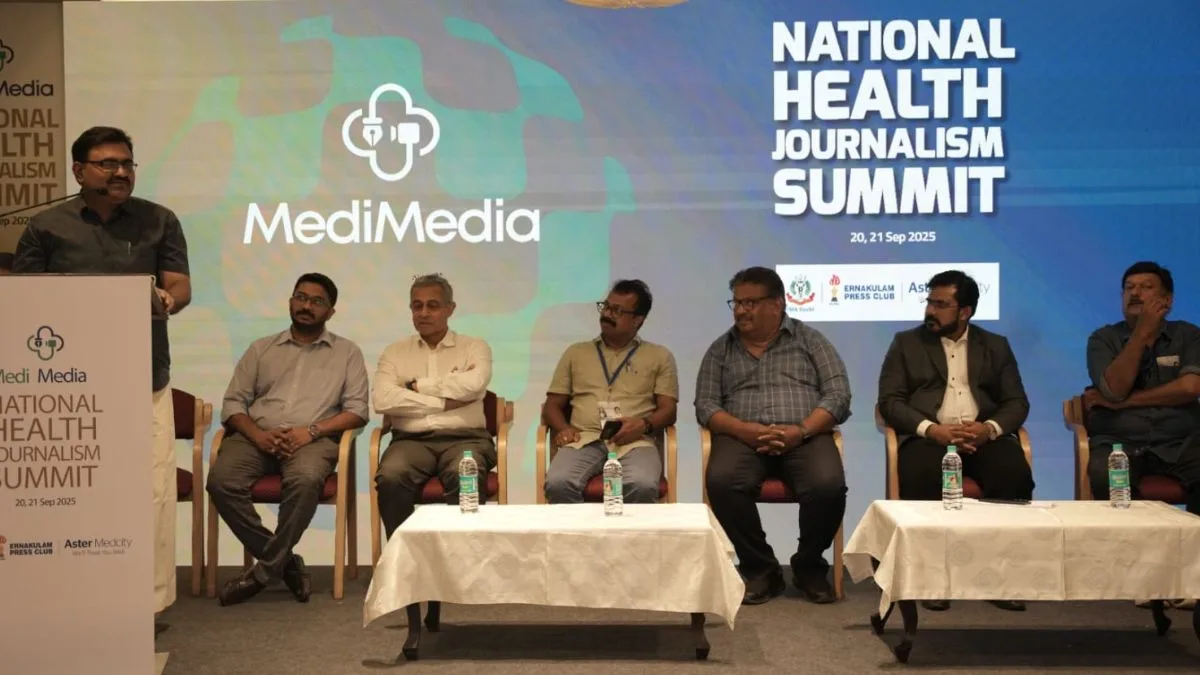
There is an urgent need for a collaborative approach between the medical fraternity and the media for correct health information to be disseminated to the general public, a recent national conference on health journalism held here has concluded.
While it is imperative for the media to report factually correct information in simple layman’s language, it is up to the medical fraternity to provide that information, participants at a two-day “Medi-Media” National Health Journalism Summit, jointly organised by Aster Medcity, Ernakulam Press Club, and the Indian Medical Association (IMA) Kochi Chapter on 20-21 September.
Advertisement
Emphasising the importance of health reporting and discussing critical issues and the future of the healthcare sector, the summit saw the presence of 30 journalists from across the country in dialogue with members of the medical and legal fraternity.
Advertisement
“The goal of the National Health Journalism Summit is to initiate and develop a dialogue around the growing interest in healthcare by bringing together experts from the media, medical, and legal sectors,” said Dr Nalanda Jayadev, CEO of Aster Medcity.
The media has often been charged with reporting “factually incorrect information” or “hearsay information”. At the same time, the medical fraternity, including doctors and hospital administration, has been held responsible for not sharing information, often on the grounds of protecting patient privacy.
Inaugurating the summit, Justice Devan Ramachandran of the High Court of Kerala, said health journalism bridges the gap between ordinary people and the medical community. He said, “It is through the media that complex information in the field of medicine can be made easily understandable to the general public. Health journalism bridges the gap between ordinary people and the medical community.”
Speaking from the perspective of an ordinary person, Justice Ramachandran said, “We want to be healthy, but don’t want to do anything for it. What do we do? We search for information. This is where medical journalism plays an important role, in the days to come and in the days we are seeing. Particularly, after the pandemic, we have seen that the way the world has changed. The challenges are also very different from what we have seen a few years ago. As ordinary citizens, we are very confused. This is why I believe medical journalism is a specialised niche.” Medical journalism, Justice Ramachandran added, requires a lot of research and thought, and it is not something that can be taken lightly.
Noting that there is a thin line between advocacy, propaganda, and information in the medical sector, Dr A Vani Kesari, from the School of Legal Studies, CUSAT, Kochi, said information must be fact-based. When ads masquerade as information and propaganda is conducted through influencers, that is when it becomes risky. “This is where media literacy plays a role,” Dr Kesari said, adding that the regulatory landscape has several laws.
Media personnel noted that while health and medical reporters need to make a clear distinction between research and fact-finding, it was also important for them to have access to information. They look for information in medical journals, peer reviews, expert opinions and surveys. But doctors must give them information that the public needs. “Crisis reporting must be integrated with journalism courses,” said Dr Mohammad Asheel, former Executive Director, NIPMR, Kerala Social Security Mission.
Acknowledging the exemplary role played by the media during the COVID-19 pandemic, terming it a prime example of the importance of health reporting in the healthcare sector, the summit noted that such collaborative efforts are highly essential in the future as well. The critical role played by the media during the pandemic was cited as an example of how journalism contributes to healthcare delivery.
The summit evaluated that Artificial intelligence can have a major impact on patient treatment and may help reduce treatment costs in the future. However, the summit opined that AI cannot replace the human touch and care provided by healthcare workers. In this context, Dr Jiku Jose, CEO of Scire Science, said, “It’s really important for the media to be part of science and has an important role to play.”
Participants at the summit highlighted the importance of the doctor community and journalists working together to prevent the spread of misinformation and information overload in the times to come. Kochi Mayor M Anil Kumar, underlined in his valedictory address, the importance of health reporting in shaping public awareness.
Advertisement