Ethics bypassed
Reform UK leader Nigel Farage has made an unmistakably political calculation. Rather than allow a parliamentary standards investigation to define his future, he has chosen to put himself before the electorate first.
Addressing the 7th Rajasthan Energy Summit here on Thursday, Hickling described the India–UK Vision 2035 as a cornerstone of bilateral cooperation in the energy sector.




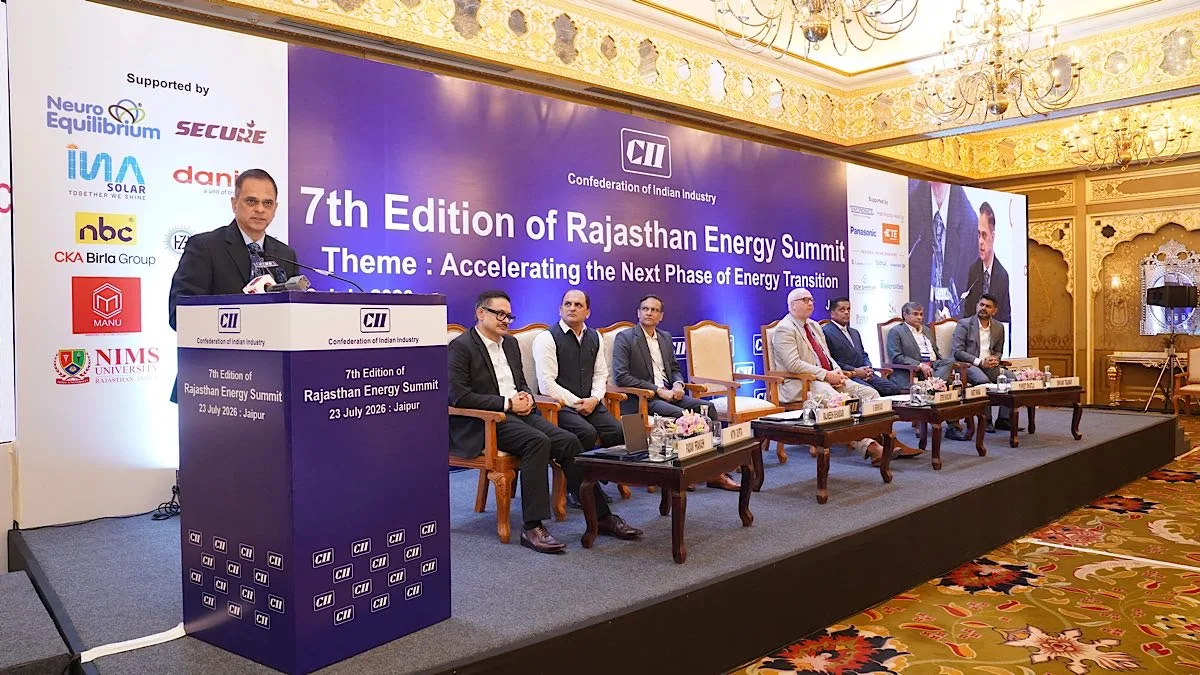
Photo:SNS
Britain’s Deputy High Commissioner in India, Steve Hickling, has lauded the India–UK Comprehensive Economic and Trade Agreement (CETA) 2025 as a new chapter in bilateral relations that will provide a comprehensive economic framework to deepen cooperation in renewable energy and other sectors.
Addressing the 7th Rajasthan Energy Summit here on Thursday, Hickling described the India–UK Vision 2035 as a cornerstone of bilateral cooperation in the energy sector.
Advertisement
He praised India’s journey in renewable energy—from becoming a global leader in solar deployment to rapidly expanding wind energy, green hydrogen and smart, resilient infrastructure.
Advertisement
He said, “The signing of the CETA in 2025 marks the beginning of a new chapter in bilateral relations between the two nations. More than a trade agreement, it provides a comprehensive economic framework to deepen cooperation across renewable energy, green manufacturing, infrastructure, technology and investment.”
“Accordingly, the India–UK Vision 2035 recognises energy cooperation as a cornerstone of bilateral cooperation,” the British diplomat said, adding that both countries share a common vision of building energy systems that are resilient, affordable and low-carbon while advancing energy security and economic growth.
Hailing India’s progress and achievements in the energy sector, he said, “India’s journey in renewable energy—from becoming a global leader in solar deployment to rapidly expanding wind energy, green hydrogen and smart, resilient infrastructure—offers immense opportunities for collaboration in innovation, technology, finance and the clean energy transition.”
He added, “As we move forward, the challenge is no longer simply generating clean energy, but integrating it into our power systems in a manner that is reliable, affordable and accessible to all.”
The summit, on the theme of “Accelerating the Next Phase of Energy Transition,” was organised by the Confederation of Indian Industry (CII), Rajasthan.
Announcing Rajasthan’s preparedness to take a long leap in the energy sector, state Chief Secretary V. Srinivas said, “Rajasthan stands at the forefront of building a future-ready energy system.”
He said Rajasthan has emerged as one of India’s leading energy states under the leadership of Chief Minister Bhajan Lal Sharma, with a clear focus on building a self-reliant, future-ready energy ecosystem aligned with the Viksit Rajasthan @2047 vision.
The state’s strategy goes beyond increasing generation capacity to strengthening transmission, distribution, energy storage, and grid resilience.
Furthermore, Rajasthan is also the first state in the country to sign a formal action framework to accelerate the state’s transition towards clean energy. The state currently has more than 42 GW of installed solar capacity, the highest among Indian states, while its total clean energy capacity has reached nearly 48 GW, Srinivas said.
The Chief Secretary further said that the state’s energy policy recognises electricity not merely as infrastructure, but as an enabler of agricultural resilience, rural livelihoods, industrial growth, and employment generation.
Chairman and Managing Director, Rajasthan Renewable Energy Corporation, Rohit Gupta, said India now has the world’s third-largest installed renewable energy capacity, driven largely by strong private sector participation in both manufacturing and deployment.
On the occasion, Managing Director, GE Power India Limited and Business Leader – Steam Power Services, India, GE Vernova, Puneet Bhatla said India is the world’s third-largest energy consumer and the third-largest greenhouse gas emitter, reflecting the scale of its growing economy and energy demand.
He said that the need of the hour is accelerated modernisation, clear efficiency benchmarks and enabling green finance to strengthen the transition while maintaining grid stability and supporting future energy demand.
Chairman of CII Rajasthan and Managing Director of NeuroEqilibrium Diagnostic Systems Limited, Rajneesh Bhandari, delivered the welcome note. Vice Chairman of CII Rajasthan and Group CEO of Secure Meters Limited, Suket Singhal, and Convener of the ClI Rajasthan Panel on Energy and Water and Managing Director of Danish Power Ltd, Shivam Talwar, also spoke.
Advertisement