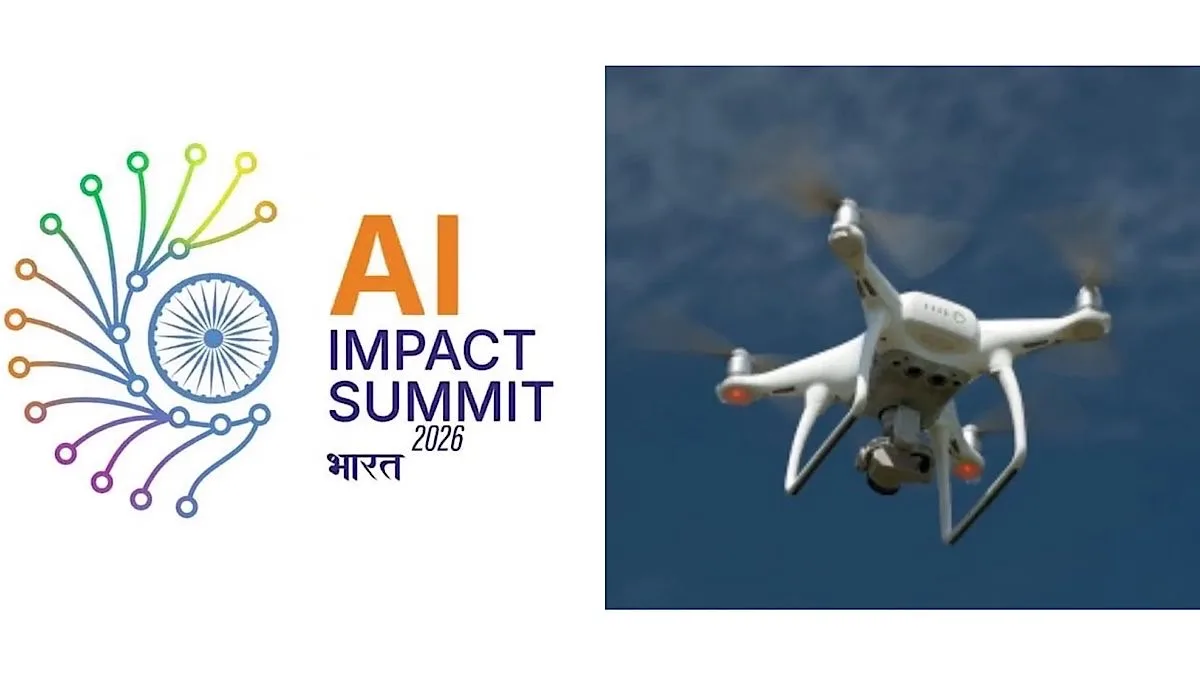
Amid cutting-edge innovations on display at the India AI Impact Summit 2026, a team of young engineers from Lovely Professional University unveiled ‘Vritra’, an AI-enabled vertical take-off and landing (VTOL) drone developed in collaboration with the Indian Army and currently deployed in active service.
Representing the university, Mohammad Toyib, a third-year B.Tech Aerospace student, said the project was fully funded by the Army and built to meet precise operational requirements.
Advertisement
“The name of our project is Vritra. It is an AI-enabled VTOL drone developed for the Indian Army and is currently in service at the Jalandhar Base under Vajra 11 Corps,” he said.
Designed to address tactical and logistical needs, Vritra can carry a payload of up to 9 kilograms, operate within a 25-30 kilometre range, and remain airborne for approximately 1.2 hours. Equipped with thermal and infrared cameras, the drone enables advanced surveillance operations across diverse terrains and challenging conditions.
According to the team, the drone has a dual-use capability. Apart from intelligence, surveillance and reconnaissance (ISR) missions, it can transport critical supplies including medical kits, emergency aid and even ammunition to forward locations.
The VTOL configuration allows it to take off and land vertically, eliminating the need for a runway and enhancing its operational flexibility.
Toyib said the development team spent nearly two months working closely with Army officials in Jalandhar Base to design and assemble the drone in line with specific constraints laid out by defence authorities.
Highlighting the technical challenges, team member Noman Aslam Khan said the Army had defined strict parameters, including a mandatory 9 kg payload capacity and an operational range of up to 30 kilometres.
“We had to design the drone around these constraints. From size and structural configuration to aerofoil design and endurance optimisation, several technical aspects had to be carefully engineered,” he said.
The multidisciplinary team comprised students from Aerospace Engineering, Computer Science Engineering, and Electrical Engineering, reflecting an integrated approach combining aerodynamics, AI systems, avionics and electrical design.
Beyond defence applications, the developers see significant potential in disaster management and humanitarian relief. With its thermal imaging and autonomous capabilities, Vritra can help detect survivors during floods or earthquakes and deliver medical supplies directly to affected areas.
As India accelerates its push towards indigenous defence innovation and AI-driven technologies, projects like Vritra highlight the expanding role of academic institutions in advancing strategic capability and humanitarian response through advanced engineering solutions.