Prime Minister Narendra Modi on Wednesday released the 21st installment of the Pradhan Mantri Kisan Samman Nidhi (PM-KISAN) Yojana into the accounts of farmers across the country from Coimbatore, Tamil Nadu. On this occasion, Rs 316.38 crore was directly transferred to the accounts of 15.82 lakh farmers in Haryana.
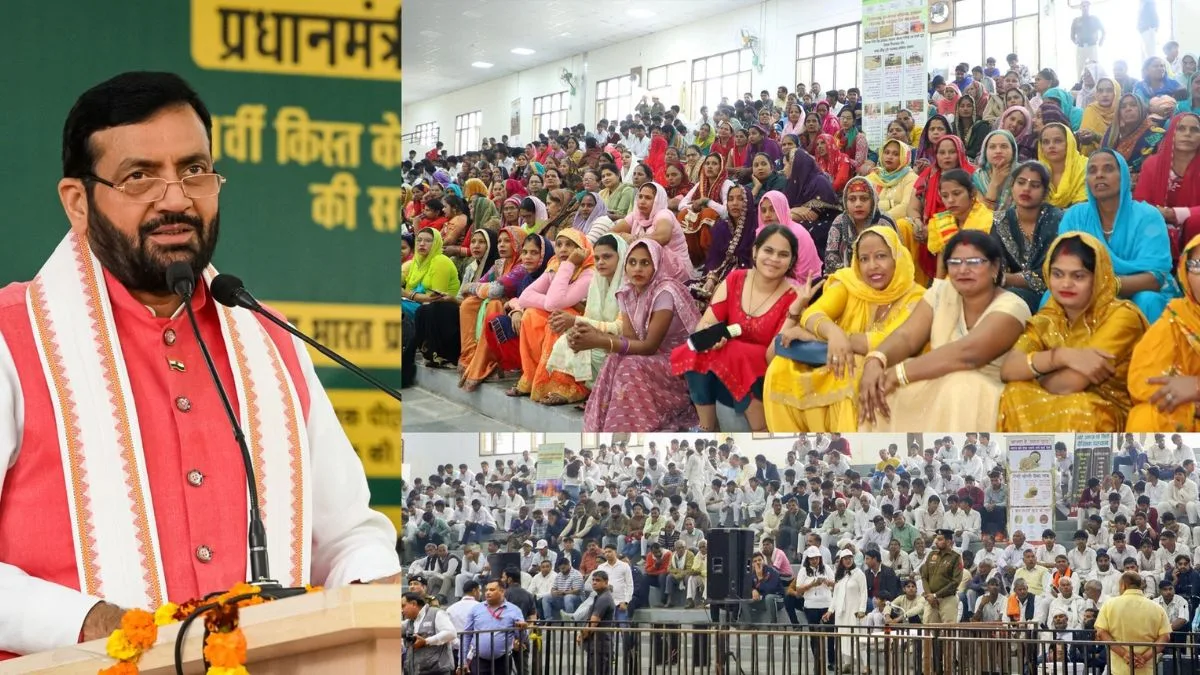
A state-level function was organized in Palwal district, where Haryana Chief Minister Nayab Singh Saini attended as the chief guest. Similar programs were held across all districts, attended by Cabinet Ministers, State Ministers, and Members of Parliament. The Prime Minister’s address was broadcast live during the events.
Advertisement
Expressing gratitude to the Prime Minister on behalf of the state’s farmers, the Chief Minister stated that Rs 14.86 crore has been credited today to the bank accounts of 74,299 farmers in Palwal district. With this 21st installment, a total of Rs 7,233.74 crore has been disbursed to Haryana farmers under the PM-KISAN scheme so far.
In his address, Chief Minister Nayab Singh Saini highlighted that Prime Minister Narendra Modi is consistently working to empower farmers and enhance their prosperity. He urged farmers to move beyond traditional farming, focus on value-added crops, establish farm processing units, adopt the farm-to-fork model, and promote agri-tourism and branding.
Nayab Singh Saini said that Prime Minister Modi has emphasized four key pillars to achieve the vision of a developed India by 2047- farmers, the poor, women and youth. He highlighted that the prosperity of farmers—the first pillar—is crucial to realizing this vision.
“To achieve this, Haryana is continuously working to ensure the welfare of farmers and make agriculture a profitable sector. Under the visionary leadership of Prime Minister Narendra Modi, Haryana is progressing rapidly towards the goal of a “Developed India – Developed Haryana.”
He added that by the year 2047, when India celebrates the centenary of its Independence, farmers will be self-reliant, water and environment conscious, digitally empowered, connected to global markets and a center for high-quality and branded produce.
Referring to the various schemes implemented for farmer welfare, the Chief Minister said that under the Prime Minister’s leadership, farmers have become the center of national policy. While the state promotes natural farming, the government is also encouraging horticultural crops as an alternative to traditional crops to boost fruit and vegetable cultivation.
He informed that the incentive under the Stubble Incentive Scheme has been increased from Rs 1,000 to Rs 1,200 per acre. Under the Bhavantar Bharpai Yojana, designed to protect horticultural farmers from market fluctuations, assistance totalling Rs 135 crore has been directly transferred to the bank accounts of about 30,000 farmers over the last 11 years.
The Chief Minister further said that Haryana is the first state in India where all crops are procured by the government at Minimum Support Price (MSP), and payments are made to farmers within 48 hours.
He added that today’s youth are adopting farming as an innovation-driven and entrepreneurial activity, and that through digital data systems, farmers can now access scheme benefits quickly, transparently and easily.
Addressing the event, Haryana Public Works Minister Ranbir Gangwa said that today, the Prime Minister has released crores of rupees into the accounts of farmers as the 21st installment. Under the Pradhan Mantri Kisan Samman Nidhi (PM-KISAN) Yojana, farmers receive financial assistance of Rs 6,000 per year.
He further said that, under the Prime Minister’s leadership, numerous key schemes are being implemented for the benefit of farmers, enabling farmers across the country to directly reap their benefits.