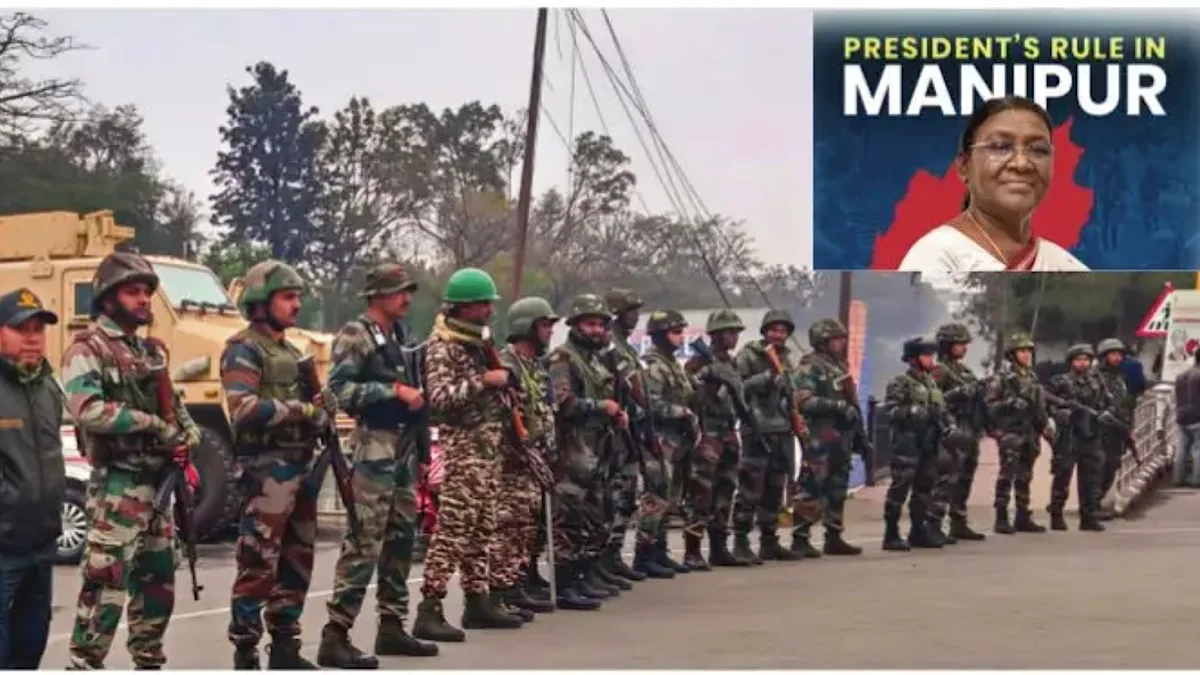
The imposition of President’s Rule in Manipur on 13 February, 2025, placing the 12th Manipur Legislative Assembly under suspended animation, stands among the most consequential constitutional interventions in the state’s political history since its merger with India. Unlike many earlier invocations of Article 356, this was not a response to routine political instability, legislative deadlock, or the collapse of a coalition.
It followed a prolonged and violent ethnic conflict that systematically eroded the authority of the elected government, fractured civil administration, and rendered normal governance virtually impossible. Nearly a year later, Manipur remains suspended in political limbo. The state is neither governed by an elected government nor moving decisively towards democratic restoration. The Assembly has not been dissolved, and the Bharatiya Janata Party continues to command a numerical majority within it. Yet all executive authority rests with the BJP-led Central Government, exercised through the Governor and the Union Ministry of Home Affairs. This unusual constitutional arrangement – a retained majority legislature without power and an extended President’s Rule – raises questions that go far beyond Manipur.
Advertisement
Is this merely a tactical pause to allow peace to return? Is it political insurance to protect the ruling party from future risk? Or does it reflect a deeper strategic design shaped by electoral calculations, security priorities, and geopolitical considerations? These questions became sharper following a closed-door meeting on 14 December, 2025, when BJP legislators from Manipur were summoned to the party headquarters in New Delhi. Senior party leaders, including BL Santhosh and Sambit Patra, directed the MLAs to prioritise peace, ensure free movement, and visibly engage across ethnic lines. Publicly, the BJP described the meeting as focusing on “peace and progress,” while privately ruling out any immediate restoration of an elected government. The symbolism of the meeting was unmistakable, but so was the ambiguity it left behind.
At the heart of this moment lies a fundamental contradiction that remains insufficiently confronted: how can MLAs of a suspended Assembly be expected to bring peace when the Central Government itself is directly ruling Manipur under President’s Rule? Constitutionally, keeping the Assembly under suspended animation rather than dissolving it preserves the option of restoring a government without fresh elections. Politically, however, this choice carries deeper implications. Suspension serves as a powerful political instrument for the ruling party at the Centre. It discourages defections by keeping alive the promise ~ explicit or implied ~ of a return to power, ensuring party discipline among MLAs who might otherwise drift or defect. Dissolution would introduce uncertainty and weaken internal cohesion.
Suspension also defers accountability. Under President’s Rule, governance failures ~ whether in law and order, humanitarian relief, displacement management, or administrative paralysis ~ are formally borne by the Union rather than by a party-led state government. This insulation is particularly significant when the same party governs both at the Centre and would otherwise govern the state. At the same time, suspension creates a holding pattern that allows the Centre to wait out volatility. The violence that erupted on 3 May 2023, was neither episodic nor easily containable. Keeping the Assembly in suspended animation enables selective intervention without committing to a political arrangement that might collapse under renewed pressure. The BJP today confronts a paradox in Manipur. It possesses numerical strength in the Assembly without effective political control, and it exercises formal authority without democratic legitimacy. Restoring a BJP government prematurely would expose the party to immense risk.
If such a government were to fail again – administratively, politically, or morally – the consequences would be severe. In Manipur, it would further erode public trust ahead of the 2027 Assembly election. Nationally, it would damage the party during the crucial 2026 electoral cycle, when Assembly elections are due in Assam, West Bengal, Tamil Nadu, Kerala, and Puducherry. Unlike Manipur, these states carry far greater electoral weight. Images of renewed violence, administrative breakdown, or moral failure in Manipur under a restored BJP government would quickly be weaponised by political opponents elsewhere. The Centre’s reluctance to restore an elected government, therefore, reflects electoral calculation rather than indecision or disengagement.
The most striking contradiction in the present arrangement is the role assigned to Manipur’s MLAs. Under the President’s Rule, they possess no executive authority. They cannot direct the police or security forces, reopen highways, dismantle buffer zones, oversee arms recovery, implement rehabilitation for internally displaced persons, or allocate resources. Law and order, intelligence operations, security deployment, and administrative control lie entirely with the Centre. Yet these same MLAs are being instructed to restore peace, ensure free movement, and set examples by travelling across ethnic divides. This expectation is structurally incoherent. Peace in Manipur today is not merely a matter of persuasion or symbolism.
It depends on decisions regarding buffer zones, neutral policing, highway access, arms recovery, and engagement with armed groups – areas wholly beyond the reach of suspended legislators. Asking MLAs to travel into each other’s areas without addressing these structural constraints risks reducing peace-building to performative gestures rather than substantive change. The result is asymmetric accountability: the Centre governs without fully owning outcomes, while MLAs are expected to persuade without power. This is neither cooperative federalism nor shared responsibility, but a carefully calibrated imbalance. The emphasis on MLA visibility also points to another dimension of the strategy: peace as performance. The BJP recognises that peace imposed solely through central authority risks being perceived as coercive.
Keeping MLAs visible – issuing appeals, crossing ethnic lines, staging gestures of reconciliation – creates an image of local ownership and continuity. This serves political objectives by framing peace as organic, preparing ground for a future government, and allowing selective attribution of success or failure. Yet symbolism cannot substitute for structural transformation. Communities living amid displacement, restricted movement, and de facto segregation are unlikely to be persuaded by optics alone. Without dismantling buffer zones, restoring genuine mobility, ensuring neutral security, and rebuilding trust in institutions, peace risks becoming an optical threshold – just enough stability to justify delay, but not enough to prevent relapse.
A growing concern within Manipur’s public discourse is that President’s Rule itself has evolved from a temporary exception into an extended governance model. From the Centre’s perspective, prolonged central rule offers direct administrative control, unmediated deployment of security forces, freedom from local political constraints, and flexibility in border and security management. This is particularly relevant given Manipur’s strategic location along the Indo–Myanmar border and the instability in Myanmar. Yet Article 356 was never intended to substitute democratic governance indefinitely. Normalising extended President’s Rule risks hollowing out federalism and setting dangerous precedents for other conflict-affected regions.
Within Manipur, narratives have also emerged that view prolonged central rule as part of a proxy strategy to weaken Meitei-led insurgent structures. Whether empirically provable or not, the persistence of such perceptions matters. When communities believe constitutional mechanisms are being selectively deployed against them, alienation deepens and reconciliation becomes harder. Manipur’s political fate cannot be separated from the BJP’s broader electoral map. The party governs in Assam, seeks expansion in West Bengal, struggles for relevance in Tamil Nadu and Kerala, and supports an alliance government in Puducherry.
A destabilised Manipur risks becoming a national embarrassment during this cycle. Conversely, Manipur kept under managed stasis – neither collapsing nor resolving – minimises immediate electoral exposure. This calculus reflects the reality that national parties often prioritise national risks over regional aspirations, especially where electoral weight is limited. The central dilemma remains unresolved: should the Centre resolve the crisis first and then restore an elected government, or restore a government to claim political ownership of peace? Both options carry risks. For now, the Centre appears to have chosen delay, hoping that time, security management, and incremental normalisation will create safer conditions for political transition.
Legally, the suspension of the Manipur Assembly may be defensible. Politically, its prolonged continuation is corrosive. Democracy is not only about elections; it is about accountability, participation, and trust. Every additional month of suspended democracy widens the distance between the state and its citizens and weakens constitutional politics. Peace cannot be outsourced to the powerless. If the Central Government believes peace is achievable under President’s Rule, it must own that responsibility fully and transparently. If peace requires political leadership, meaningful authority must be restored to elected representatives. Anything in between risks turning Manipur into a laboratory of managed instability – stable enough to avoid embarrassment, unstable enough to avoid accountability. Manipur deserves more than symbolism and suspension. It deserves governance with responsibility, power with accountability, and peace rooted in democratic legitimacy.
(VIEWS ARE PERSONAL TO THE AUTHOR. THE WRITER IS A POLITICAL ANALYST, PEACE PRACTITIONER AND EXECUTIVE EDITOR OF THE IMPHAL REVIEW OF ARTS AND POLITICS. HE WRITES ON GOVERNANCE, CONFLICT, AND PUBLIC POLICY IN NORTH-EAST INDIA)