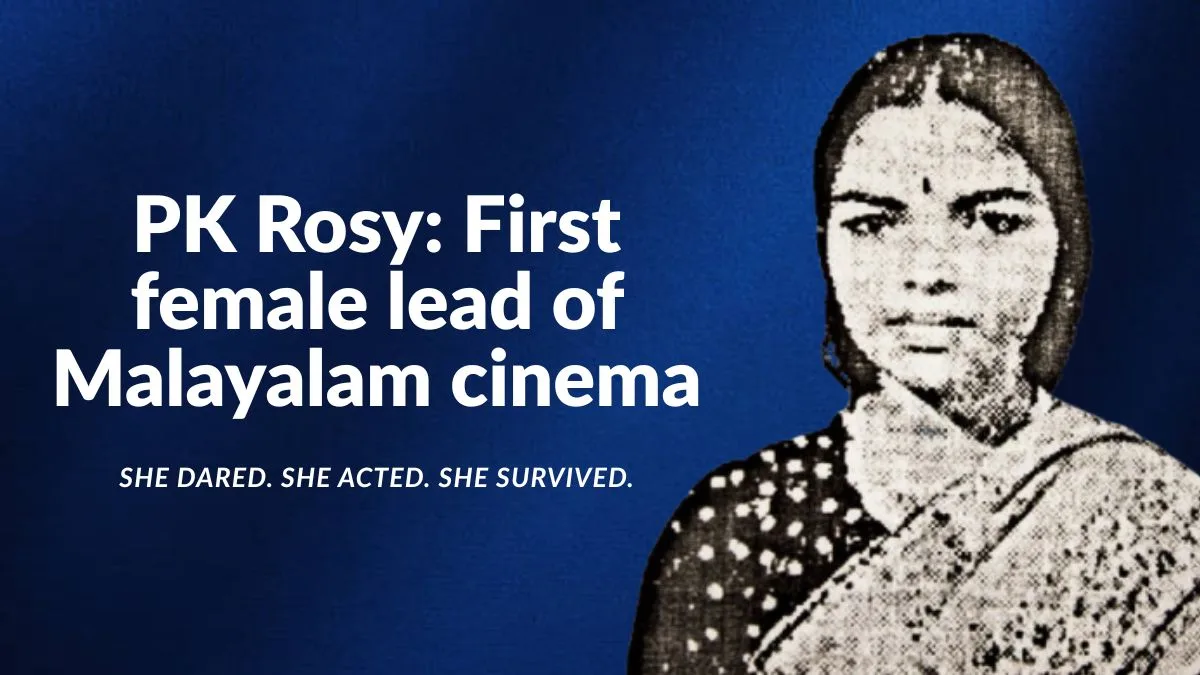
Imagine stepping into a cinema hall in the 1920s. The lights dimming. The projector rolling. And there on the silver screen is a young woman daring to do what no one thought she could. But this wasn’t just any woman. This was PK Rosy, born Rajamma, a girl from one of the lowest castes in Kerala, who became the first female lead in Malayalam cinema. Her story is one of courage, heartbreak, scandal, and erasure. The story has almost vanished from history, only to be reclaimed decades later.
A girl born into caste constraints
PK Rosy entered the world on 10 February 1903 in Trivandrum (now Thiruvananthapuram), in the princely state of Travancore. Born as Rajamma in Pulaya family, her early life was anything but easy.
Advertisement
The Pulaya community was considered one of the lowest castes and was treated as slaves. They were grass cutters by occupation, often sold along with land and punished for any ‘wrongdoing’.
Advertisement
Yet from young age, Rajamma showed a spark that set her apart. She was curious, lively, and drawn to the arts. While most girls in her community were confined to domestic labour, Rajamma found a passion for performing.
Also Read: Rituparno Ghosh: From Tagore’s pages to Satyajit Ray’s lens, how a storyteller made Calcutta breathe cinema
Her uncle, a local performing artist, became her earliest mentor. With his encouragement, she began participating in local plays defying the societal norms that frowned upon women, especially Dalit women, taking to stage.
Her family’s religion and names add another layer of intrigue to her story. Some records suggest her family had converted to Christianity. Others insist they remained Hindu. Her father may have converted temporarily to give her the chance to study in a church school, and her name was reportedly changed from Rajamma to Rosy for her film role.
From stage to spotlight
Before the arrival of cinema in Kerala, theatre was the main form of entertainment. And theatre, especially performances based on Hindu mythology, was male-dominated. Women rarely performed. Dalit women performers were unheard of.
Rajamma however had talent and determination that could not be ignored.
She quickly gained recognition for her performances in local drama troupes. One of her most notable early works was Kakkirasi (Kaakarashy). It was dance drama based on Hindu mythology.
Traditionally only men performed in these productions. But Rajamma’s performance broke the mold. Her presence on stage challenged gender norms and caste hierarchies. This made her small but rising star in her community and beyond.
Competing troupes sought her out. The Kakkarasi drama troupe and the Rajah Party Drama Troupe vied for her talent. They were eager to feature the young actress who drew audiences with her skill. This period was crucial in building her confidence and experience preparing her for even bigger stage: silver screen.
Entering Malayalam cinema: Vigathakumaran
In 1928, the ambitious filmmaker JC Daniel was preparing the first Malayalam-language film, Vigathakumaran (The Lost Child). Daniel’s original choice for the female lead, a woman named Lana from Mumbai, didn’t work out.
This was when Rajamma, soon to be Rosy, was offered the role of Sarojini, an upper-caste Nair woman.
Imagine the ‘audacity’. a Dalit woman portraying an upper-caste character in 1920s Kerala. This casting was revolutionary and would spark one of the first known caste controversies in Indian cinema.
For ten days, Rosy worked tirelessly on set. She would earn five rupees per day. Her performance, dancing and acting in a silent film was earning praise.
Vigathakumaran was more than a movie. It was a social experiment challenging the rigid norms of caste and gender. Yet, when the film premiered, society wasn’t ready to celebrate this daring new actress.
Premiere night chaos
The premiere took place at Capitol Theatre, Trivandrum, in front of a mixed audience that included members of various castes. At first, the audience’s disapproval was quiet. But when it was revealed that the heroine was a Dalit woman portraying a Nair, anger erupted.
A scene in which the hero plucks a flower from Rosy’s hair and kisses it became the flashpoint. Upper-caste spectators unable to tolerate a Dalit woman in such a role reacted violently. Rocks were thrown at the screen. Chaos engulfed the theatre. Mob didn’t stop there. They damaged the theatre and even set fire to Rosy’s house.
Both JC Daniel and Rosy were forced to flee for their lives. Vigathakumaran screenings in other towns like Nagercoil, Kollam, and Alappuzha were attempted, but Daniel’s career was ruined, and the film itself was later lost to history. The reel was destroyed, and with no surviving footage, only a handful of photographs remain as evidence of Rosy’s trailblazing role.
Life after tragedy: Rajammal emerges
After the violence and social ostracism, Rosy disappeared from the public eye. She married a Tamil truck driver Keshavan Pillai and moved to Nagercoil, Tamil Nadu. Then she adopted new name Rajammal. “Ammal” is a respectful suffix used for women in Kerala and Tamil Nadu.
In her new life, she assimilated into upper-caste society raising her children with no knowledge of her Dalit heritage or her stint in cinema.
Rediscovery: Honouring a forgotten pioneer
For decades, both Rosy and Daniel remained unsung heroes of Malayalam cinema. It wasn’t until 1992 that the Kerala government instituted the JC Daniel Award, finally recognising Daniel as the father of Malayalam cinema. Rosy’s recognition came much later.
In 2015, the PK Rosy Smaraka Samithi (PK Rosy Memorial Committee) was established to celebrate her legacy. Her story has since inspired books, documentaries, films. In 2023, Google paid tribute to her 120th birthday with doodle.
To understand Rosy’s story fully, one must grasp societal structure of 1920s Kerala. Caste system was rigid. Dalit communities like Pulayas were at the bottom. Women particularly from marginalised communities were discouraged from public performance. Cinema was emerging. But it was dominated by upper-caste men and ideals.
In this environment, Rosy’s entry into film was rebellion. It was a political and social statement that challenged norms that dictated who could perform, who could be loved on screen, who could occupy public space.
PK Rosy’s life was like a film that never found its reel. Her story almost lost to smoke and silence. Yet its echoes refuse to fade. She was a girl who danced on stage when society told her to stay hidden.
And perhaps that is her greatest scene. One without cameras, without applause, yet eternal; a girl from the margins, who became a heroine for all time.
Advertisement