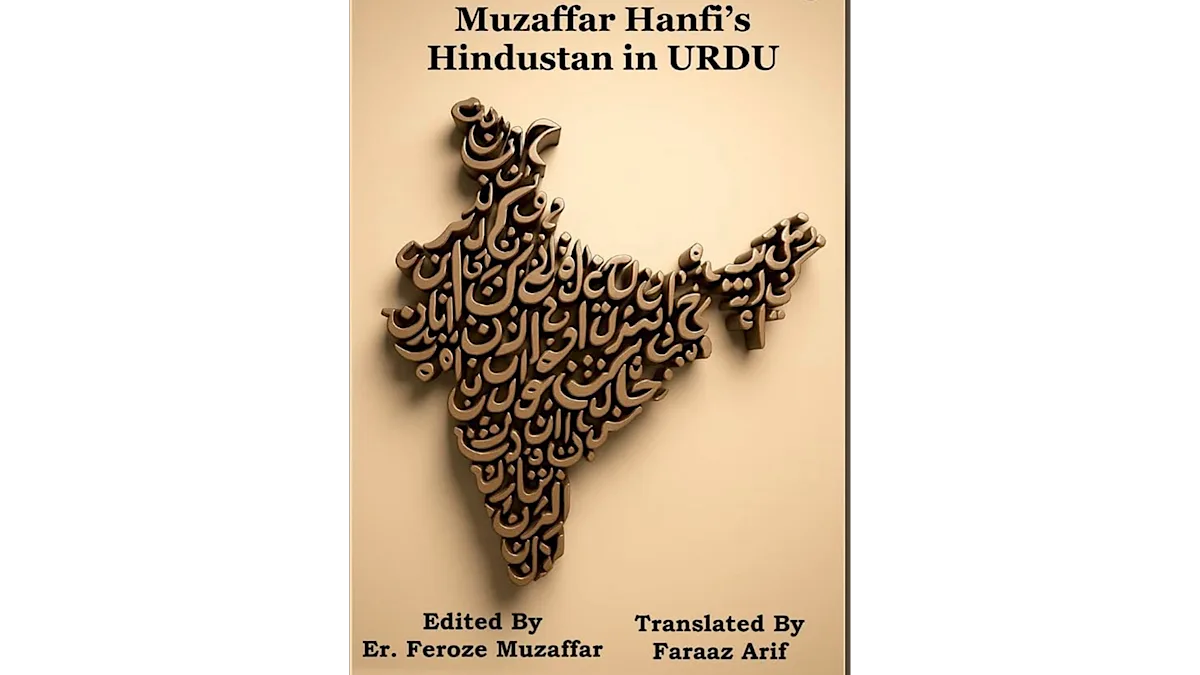
Long confined in popular imagination to the delicate terrains of love and longing, Urdu poetry has often been misread as inward-looking, steeped in intimacy yet distant from the urgencies of the world. Muzaffar Hanfi’s Hindustan in Urdu, edited by Firoz Muzaffar and translated by Faraz Arif from Muzaffar Hanfi’s work, gently unsettles that assumption and reveals a parallel, powerful tradition where verse becomes witness, resistance, and memory. Urdu poetry, as the book reminds us, has always moved alongside history.
Its poets did not merely chronicle personal emotion; they absorbed and articulated the tremors of their time. Long before 1857, they had begun to register the unsettling advance of the East India Company and the slow unravelling of a civilisation. In the melancholic cadences of Mir Taqi Mir, one encounters a Delhi stripped of its splendour, its people displaced and its dignity fractured. His lines do not simply mourn a city; they echo a collective dispossession. In the biting satires of Mirza Sauda, one finds a vivid delineation of cultural decay, while poets like Mushafi speak with startling clarity of economic plunder and loss.
Advertisement
These were not isolated expressions of grief but early articulations of a nascent nationalism, emerging even before organised resistance had taken shape. The legacy extends beyond poetry into action. Figures such as Hasrat Mohani, Maulana Muhammad Ali Johar, Maulana Abul Kalam Azad, Zafar Ali Khan, and Allama Iqbal stand as reminders that Urdu’s literary voices were deeply enmeshed in the freedom struggle itself. What ultimately emerges is a reorientation. Urdu poetry appears not as an escape from reality but as a deeply engaged form, where love for the beloved expands into love for the land, and where language becomes an instrument of awakening