From the minutiae of everyday lives
Subliminal Poems, Radha Chakravarty's debut collection of poetry traces the artistic journey of Chakravarty revealing her mastery of different forms of poetry.
Radha Chakravarty has dedicated her recently published second book of poems In Your Eyes A River to distinguished poet Keki Daruwalla, ‘for believing in me’.




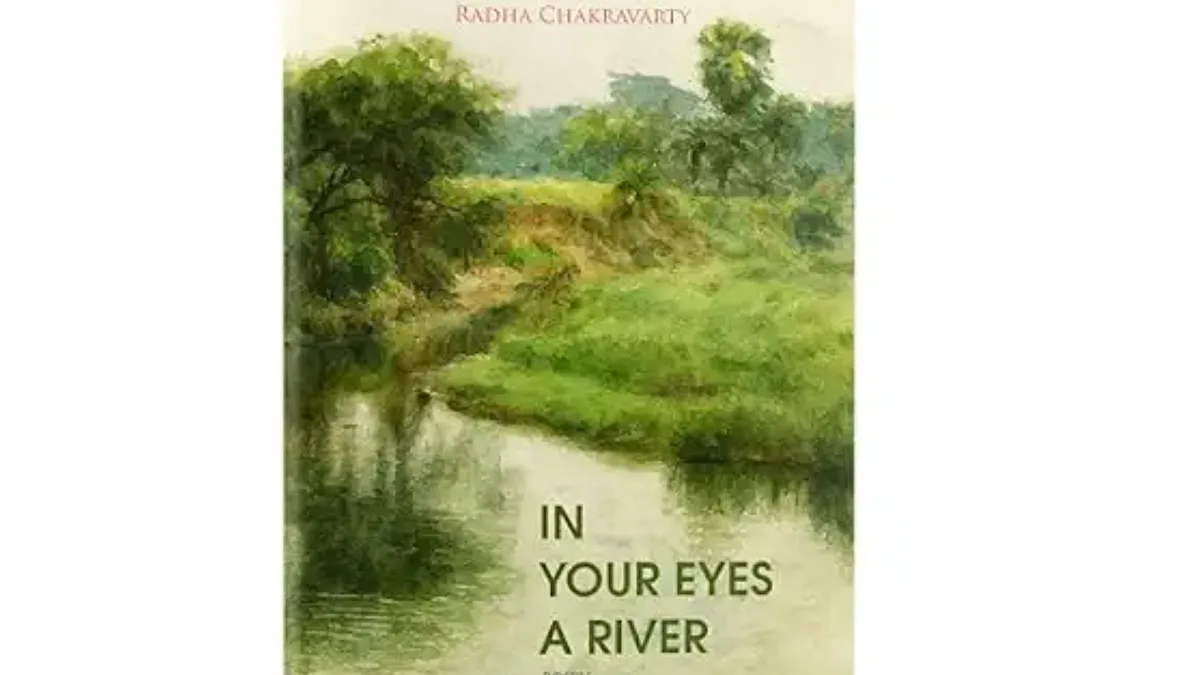
Photo:SNS
Radha Chakravarty has dedicated her recently published second book of poems In Your Eyes A River to distinguished poet Keki Daruwalla, ‘for believing in me’. There can be no better endorsement than this, when a stellar veteran poet encourages a talented younger poet to travel confidently in her poetic journey. The volume is noteworthy as it does not include any prefatory remarks by the poet or any foreword or blurb.
The poet is more than confident that her poems have the ability to reach the minds and hearts of informed readers. Readers are led into a mosaic of competently crafted poetic responses to lived experiences, perceptions, convictions, cerebral and emotional, blending in a tapestry of many hues, creating images that are vivid and yet subtle. Personal memories of loved ones, ancestral homes, parents and grandparents are chronicled with aesthetic grace, skilled use of images and wordplay. The poet skims through the albums stashed away in the recesses of the mind, as memories of events, feelings and perceptions zoom in and prove how relatable these are despite the march of calendar time.
Advertisement
Some of the poems recreate moments of the past blending them with the present through the poet’s personal immersion in her ancestry through the tender reliving of her father’s childhood and adolescence, “ I traverse, now, the trail you took on sunburnt days,” and the poem ends with the telling lines, “I stand face to face with your impossible story, and find at last the missing opening lines of mine.” These are the lines from the title poem, ‘In your Eyes a River’, that weave together moments of hereditary recall of colonial East Bengal in British India.
In another poem, we notice how the ‘unhomed migrants’ ahistorical non-identity is represented so well, even in the title of the poem ‘Driftwood Dreams’, which beautifully expands on this non-belonging. The poem ‘Red Hibiscus’ is an intensely personal poem that is deeply disturbing too, as it describes in Chakravarty’s nuanced style how the loved one, in this case, the poet’s mother, is slowly sinking into dementia and tracks the helplessness of the Alzheimer patient, ‘lost in the forest of forgetting’, eventually becoming completely oblivious, “Slowly, slowly, day by day, how to see, hear, touch, feel and pray.” Again, in the significantly personalised poem, ‘The Old House Remembers’, the ancestral mansion in Shyambazar with its grandfather clock, grand piano, mirrored doors and cavernous kitchen, all these treasured fragments of the tangible creating intangible impressions ‘our very own hell and haven’ are presented as a collage of times past but not forgotten.
Advertisement
The three poems, ‘Grandmother’s Gramophone’, ‘Keys to Lost Secrets’ and ‘Wild’ seem heart-wrenching, as the urgency and intensity expressed in the poet’s intimate implorations to her grandmother and mother, whom she addresses directly, tearing herself away from sombre and mellowed reflections and calling out with impassioned restlessness, “Are you listening to the gramophone too? These tears. Are they yours or mine?”
Similarly, the jingle of the bunch of keys tied to the sari-end and thrown over the shoulder in the poem ‘Keys to Lost Secrets’ is not just sensitive but recreates a haunting moment and sends in resignation as the jingling of the keys fall silent forever. In the poem ‘Wild’, once again traces a going back and forth in time, braiding the past and the present as the voice of the poet confesses a searing sense of loneliness as she battles her way through the complexities of life, yearning for the calming presence of her mother’s touch, recalling the many occasions when her mother combed her unkempt hair.
However, not all poems in Radha Chakravarty’s book revisit intimate familial spaces, expressing a profound sense of loss and longing for deceased family members. Almost breaking free from the languorous moments of recalling the poem, ‘Impossible Question’, begins with this dramatic line, “I am Gargi, ancient Mithila’s pride.” Also, fascinating is the poem, ‘Another Story’ that presents Sita as a voice and identity, rather than a suffering victim. The poem is based on Chandrabati’s Ramayan, which does not hero-worship Rama but presents him as “a fallible man, no hero divine-a demanding brother, an unjust father/, a jealous husband who doubted his wife.”
Among the poems that deal with macro issues, the contrapuntal poem, ‘Blue Gold’ is a powerful poem in which each short line carries incisive force, as it transports the readers from the complacency of cultured, educated middle class and upper middle class lifestyle experiences and responses to the world of the masses, most often neglected, ignored and rarely the subject of poetry. The rhyming couplet sets the mood of the poem, which interrogates and deconstructs the pretensions of empire builders, “ruthless masters brandish whips” for history records how Indigo farming was a tool of oppression and exploitation, “Indigo, colour of peasant’s pain/Neel, the toiling peasant’s bane.” Also, the poem, ‘Wounded Walls’ that critiques the Jallianwala Bagh massacre underscores the fact that such dastardly acts of barbarism are never forgotten, rather they remain in the ecosystem, haunting the present with ‘undead questions.’
There are quite a few poems that inform the readers that the poet has travelled widely, from the spectacular Kanchenjunga in Darjeeling, to watching the red panda in the Darjeeling zoo, Vesuvius in Naples, the Mouth of Truth in Rome, and papyrus parchment in a museum in Egypt. Among such symbols and metaphors of the splendours of natural landscape and the richness of human civilisation, there are poems about a winter without leaves, and the rhetorical question about the desolation that the natural world has been subjected to, through human indifference, so the poet asks where have all the bulbuls gone and in conclusion she asks with innocuous clarity, where have all the poets gone?
Radha Chakravarty’s second book of poems, In Your Eyes a River, does not merely chronicle memorable images of love and longing, loss and pain; the poems are simultaneously deeply personal and yet universal, an enviable poetic skill that will attract admiration. Chakravarty’s poems stand out as they contain the efficacy to resonate in the minds and hearts of diverse readers belonging to diverse geographies and cultures.
The writer is President, Executive Committee, Intercultural Poetry and Performance Library, Kolkata
In Your Eyes A River
By Radha Chakravarty
Hawakal, 2025
Price: Rs 600, 90 pages
Advertisement