Bengal to amend Panchayat law; officials to replace elected heads as signatory authority
The BJP-led state government has repeatedly accused several elected representatives of failing to discharge their administrative responsibilities.
In Kharagpur Sadar, elections are rarely decided by waves alone ~ they are negotiated on the ground, shaped by memory, and often settled by margins small enough to haunt both winners and losers.




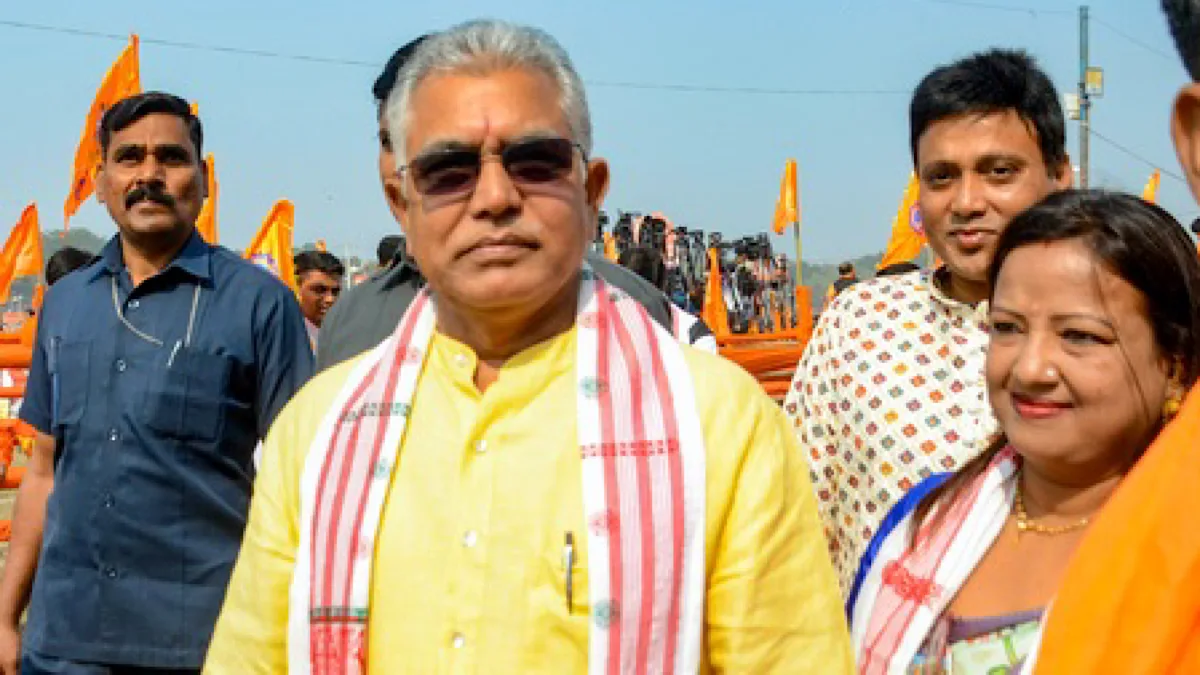
West Bengal, BJP leader Dilip Ghosh
In Kharagpur Sadar, elections are rarely decided by waves alone ~ they are negotiated on the ground, shaped by memory, and often settled by margins small enough to haunt both winners and losers. As the constituency heads to polls on 23 April in the first phase of elections, the political battle here is less about momentum and more about micro-calculations ~ of caste, community, turnout, and now, even the absence of voters.
At the heart of this contest is a high-stakes rematch between Dilip Ghosh of the BJP and Pradip Sarkar of the Trinamul Congress ~ two leaders whose electoral histories in Kharagpur Sadar are deeply intertwined. But beyond the personalities, this election is being shaped by three decisive variables: the impact of the Special Intensive Revision (SIR) of electoral rolls, the constituency’s complex demographic structure, and a persistent disconnect between industrial potential and lived reality.
Advertisement
The single most disruptive factor this time is the deletion of nearly 44,000 names from the electoral roll following the SIR exercise overseen by the Election Commission of India. In a constituency where the 2021 result was decided by just 3,771 votes, this is not a marginal adjustment ~ it is a structural shift.
Advertisement
Political observers say neither the BJP nor the Trinamul Congress can confidently map where these deletions have hit hardest. “If even 10-15 per cent of those removed voters were concentrated in specific pockets, it could overturn booth-level dynamics,” said a local political analyst in Kharagpur. “This election will depend less on swing and more on who manages turnout better among the remaining voters.”
The contest, however, is not strictly bipolar. Communist Party of India (Marxist) candidate Madhusudan Roy and Congress nominee Papiya Chakraborty add a third layer to the race, potentially splitting votes in what is expected to be another tight finish.
Kharagpur Sadar’s political behaviour has rarely mirrored the broader state trend. While Mamata Banerjee led the TMC to a sweeping victory in 2021, this seat went to the BJP ~ continuing its pattern of defying state-level narratives.
The explanation lies partly in its demographic composition. As a railway and industrial town anchored by Kharagpur Junction and IIT Kharagpur, the constituency has a large non-Bengali, migrant-origin population ~ Telugu, Hindi, Marathi, and Odia-speaking communities ~ whose voting preferences often differ from rural Bengal.
“In railway colonies, people talk about jobs, transfers, pensions ~ not local politics,” said S Narayanan, a retired railway employee. “Many here feel national issues matter more, so BJP gets an advantage. But in old Kharagpur and nearby areas, TMC’s local network is stronger.”
This duality creates what political strategists describe as a “split constituency” ~ one where national narratives and local governance compete simultaneously, often neutralising each other.
For the BJP, Ghosh’s return is both a tactical and symbolic move. Having first broken the Congress stronghold in 2016, he remains one of the few leaders with a personal vote base cutting across communities. His campaign has leaned heavily on themes of law and order, migration, and identity politics, while also arguing that alignment with the Centre could accelerate stalled infrastructure projects.
“The people are frustrated. There is no industry growth, no proper jobs,” Ghosh said during a recent campaign, reiterating his claim of a “wave of change.”
The TMC, however, is countering this with a hyper-local strategy centred on Sarkar’s accessibility and organisational reach. Having narrowly lost in 2021, Sarkar’s campaign is focused on booth-level consolidation and welfare delivery narratives.
“Dada ekhane thaken, dekha paoa jai (He lives here, we can reach him),” said Shampa Das, a resident of Malancha. “Vote dileo amader kachhe thaken (Even after elections, he stays connected).”
The Left-Congress alliance, though not seen as frontrunners, could still play spoiler. In a tightly contested seat, even a small vote share shift could alter the final outcome.
Few constituencies embody contradictions like Kharagpur Sadar. It hosts one of India’s premier engineering institutes and critical railway infrastructure, yet struggles with basic civic issues.
Residents repeatedly point to stalled projects, poor drainage, water scarcity, and pollution from nearby sponge iron factories. “Factory thakuk, kintu dhulo aar dhua bondho hok (Let the factories stay, but stop the dust and smoke),” said Salim Khan, a shopkeeper near NH-16.
There is also a growing perception that political fragmentation between state and Centre has slowed development. “Jodi ek party thake, kaaj ta taratari hote pare (If the same party is in power, work may move faster),” said a first-time voter outside Kharagpur College. “Amra development chai, rajneeti na (We want development, not politics).”
Despite changing narratives, the electoral pattern since 2011 remains consistent ~ Kharagpur Sadar swings, but narrowly. No party has managed to dominate it across consecutive elections. Even Ghosh’s 2016 victory, though decisive politically, came with a relatively modest vote share.
This suggests that the 2026 outcome will likely be determined not by a sweeping mandate but by marginal gains ~ booth management, turnout, and the ability to retain core voters while making small inroads into the opponent’s base.
With a reduced voter base, a triangular contest, and deeply localised issues, Kharagpur Sadar stands out as one of the most analytically complex seats in this election.
“Prottekbar bodol hoy, kintu amader jibon bodlay na (Every time the winner changes, but our lives don’t),” said an elderly voter near Gole Bazar.
On 4 May, when results are declared, Kharagpur Sadar may once again swing. But whichever way it goes, the deeper story of this constituency, of shifting loyalties and static problems, is unlikely to change overnight.
Advertisement