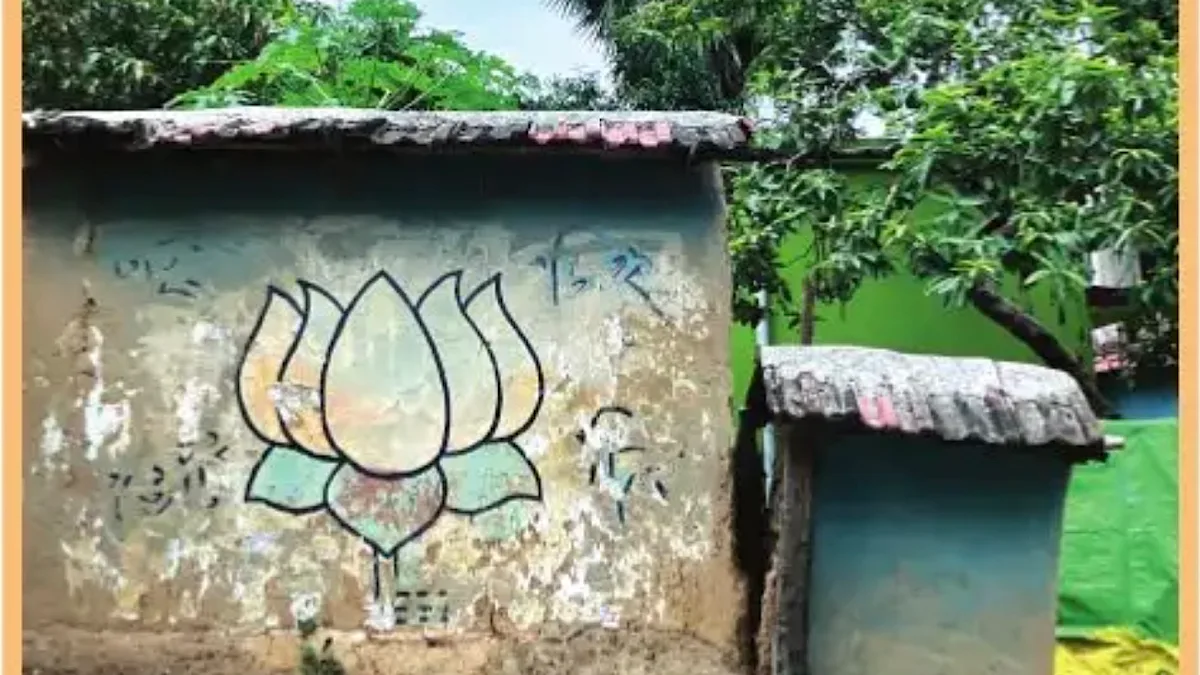
If Lord Rama was banished for a period of fourteen years, His ardent devotees, the Bharatiya Janata Party, has had to wait fifteen years to capture power in West Bengal. And now as chants of “Jai Shri Ram” rend the air, the uncanny synchronicities of our iconic epic, The Ramayana, is unmistakable. “Poriborton” or Change has once again arrived in the land and at the venue of the inauguration of the new state government, Suvendu Adhikari was sworn in as Chief Minister. A wave of happiness and hope swept through the sea of people cheering and chanting.
I recall that day fifteen years ago, when Trinamool came to power in the Assembly elections of 2011. I attended the inauguration ceremony and witnessed the sheer jubilation that permeated the atmosphere. The grassroots party had swept the polls. I was working for a national newsmagazine and had covered Singur and Nandigram, the two “issues” that propelled Didi, as Trinamool party founder Mamata Banerjee was by then being called affectionately by the masses of West Bengal, to the heights of popularity in the state. The then state government (the Communist Party of India, Marxist-led Left Front government) had allotted almost 1000 acres of fertile farmland in Singur (in the outskirts of Kolkata) for the construction of a car factory to Tata Motors (for its Nano factory) and Didi had jumped in to the ‘rescue’ of the farmers who were unwilling to part with their land.
Advertisement
The agitation saw Mamata go on a hunger strike demanding that the acquired land be handed back to the owners and her party set up a makeshift stage in front of the disputed area, which became a hotbed of political discourse with journalists from across the globe, activists from around the country and the state’s civil society all gathering to lend her their support. Nandigram, where the then state government had planned a chemical hub was also a fertile farmland and Didi launched an aggressive agitation on behalf of the villagers of the area. In the tug of war between the state government and Trinamool, which was then in the Opposition, innocent villagers lost lives (in Nandigram the state police had opened fire on unarmed agitators, killing 14 young men and in Singur a young woman was burned to death allegedly by goons associated with the then ruling party).
The incidents sent shockwaves throughout the state and the electorate’s verdict was attributed to the anger of the people, who were already fed up with thirty-four years of the Communist rule. It was the height of anti-incumbency. Anti-incumbency is a word that is once again being used to explain Trinamool’s defeat in these elections. It is a phrase packed with meaning. It is a word loaded with euphemism. Inherent in it is the common person’s collective disillusionment, dismay and disbelief.
The common person’s crushing disappointment. Corruption, extortion and ‘threat to the safety of women’ became the state government’s bane in the end. In an interview Swapan Dasgupta, BJP’s candidate from the coveted Rashbehari constituency, who won the seat, told me, “The general level of corruption, which is actually really extortion, is unbelievable. This has to be dealt with. The amount of housekeeping that we have to do is stupendous.”
Anti-incumbency is a word that is once again being used to explain TrinamoolÊs defeat in these elections. It is a phrase packed with meaning. It is a word loaded with euphemism. Inherent in it is the common personÊs collective disillusionment, dismay and disbelief.
Yet the BJP captures West Bengal was not a cakewalk. For the past decade and a half, the saffron party has been trying to make an entry. While in subsequent elections its numbers had gone up by leaps and bounds (shooting up from only three in the 2016 Assembly elections to 77 in the 2021), power was elusive. Former Bengal BJP Vice President Chandra Kumar Bose attributes this to what he says was “The perception of the party as having a communal image. This was a deterrent for voters in a state like West Bengal which has a secular bent of mind”.
Bose left the party when he felt that his insistence on being ‘more inclusive in terms of religion, caste, etc’ was not adequately paid heed to. He joined the Trinamool in April 2026 though he did not contest the elections. While in the BJP he was given a ticket to run against Mamata Banerjee and was defeated. In the 2026 elections he campaigned for Didi. Bose, who is the grandnephew of Netaji Subhas Chandra Bose points out further that winning West Bengal has always entailed capturing the nearly 30 percent minority vote. The BJP’s endeavor was to try to consolidate the majority vote. Suvendu Adhikari, who after joining the BJP, too had contested Mamata Banerjee twice: in the Assembly elections of 2021 (Nandigram) and 2026 (Bhawanipore) respectively.
He won against her both times. In these elections the role of the Special Intensive Revision of Electoral Rolls (SIR) conducted by the Election Commission played a significant role. BJP leaders and supporters of the party attribute the victory to a number of factors. “First of all, there is the ‘double engine’ factor,” says Dipak Ghosh, a gold shop owner in Rashbehari, who is an out an out BJP supporter and is gloating about Swapan Dasgupta’s victory in his constituency. “Many things get stuck in this state because there is a constant tussle with the Centre. We want to see that changed. Therefore ‘Poriborton’ is good. We really needed this.” That the fray was essentially going to be between the Trinamool and the BJP was a foregone conclusion.
However, this election is seeing the reemergence of two parties which had held power in the state for long periods – the Left and Congress. From virtually eroded in the last elections, each party has gained two seats in Assembly 2026. “Our goal is to try to regain turf,” Adhir Ranjan Chowdhury, Congress leader and former Member of Parliament told me in an interview. He contested from the Baharampur constituency in Murshidabad. CPIM leader Mohammad Selim says that the Left’s agenda is to try to reestablish itself in terms of its ideology. “We have been in power here for three decades,” he tells me in an interview.
“The saffron party has come with sweeping positivity,” says educator Shraddha Oza. “May it bring hope, work and ethics.”
“We understand the pulse of the people. We don’t have any doubts about where we have gone wrong and we have been introspecting. The subsequent elections will determine whether we are on the right track or not. We are always at the command of the people.” No it does not seem like yesterday, as the saying goes, that we saw the Left Front government get uprooted by the grassroots Trinamool. It has been fifteen years. The winds of change that was blowing before the elections of 2011 were blowing before the elections of 2026 too. The electorate’s voice is as hopeful as ever. Says Shraddha Oza, an educator associated with the Ashok Hall Group of Schools who feels that the education system in the state needs attention.
“The saffron party has come with sweeping positivity,” she says. “May it bring hope, work and ethics.” In our interview, Swapan Dasgupta spoke about the education system being in shambles in the state currently and Ms Oza is delighted to know that it is in the BJP’s list of priorities to redress the wrongs. I speak to Anwara Bibi, a vendor, who sells roasted corn at the Lake Market in Kolkata. She is from Baruipur of the South 24 Paraganas District. She says she is happy as long as the party looks after their needs. “I don’t understand all this talk about minority. I am an Indian and whoever forms the government is my government. We are poor people. We don’t think about politics. If our basic needs are met, what more can we ask for.” Her husband who has a stall selling banana leaves in the same area agrees. “The next five years we will see how much they care for us, all of us.”
(The writer is Editor, Features,The Statesman)