A longstanding quest for green steel, besides the growing desperation to contribute to breakthroughs in research and development, together have recently instigated a bunch of scientists and scholars to rush to Australia from Durgapur, Asansol, Dhanbad, Mumbai and Hyderabad.
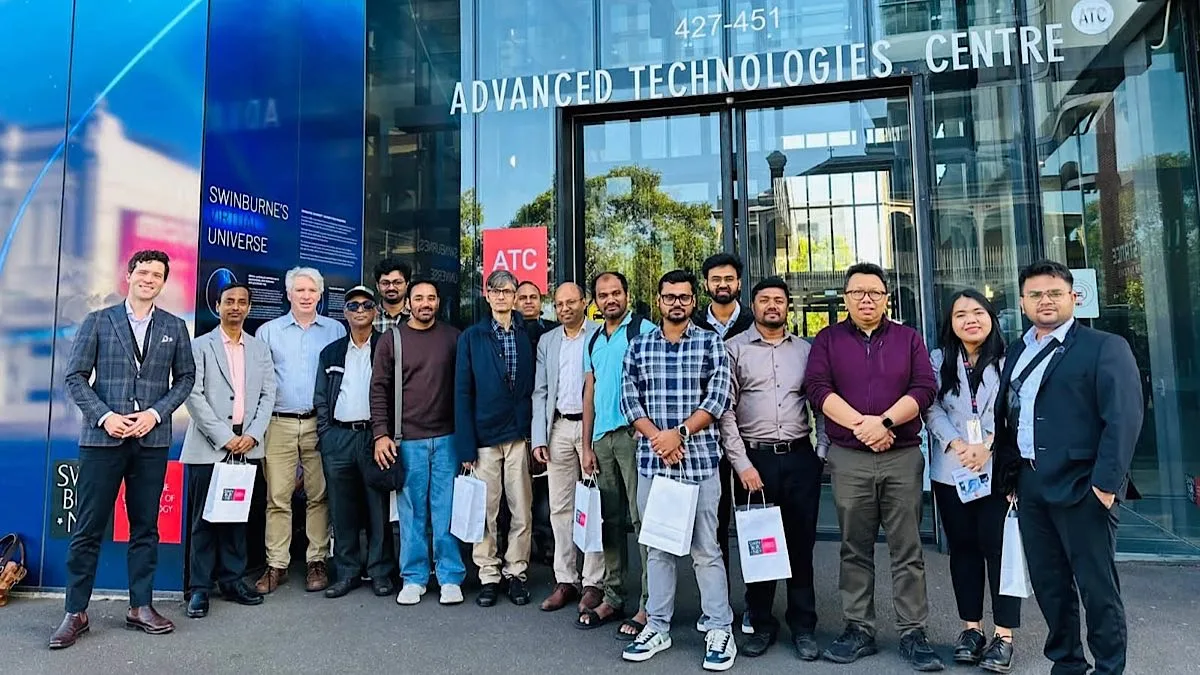
Under the Advanced Green Steel Research Collaboration of India-Australia Minerals Scholar Network (IAMSN), researchers from the National Institute of Technology, Durgapur, Kazi Nazrul Islam University, Asansol and the IITs of Mumbai and Dhanbad have been taking a week-long tour to several tech-varsities and research laboratories in Australia.
Advertisement
The future of green steel and sustainable minerals, according to the team leaders from NIT, Durgapur, took a major step forward as scientists and scholars from India and Australia came together at the laboratories of the Commonwealth Scientific and Industrial Research Organisation’s (CSIRO) Clayton Laboratories for the second IAMSN.
NIT, Durgapur, incidentally has actively been collaborating with Australian institutes for a sustainable, low carbon ‘green’ steelmaking technology, focusing on hydrogen-based processes and AI in metallurgy.
Funded by Australian government, and led by CSIRO, the programme is fast emerging as a flagship platform for collaboration in low-carbon steelmaking between Australia and India.
“Declared as part of the first Joint Prime Ministers’ Statements in 2023, the Australian Premiere looked forward to cooperation with India through the IAMSN to develop an ecosystem of technical talent across both nations, with expertise in green steel and critical minerals,” Dr Arup Mondal, assistant professor cum supervisor, NIT, Durgapur told The Statesman from Canberra yesterday. The Network, as he claimed, would support India’s emergence as a renewable technology manufacturing powerhouse and Australia’s goal of becoming a renewable energy superpower.
The IAMSN arranged participation of leading researchers from premier institutions in India for meetings in Melbourne, creating a rare convergence of ideas, technology, and policy vision focused on decarbonising one of the world’s most energy-intensive industries. The delegation was led by Professor Arvind Choubey (Director, NIT Durgapur) and also comprised Dr Mandal, Dr Prasenjit Singha and Avash Kumar Saha – all members visiting CSIRO. Saha is the first scholar from India selected by CSIRO under the Network.
The symposium also saw participation from Somnath Mukherjee (IIT-ISM Dhanbad), Arunkumar Bheemanalli (IIT Bombay), Dr Arghya Majumder (Director & Supervisor, Kazi Nazrul University, Asansol). Their collective participation, as Prof. Choubey believes, “reflects the growing depth of India’s engagement in global green steel research.”
He acknowledged the leadership of Keith Vining, Group Leader at CSIRO Mineral Resources, and Dr Nawshad Haque, team leader and leader for IAMSN at CSIRO. Both Keith and Haque had attended Durgapur NIT a year ago on this issue. Choubey said: “The collaboration has moved beyond formal agreements to real scientific outcomes.”
Dr Majumder of KNU Asansol expressed his strong interest in initiating collaborative research with CSIRO, particularly in sustainable steelmaking. In fact, all the participants have emphasised their commitment to keeping the India–Australia Minerals Scholar Network active, outcome-driven, and making it an impactful platform of research collaboration.
The scholars also participated in the 7th Association of Iron and Steel Technology Conference, led by Professor Geoff Brooks of Swinburne University of Technology jointly with CSIRO. The Indian scholars and scientists presented their research work at the conference, gaining international visibility.