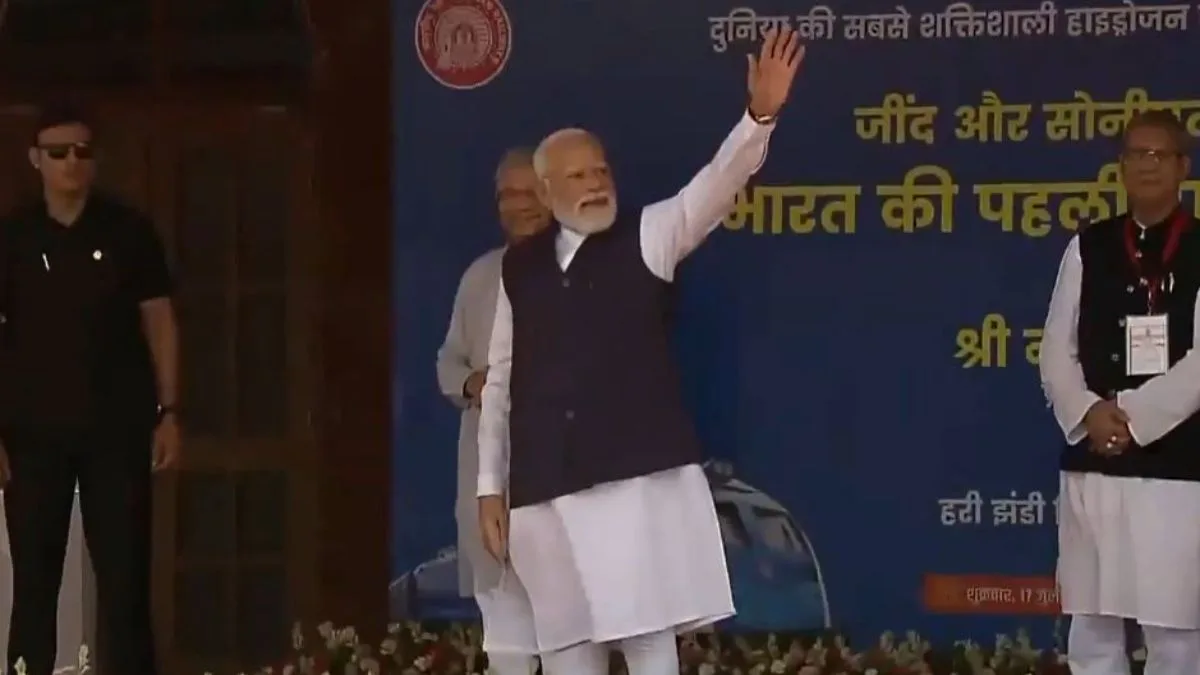
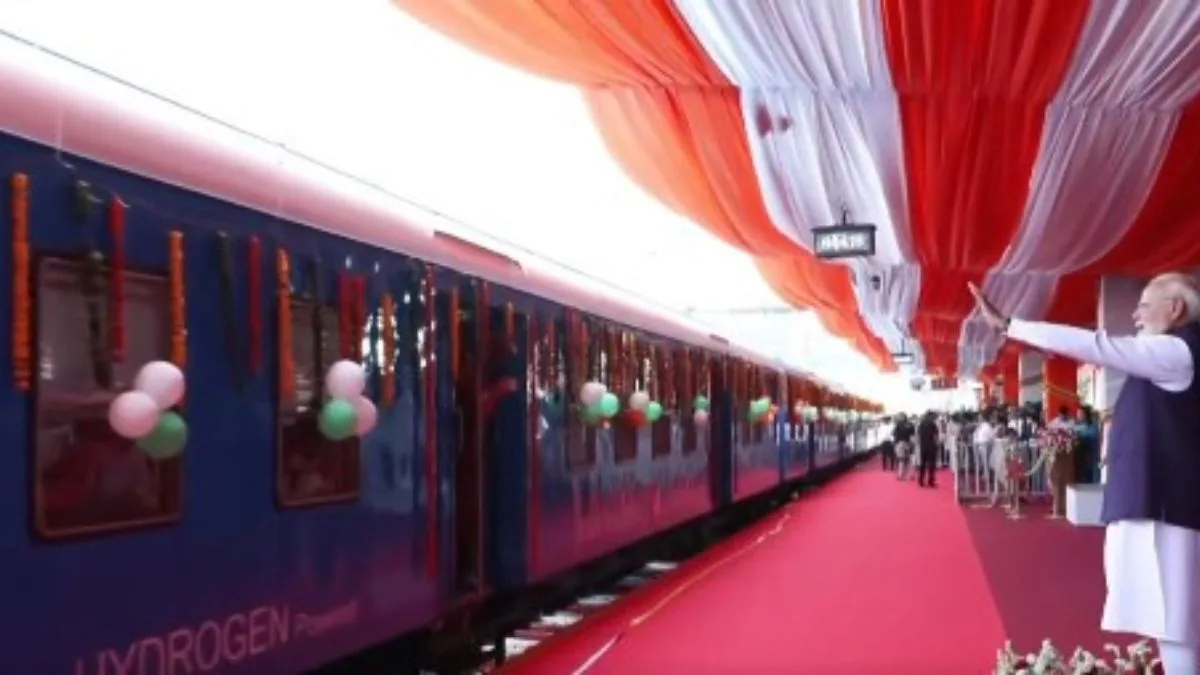
Prime Minister Narendra Modi on Friday kicked off a new chapter for Indian Railways by flagging off the nation’s very first hydrogen-powered passenger train in Haryana. The launch officially pushes India into an exclusive global club of just five nations alongside Germany, France, Sweden, and China currently operating commercial trains on green hydrogen fuel cells.
The 10-coach trainset made its debut on the 89-kilometre Jind-Sonipat broad-gauge corridor, a journey it will cover in about two hours with halts at 14 stations. Aimed at everyday passengers, the department has capped tickets between Rs 5 and Rs 25. While the commercial runs will maintain a controlled top speed of 75 km/h, the train itself features a built-in design capacity to hit 110 km/h. Immediately after the launch event, Modi headed to a public rally in Jind to clear the decks for nine regional infrastructure projects, which include a new elevated railway network and two medical colleges.
Advertisement
The high-profile inaugural run was managed by a local crew from the Jind headquarters, led by passenger loco pilot Rajesh Kumar and senior assistant loco pilot Gagandeep Singh. Singh had recently wrapped up intensive technical training under experts from Chennai to master the new operating system. According to the crew, the train uses a strictly isolated cabin setup; if commuters need any assistance on the move, the pilots connect directly with the on-board Train Manager, who handles real-time updates through a centralized public address system.
“The way this train handles is a complete shift from the diesel engines we have driven for years,” Rajesh Kumar said, describing his time at the controls. “The pick-up is immediate because the system gives you much better torque right away. On top of that, the heavy internal insulation makes the cabin totally soundproof, giving everyone a remarkably quiet and smooth ride.”
The engineering behind the 3,200-horsepower trainset depends entirely on a clean-energy hydrogen fuel cell matrix. Under the hood, compressed hydrogen gas is pushed into the cells at a pressure of roughly 8.5 bars. Once inside, it reacts chemically with incoming atmospheric oxygen to generate electricity, which directly powers two separate 1,200 kW power cars mounted at both ends of the rake. This clean reaction leaves behind nothing but water vapor and liquid water, making it a completely zero-emission transit setup. The vapor vents straight into the air while the water drains safely out under the chassis.
To keep things secure on the tracks, the train operates with an automated fire extinguishing setup and a network of 26 specialized sensors designed to instantly spot unexpected heat spikes, open flames, or micro-leakages of hydrogen gas. According to available information, the train has a seating capacity of 682 passengers, yet the number of passengers traveling during peak hours reaches up to 2,600.The train holds up to 440 kilograms of hydrogen fuel at a time, giving it a maximum range of 356 kilometers on a single fill, easily covering its estimated daily requirement of about 300 kilograms.
“Getting the chance to run India’s very first hydrogen train is a huge point of pride for our local team,” Gagandeep Singh said, speaking on behalf of the crew. “The railway has delivered an incredibly advanced piece of technology, and being trusted with its first official run is a massive honor.”
Railway officials chose the Jind-Sonipat section for this rollout because the non-electrified broad-gauge line has relatively low traffic density, running just eight daily trains, which makes performance tracking simple. Its 145-kilometre proximity to New Delhi also ensures that central technical teams can deploy immediate support during the initial operational phases. Germany had set a precedent before India. It launched the world’s first commercial hydrogen passenger service in 2018. It started operations with its full fleet in 2022.