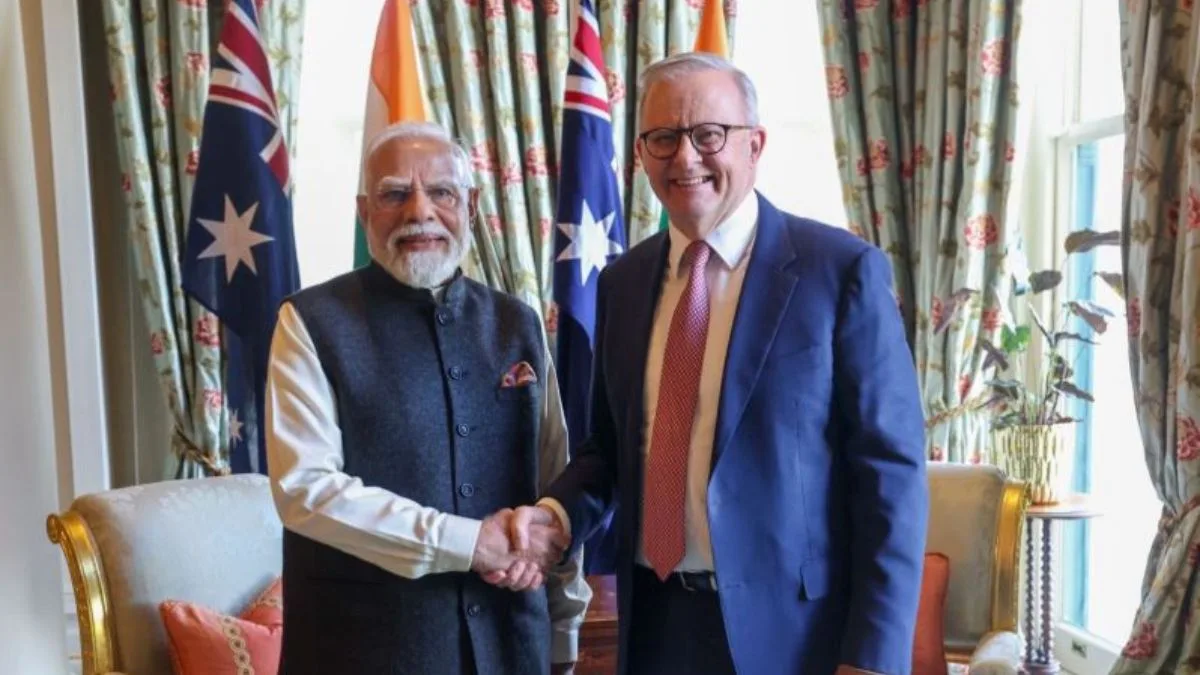
Prime Minister Narendra Modi and Australian Prime Minister Anthony Albanese on Thursday unveiled an ambitious agenda to elevate the India-Australia Comprehensive Strategic Partnership, announcing a wide-ranging set of initiatives covering trade, clean energy, nuclear cooperation, critical minerals, defence innovation, maritime security and emerging technologies, while reaffirming that the fight against terrorism remains a shared global responsibility demanding stronger international collaboration.
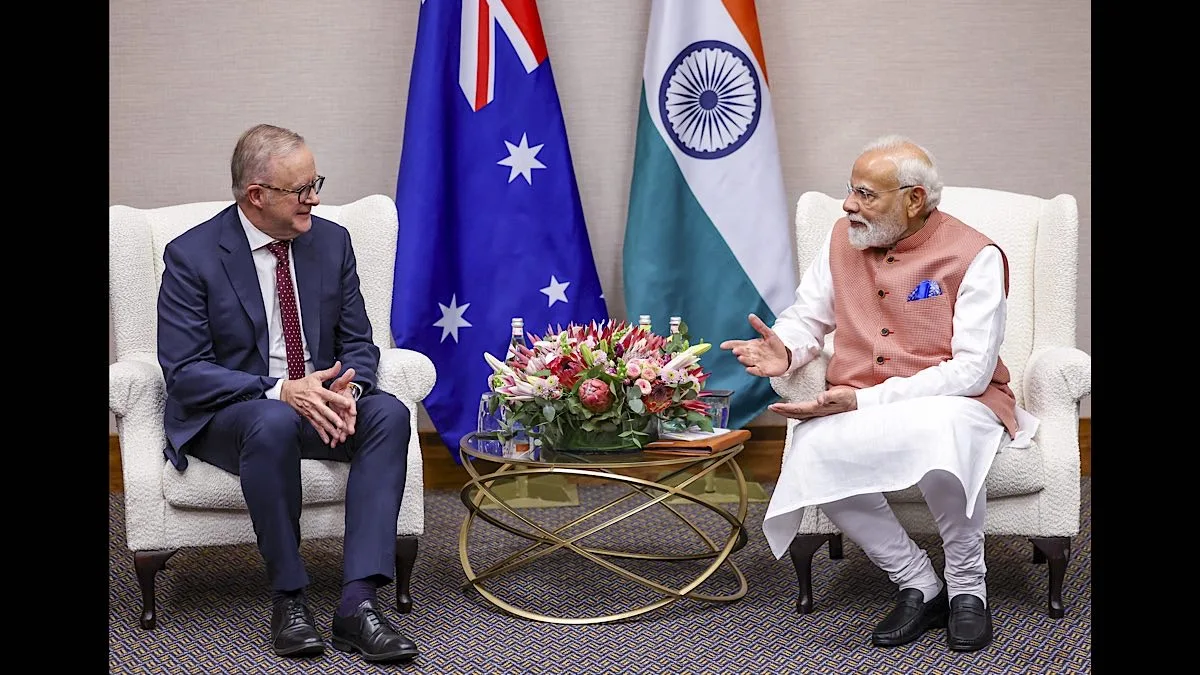
Speaking at a joint press statement after the Third India-Australia Annual Summit in Melbourne, the two leaders projected India and Australia as trusted strategic partners united by democratic values, shared interests in the Indo-Pacific and expanding economic complementarities.
Advertisement
Describing the relationship as one built on deep mutual trust, Modi said India and Australia shared the characteristics of being “two vibrant democracies, two multicultural societies, and two important ocean powers,” adding that their common worldview had enabled bilateral ties to grow at an unprecedented pace.
“These shared characteristics, along with our common worldview, inspire us to move forward together with deep mutual trust,” the Prime Minister said, noting that the Comprehensive Strategic Partnership had acquired new momentum over the past few years and that the latest summit had opened fresh avenues for collaboration.
Modi thanked Albanese for the warm welcome extended to the Indian delegation and praised his Australian counterpart’s personal commitment to strengthening bilateral relations.
“His personal efforts and commitment have taken India-Australia relations to new heights and broadened their scope,” Modi remarked.
Economic cooperation emerged as one of the principal pillars of the summit, with both countries agreeing to fast-track negotiations on the proposed Comprehensive Economic Cooperation Agreement (CECA), which is expected to significantly expand the gains achieved under the Economic Cooperation and Trade Agreement (ECTA) signed in 2022.
“The Economic Cooperation and Trade Agreement signed in 2022 has steadily expanded the scope of our trade and investment. We have now decided to expedite work on the Comprehensive Economic Cooperation Agreement (CECA), which will be balanced, ambitious and beneficial for both countries,” Modi said.
The Prime Minister also announced that India and Australia would accelerate negotiations on a Bilateral Investment Treaty aimed at promoting greater investment flows and providing long-term confidence to businesses in both countries.
The leaders underscored their commitment to advancing the clean energy transition by expanding the India-Australia Renewable Energy Partnership through enhanced investments, technology cooperation and industry collaboration. As part of these efforts, Modi announced the establishment of a Rooftop Solar Training Academy in Gujarat under the PM Surya Ghar Yojana, designed to train women and youth in renewable energy technologies and create a skilled workforce for the sector.
One of the landmark outcomes of the summit was the signing of an agreement on nuclear energy cooperation that will facilitate uranium supplies from Australia to India, reinforcing New Delhi’s efforts to diversify its clean energy sources.
“Today, we signed an important agreement in the field of nuclear energy. This will open the way for uranium supplies from Australia to India and provide fresh momentum to our clean energy objectives,” Modi said.
Reflecting the increasing strategic importance of critical minerals and advanced technologies, the two Prime Ministers launched the Australia-India Partnership on Cyber, Critical Technologies and Supply Chains (AI-PACTS) and agreed to establish a Critical Minerals Corridor to develop resilient and trusted supply chains supporting future technologies, advanced manufacturing and the clean energy economy.
Highlighting the strategic significance of the Indo-Pacific, Modi said the region represented not merely a geographical concept but a shared vision for regional stability and prosperity.
“The Indo-Pacific is not merely the confluence of two oceans. It is also a symbol of the shared aspirations of like-minded democracies such as India and Australia,” he observed.
Defence and security cooperation also figured prominently during the summit. The two countries adopted a Joint Declaration on strengthening defence and security cooperation and agreed to establish an India-Australia Defence Innovation Corridor linking defence start-ups, research institutions and industries. They also unveiled a Maritime Security Collaboration Roadmap to deepen cooperation across the Indo-Pacific, including in shipbuilding, ship repair, maintenance and maritime domain awareness.
Reaffirming the shared commitment to combating terrorism, Modi said both nations regarded the menace as a threat to all humanity rather than an issue confined to individual countries.
“India and Australia believe that terrorism is not a challenge for any one country alone; it is a grave threat to all of humanity. Therefore, our fight against terrorism is shared, our resolve is unwavering, and our cooperation continues to grow stronger,” he said.
The Prime Minister also emphasised that global conflicts could only be resolved through dialogue and diplomacy, reaffirming the commitment of both countries to safeguarding peace, stability, freedom of navigation and a rules-based international order across the Indo-Pacific.
People-to-people ties, Modi said, remained the strongest foundation of the bilateral relationship. He praised the contribution of the Indian diaspora to Australia’s development, noted Australia’s continued popularity among Indian students and welcomed the opening of Australian university campuses in India, describing it as the beginning of a new chapter in educational cooperation. Both governments, he added, would continue encouraging exchanges among students, professionals, researchers and tourists.
Addressing the gathering in cricket-loving Melbourne, Modi injected humour into his remarks by drawing parallels between diplomacy and the sport that unites both nations.
“Today, as we are in Melbourne, the sporting capital of the world, not talking about sports would be like winning the toss in a cricket match and then never starting the game,” he said.
“Cricket has its own diplomatic language in India-Australia relations. Our agenda is as focused as a One-Day match, our decisions are as swift as T20, and our partnership is as long-lasting and deep as a Test match,” he added, drawing smiles from the audience.
The Prime Minister also highlighted opportunities arising from the fact that India and Australia would host major international sporting events, including the Olympic Games and the Commonwealth Games, saying these would generate new avenues for cooperation and investment in sports infrastructure.
Modi further described the bilateral relationship as a partnership designed not only to address present challenges but also to shape the future of the Indo-Pacific and the wider international order.
“We will continue to move forward together based on our shared vision,” he said, while thanking Albanese for his friendship and leadership and expressing confidence that the Australian Prime Minister’s next visit to India would further strengthen the growing partnership.
The summit marked another significant milestone in one of India’s fastest-growing strategic relationships, with both governments committing to broaden cooperation across defence, clean energy, critical technologies, resilient supply chains, education, innovation, maritime security and regional stability as they seek to shape a secure, prosperous and rules-based Indo-Pacific.