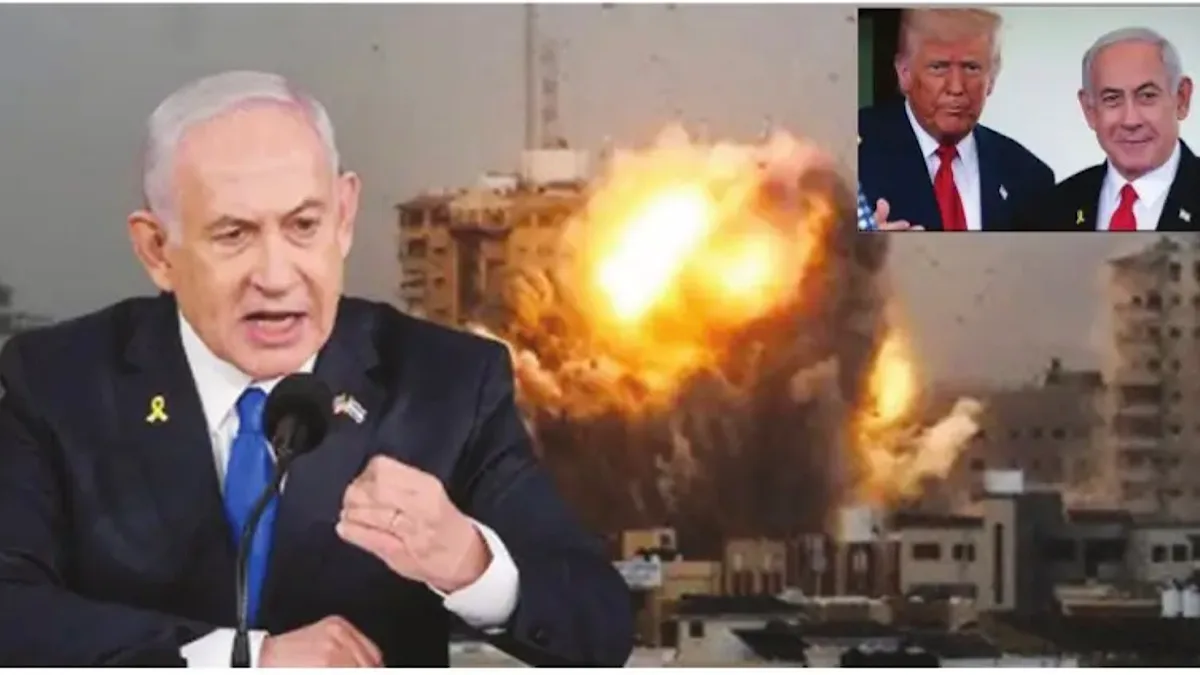
Few politicians have exhibited Benjamin Netanyahu’s talent for political survival. Through scandals, elections, wars, and coalition upheavals, he has repeatedly found ways to defy predictions of his demise, by reaching for every available lever to extend his hold on power. Netanyahu’s career is a study in reckless political brinkmanship. More than once, he has stared into the abyss ~ written off after electoral defeats, abandoned by allies, and challenged by rivals, only to reach into his political hat and produce yet another rabbit. Whether through tactical alliances, ideological repositioning, or sheer persistence, he has repeatedly transformed apparent endings into new beginnings, cultivating a reputation as one of the most durable and daring survivors in modern democratic politics.
But now serious questions abound ~ has he finally run out of tricks? The longest serving Prime Minister of Israel (more than 17 years over three separate tenures) may just have bitten off more than he can chew with his initial flattening of the Gaza Strip, subsequent battle with Iran, and the continued onslaught on Lebanon. As a peace treaty between the United States of America and Iran gains traction, where does that leave Netanyahu? Counterintuitively, the path to peace is always strewn with political landmines, as far as Netanyahu and his political appeal is concerned. For decades he has cast himself as the sentinel at Israel’s gates, warning against Tehran’s ambitions, Hezbollah’s arsenal, and Iran’s foothold in Syria.
Advertisement
Much of his political legitimacy has flowed from the belief that he alone possesses the resolve to confront these threats without hesitation. Therefore, any portents of peace delegitimize Netanyahu’s politics. Every step towards de-escalation risks further alienating his hardline allies who keep him in power i.e., ultra-conservative factions who see Gaza and Lebanon not as territories to leave behind, but as lands to be held and claimed. Given this created ecosystem, the return to normalcy tantamounts to serious turmoil at home for Netanyahu. Donald Trump and Netanyahu had entered the Iran War as partners in pressure to prove a point, part of which was mutually shared, and partly unique to Netanyahu.
Now, as the endgame looms, they seem to be at odds on how they view the cessation of hostilities. Trump wants to convert military leverage into a diplomatic settlement; whereas Netanyahu fears that a settlement could leave unresolved threats and weaken the doctrine of relentless pressure that has defined much of his political career. What began as strategic alignment is increasingly looking like a clash between a dealmaker ~ the USA ~ seeking closure, and a perennial warmonger leader like Netanyahu, who is forever wary of compromise.
The situation between Washington DC and Tel Aviv has deteriorated to a level where Trump has privately and publicly urged restraint of the Israelis regarding military actions in Lebanon and against Iran, fearing that any escalation could undermine the precariously hanging peace negotiations. He reportedly reacted angrily when Israeli actions threatened to complicate talks with Tehran. There have been unprecedented media leaks of Trump using profanities to castigate Netanyahu and his belligerence ~ never has the bilateral relationship been at such odds, so publicly. It has been a lesson in unacknowledged humility for Trump as he now seeks regional stability.
The cost of war has started telling on average American voters, and they are deeply affected. Trump’s political and economic interests clearly favour a reduction in Middle East tensions and the opening of the Strait of Hormuz, particularly as the conflict affects energy pricing, commodity shortages, shipping routes, and broader U.S. strategic priorities. A prolonged confrontation involving Iran, Hezbollah, and Israel could frustrate those objectives towards restoration of peace. Meanwhile Israel is at pains to insist that the peace talks with Iran do not bind Israel into a parallel agreement; it also knows that without Trump’s support it cannot persist with its grandstanding.
Israel’s far-right national security minister, Itamar Ben-Gvir, commented, “We are not partners to this agreement that does not ensure our security.” The reality is that earning the wrath of Trump is not an option either. In fact, Netanyahu is literally caught between the devil and the deep blue sea in terms of options. Opposition leader Yair Lapid nuanced Netanyahu’s options between, “either a direct and destructive confrontation with our greatest ally, or a submissive surrender of Israeli interests” ~ either way unsustainable. The timing is particularly bad for Netanyahu as the conundrum of bad choices is just before the forthcoming general elections due no later than 27 October 2026. These elections would effectively become a referendum on his leadership after the Gaza war, the Iran conflict, and the fallout from October 7 ~ and therefore how the endgame plays out is critical to his electoral fate.
As things stand, the endgame would seem like a moral victory for Iran with the retention of the Ayatollah regime that is even more anti-Israel than before. The flattening of the Gaza Strip by Israel will breed its own extremism in the long-term. Lastly, should peace return to Lebanon (as clearly insisted and conflated by Iran as part of the peace deal), the mood and morale of the Hezbollah would afford them claiming a similar moral victory whereas the continuation of the war, destruction and invasion would have kept up the farce of Netanyahu’s postured “muscularity” and deflected attention from the multiple failures, legal/corruption charges, and serious governance failures, including the 7 October attack.
Israel under Netanyahu has twisted the war into more than a military campaign, as it is essentially a battle for personal survival. It has consumed tens of billions of precious dollars, reshaped national priorities, strained alliances within the political spectrum, mobilized an entire generation of reservists, and left deep psychological scars that will haunt Israel. The bill can be counted in shekels and casualties, but also in the erosion of certainty that the likes of Netanyahu would like to posture – the realization that the assumptions underpinning Israel’s security for decades can no longer be taken for granted. The open friction between Trump and Netanyahu is a clear indicator of this.
(The writer is Lt Gen PVSM, AVSM (Retd), and former Lt Governor of Andaman & Nicobar Islands and Puducherry)