The ongoing unrest in Pakistanoccupied Jammu and Kashmir (PoJK) is perhaps the most serious political challenge faced by Pakistan in the territory since 1947. At one level, the protests appear to revolve around a seemingly technical issue: the reservation of 12 seats in the 45-member Legislative Assembly for refugees from Jammu and Kashmir who migrated to Pakistan after Partition. Yet, to view the present turmoil merely as a dispute over electoral arrangements would be to miss the larger story.
What is unfolding in PoJK is a manifestation of accumulated grievances over political representation, economic deprivation, regional identity and the overwhelming influence of Pakistan’s military establishment. The revolt within is, therefore, not an isolated disturbance but a sign of deeper structural contradictions that have long characterised Pakistan’s control over the region. The immediate trigger for the protests is the demand by the Jammu Kashmir Joint Awami Action Committee (JAAC) for the abolition of the 12 reserved seats. These seats, created to provide representation to refugees from Indian-administered Jammu and Kashmir who settled elsewhere in Pakistan, have been a feature of the political system for decades.
Advertisement
The argument in favour of the arrangement is that it keeps alive Pakistan’s claim that the entire former princely state of Jammu and Kashmir remains disputed and that displaced Kashmiris continue to have a political stake in its future. However, for many residents of PoJK, the arrangement has increasingly come to symbolise democratic exclusion. They argue that nearly a quarter of the Assembly should not be controlled by people who do not reside in the territory and whose electoral politics are often influenced by parties and power centres based in Pakistan.
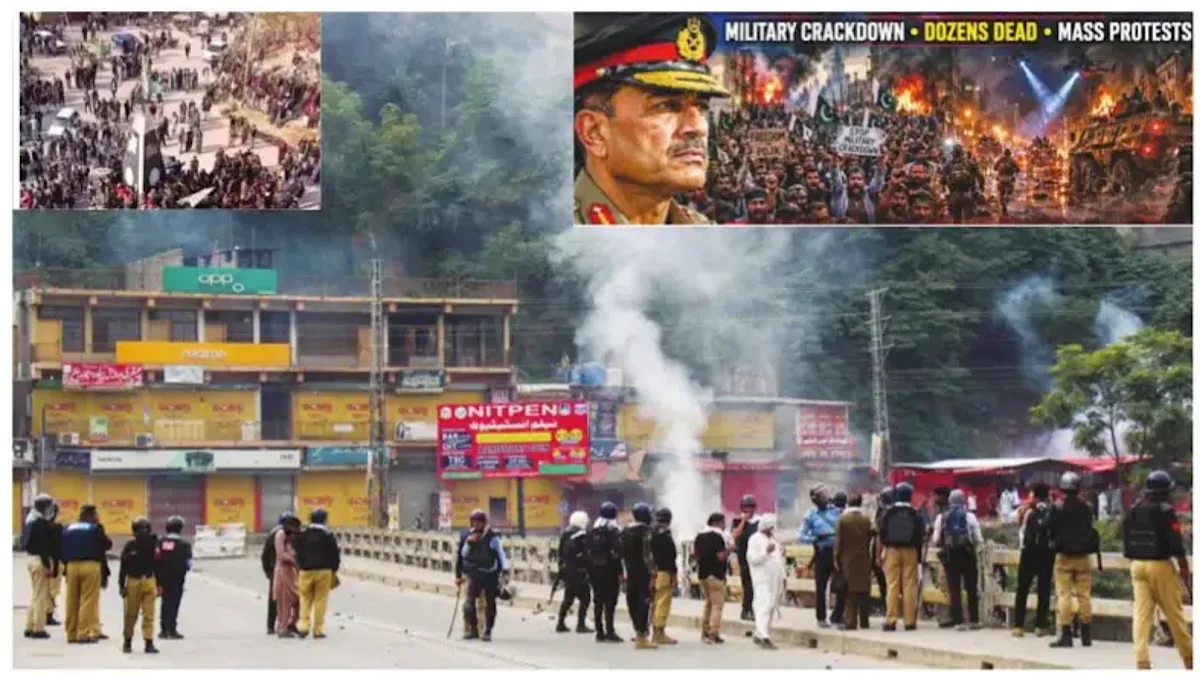
The Supreme Court of PoJK has ruled that these seats are constitutionally protected and cannot be abolished without a constitutional amendment. But legal arguments alone cannot resolve what is essentially a political crisis. The protests reveal that a significant section of the population no longer accepts the existing political compact. The massive mobilisation seen in Muzaffarabad and Rawalakot, despite bans, arrests and the deployment of security forces, demonstrates that the issue resonates deeply with ordinary people. The rise of JAAC itself is indicative of this changing political mood.
Founded in 2023, the organisation initially emerged as a grassroots movement against rising electricity tariffs, shortages of subsidised wheat and widespread perceptions of corruption and administrative inefficiency. The grievances were primarily economic. Yet, over time, the movement evolved into something much broader. It came to question not only policies but also the political structures that produced those policies. The shift from demands over electricity bills to demands for electoral reform and political representation is significant. It suggests that economic distress has exposed deeper anxieties about governance and autonomy. There is an irony in the current situation.
Pakistan has long projected itself internationally as a defender of Kashmiri political aspirations and a champion of self-determination. The rhetoric of democracy and political rights has been central to Islamabad’s Kashmir policy. Yet the images emerging from PoJK today tell a different story: thousands of protesters marching against the authorities, security forces deployed in strength, internet restrictions, curfews and allegations of excessive use of force. The contradiction between Pakistan’s external narrative and internal realities has become increasingly difficult to ignore.
This contradiction is not new. PoJK has historically occupied an ambiguous position within Pakistan’s constitutional framework. Officially, it enjoys a degree of autonomy, with its own President, Prime Minister and Legislative Assembly. In practice, however, important decisions relating to security, foreign affairs and broader policy directions have remained under Islamabad’s influence. Over the years, many residents have come to believe that their institutions lack genuine authority and that local governments operate within limits defined elsewhere.
The resulting frustration has fuelled periodic protests, but rarely have these protests acquired the scale and political character visible today. The unrest also reflects a growing assertion of regional identity. Observers who have studied the region have long noted a sense of alienation among sections of the population, particularly regarding the dominance of Pakistan’s political and military elites. Cultural affinities may exist across the border with Pakistan’s Punjab province, but political loyalties and perceptions of identity are far more complex. The current protests suggest that many residents increasingly see themselves not merely as participants in Pakistan’s Kashmir policy but as political actors with their own aspirations and grievances.
Economic issues have played a crucial role in this transformation. The protests of 2023 and 2024 centred on rising electricity costs and access to subsidised flour. Residents questioned why regions that host major hydroelectric projects, including the Mangla Dam, continued to face high electricity prices and limited economic opportunities. The sense of injustice was sharpened by memories of displacement caused by infrastructure projects and by perceptions that the benefits of development accrued elsewhere. These grievances gradually merged with demands for accountability and political reform.
Pakistan’s response to the movement has followed a familiar pattern. Authorities banned JAAC under anti-terrorism laws, accused it of sedition and detained several of its leaders and supporters. The state appears to believe that coercive measures can contain dissent. Yet experience from elsewhere in Pakistan suggests otherwise. From Balochistan to Khyber Pakhtunkhwa, reliance on security-centric approaches has often failed to address underlying political and economic grievances. In PoJK too, the use of force may suppress protests temporarily, but it is unlikely to eliminate the sentiments driving them.
Indeed, the protests in PoJK must be viewed in the broader context of Pakistan’s internal challenges. Across the country, questions of representation, federalism and legitimacy are becoming increasingly prominent. Economic difficulties, political polarisation and tensions between civilian institutions and the military have created an atmosphere of uncertainty. In such circumstances, unrest in PoJK acquires significance beyond the region itself. It becomes part of a wider debate about the nature of the Pakistani state and the relationship between citizens and institutions of power.
Whether the current movement evolves into a sustained political force remains uncertain. Much will depend on how both the authorities and the protesters respond in the coming months, particularly as elections approach. Yet one conclusion is already evident. The crisis in PoJK is not merely about 12 reserved seats. It is about competing visions of governance, identity and political legitimacy. It is about a population that increasingly seeks greater control over its own affairs and questions long-standing constitutional arrangements. Above all, it is a reminder that political consent cannot be manufactured through rhetoric or enforced through coercion. The unrest in PoJK is a revolt from within, and its implications may extend far beyond the mountains where it began.
The writer is Associate Fellow, Manohar Parrikar Institute for Defence Studies and Analyses