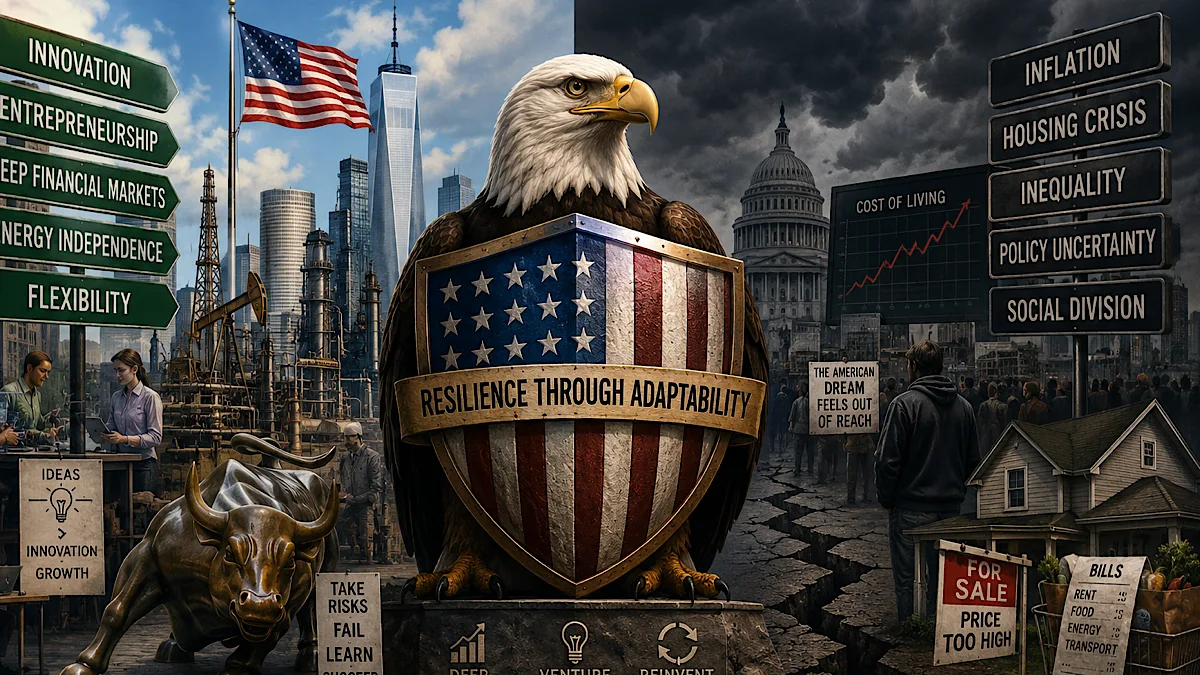
For much of the past year, economists have been waiting for the American economy to stumble. It has been hit by tariffs, labour disruptions, geopolitical tensions and renewed inflationary pressures. By conventional wisdom, such a combination should have slowed growth sharply and perhaps ushered in the dreaded spectre of stagflation. Yet the world’s largest economy has continued to expand. The temptation is to attribute this resilience either to political genius or statistical illusion.
Both explanations are inadequate. The more important story is that the United States possesses structural strengths that allow it to absorb shocks better than many of its advanced-economy peers. That does not make it invincible. But it does make it adaptable. America’s economic model has long rewarded experimentation and tolerated failure. Businesses can raise capital through deep and liquid financial markets. Venture capital finances risk. Bankruptcy, while painful, is rarely a permanent social stigma.
Advertisement
Companies facing rising costs are more inclined to reorganise, invest and innovate than to retreat into caution. This flexibility is often criticised for creating instability. Yet, in periods of upheaval, it can become a source of strength. Energy is another underappreciated factor. The shale revolution transformed the United States from a country acutely vulnerable to oil shocks into one of the world’s largest producers of oil and gas.
Europe, by contrast, discovered after Russia’s invasion of Ukraine that dependence on external energy supplies carries strategic as well as economic costs. Access to abundant domestic energy has given American industry a cushion many competitors lack. However, resilience should not be mistaken for health. Aggregate indicators can conceal deep fractures. Inflation continues to erode purchasing power. Housing affordability has become a crisis across major metropolitan areas.
Wealth creation remains unevenly distributed, fueling resentment among those who feel excluded from the prosperity reflected in stock market indices and GDP figures. There is also a danger in drawing the wrong lesson from America’s recent performance. Tariffs, immigration restrictions and policy uncertainty are not necessarily growth-enhancing simply because the economy has managed to withstand them. A robust patient surviving questionable treatment does not prove the treatment was beneficial.
It merely demonstrates the patient’s underlying constitution. Perhaps the most accurate assessment is a relative one. The United States appears strong not because it has solved its economic contradictions, but because other advanced economies face even greater constraints: ageing populations, rigid labour markets, slower innovation cycles and chronic energy vulnerabilities. America may indeed be, as one economist memorably put it, the cleanest shirt in a very dirty laundry basket. Yet even the cleanest shirt eventually stains if neglected. Adaptability has bought the United States time. Whether it uses that time to address inequality, inflation and social fragmentation will determine whether today’s resilience becomes tomorrow’s renewal ~ or merely postpones a reckoning.