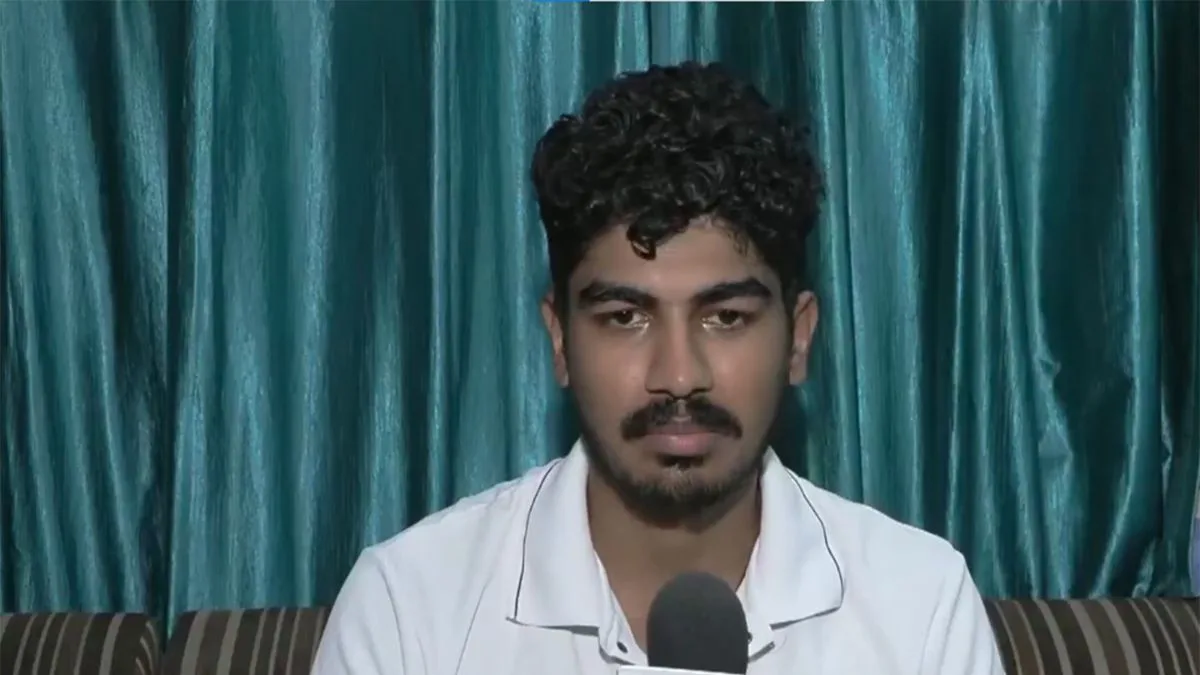
A Merchant Navy trainee from Chhattisgarh who recently returned home after completing his contract has recalled witnessing missiles and drones flying across the sky as his ship sailed through the Strait of Hormuz during heightened tensions in West Asia.
Rudransh Chaubey, who was among 22 crew members on board the vessel, said the uncertainty surrounding the conflict and reports of the Strait’s closure left the crew anxious in the initial days. He said safety guidelines issued by the Directorate General of Shipping (DG Shipping) and the shipping company helped them navigate the situation.
Advertisement
Speaking to ANI, Chaubey said he joined the ship in Egypt in December 2025 and entered the Strait of Hormuz in early February while carrying cargo bound for Saudi Arabia.
The situation became uncertain after the crew learned that Iran was closing the Strait of Hormuz. With no immediate clarity on what would happen next, those on board were left waiting for fresh instructions as the company worked out an alternative plan.
“We entered the Strait of Hormuz in the first week of February to deliver cargo to Saudi Arabia. From there, we loaded another consignment for delivery to Egypt, but that was when we learned that Iran was closing the Strait of Hormuz. We were left confused and without clear instructions on what to do next,” he told ANI.
The company later decided to redirect the cargo to Bahrain. It was during that voyage that the crew found themselves sailing through a region witnessing active military activity.
“While passing through the Strait of Hormuz, we witnessed a war-like situation unfolding. We saw several missiles and drones flying past us and observed Arab nations intercepting and destroying them. During this time, I also witnessed an attack on a ship,” Chaubey said.
Crew faced uncertainty as conflict intensified
Chaubey said the situation was particularly challenging because many crew members had never experienced anything similar before.
After unloading cargo, the vessel received instructions to load urea in Qatar before proceeding to Dubai, where it remained for nearly one-and-a-half months.
“It was a first-time experience for everyone, finding ourselves on a ship caught in the middle of a war,” he said.
He recalled that the absence of initial guidance triggered anxiety among the 22-member crew. The situation improved after the crew received detailed advisories from the Directorate General of Shipping and their company.
“Initially, there were no clear guidelines, leading to a panic-like situation on board; however, we later received clear instructions from the DG Shipping and the company regarding how to handle such a scenario,” he said.
The crew also conducted multiple emergency drills to prepare for possible threats while operating in the region.
Drone attack near vessel among most difficult moments
For Chaubey, who was on his first assignment in the shipping industry, the early days of the conflict proved especially difficult.
“When the war broke out, we didn’t know how long it would last. Since this was my very first experience in the shipping industry, encountering such a situation was entirely new to me,” he told ANI.
He said one of the most unsettling moments came when a drone attack occurred near the vessel.
“A drone attack occurred near our ship while there were 22 of us on board. We were quite rattled at the time and unsure of the best course of action, but we followed the guidelines provided by the company and the government,” he said.
Family back home followed developments closely
Chaubey said his family closely monitored developments in the region through television coverage and regularly contacted him to check on his safety.
“My family would watch the situation in the region on TV and ask me about the conditions; I would reassure them that everything was fine and there was no cause for alarm,” he said.
Communication was not always easy, he added, as satellite disruptions occasionally affected connectivity. Despite that, he tried to remain in touch whenever possible.
DG Shipping guidance helped crew navigate crisis
The sailor credited India’s Directorate General of Shipping for issuing safety protocols and providing emergency support during the crisis.
“From the very beginning, DG Shipping provided us with guidelines and procedures to follow; we were also given a helpline number so we could call immediately if any problem arose,” he said.
Chaubey has now returned home after the completion of his contract and says he is relieved to have safely navigated one of the most testing chapters of his young maritime career.
“It is a relief that we managed to get out of that situation. My only message is that everyone currently there should stay safe and follow the guidelines being issued,” he said.