The Compassion Deficit
We live in an age of extraordinary connectivity and unprecedented isolation.
As the dawn breaks over the emerald ridges of Gangtok, the mist doesn’t merely rise; it seems to ascend like incense smoke.




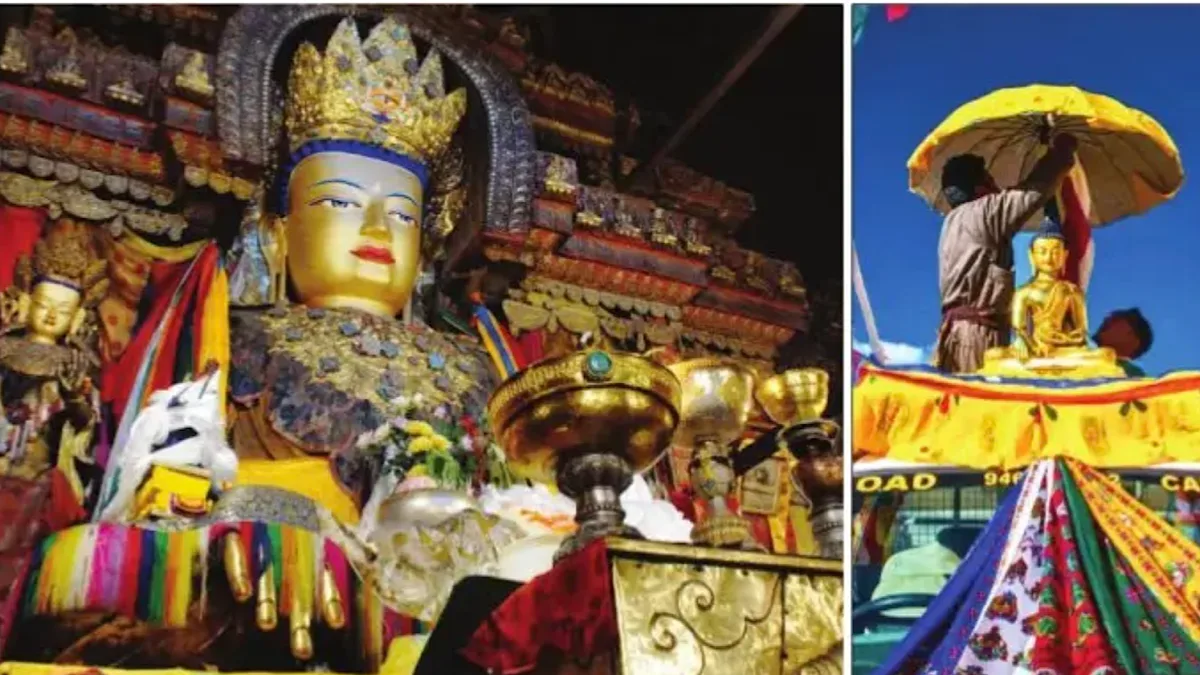
Photo:SNS
As the dawn breaks over the emerald ridges of Gangtok, the mist doesn’t merely rise; it seems to ascend like incense smoke. The air is thin, crisp, and heavy with a peculiar stillness. But as you walk towards the Tsuklakhang or Rumtek Monastery, that silence begins to breathe. It vibrates with the low, resonant hum of the dungchen (long Tibetan horns) and the rhythmic, hypnotic clicking of thousands of wooden prayer wheels. This is the commencement of Saga Dawa, the ‘Month of Merits.’ For the global traveller, Sikkim is a paradise of snow-capped peaks and rhododendron valleys.
But for those who look closer during the fourth month of the Tibetan lunar calendar, the state transforms into a living, breathing mandala of deep spirituality, ancient rituals, and unparalleled human compassion. While many associate Buddhist festivals with vibrant masked dances and loud celebrations, Saga Dawa is inherently different. It is an introspective journey, a profound collective meditation that wraps the entire Northeast’s Buddhist belt in a blanket of sacred devotion. The Confluence of Three Holies To understand the beauty of Saga Dawa, one must understand its core belief.
Advertisement
Unlike festivals that celebrate a single event, Saga Dawa honours the trinity of Gautama Buddha’s journey: his birth, his enlightenment (Nirvana), and his attainment of liberation from the mortal cycle (Parinirvana). The climax falls on the full moon day, the Saga Dawa Duchen. Local Buddhists believe that during this holy month, the cosmic scales of universe are highly sensitive. “Every action, good or bad, is multiplied one hundred thousand times during Saga Dawa,” explains an elderly monk at the Enchey Monastery, his fingers deftly moving across a strand of 108 wooden beads. This belief alters the very fabric of daily life. For thirty days, an unspoken vow of kindness takes over.
Advertisement
Kitchens turn strictly vegetarian, butchers close their shops, and arguments are deferred. It is a time when the ego takes a backseat, and empathy becomes the local currency. Lesser-Known Rituals: Beyond the Tourist Eye While the grand processions are visible to all, Saga Dawa houses several lesser-known, intimate rituals that hold deep cosmic significance, they are – The Srog-bLu (Saving of Lives), The Midnight Bumkor and The Nyungne (Fasting Ritual) The Srog-bLu (Saving of Lives): One of the most beautiful yet rarely documented practices is Srog-bLu. Instead of merely feeding the poor, devotees visit local markets to buy animals, fishes, birds, or goats, doomed for slaughter.
With chants of blessings, these creatures are set free into rivers or forests. It is a direct, practical application of Buddha’s teaching of non-violence, witnessing a fish splash back into the Teesta River is a poignant moment of pure liberation. The Midnight Bumkor: In the dead of night, before the full moon day, a quiet ritual takes place. The Holy Scriptures, the Kangyur (the translated words of Buddha) are carefully taken out of the monastery library. Devotees and monks carry these heavy, cloth-bound texts on their heads and walk in a silent procession around the town or monastery perimeter. The belief is that the physical weight of wisdom purifies the land and its people.
The Nyungne (Fasting Ritual): For the highly devout, the festival involves Nyungne, a grueling two-day ascetic practice of strict fasting and absolute silence. On the second day, even swallowing one’s own saliva is prohibited. It is a radical empathy ritual, designed to make the practitioner feel the hunger and suffering of all sentient beings in the universe. The Visual Poetry of the Full Moon The visual landscape of Sikkim during the peak of Saga Dawa is nothing short of poetry. The towns are painted in shades of white, saffron, and maroon. The most striking visual is the Kora, the circumambulation. From toddlers strapped to their mothers’ backs to fragile octogenarians bent with age, thousands walk clockwise around monasteries and stupas.
The collective motion creates a human whirlpool of devotion. The air smells of burnt juniper leaves (Sang) and melting yak-butter lamps, whose flickering golden flames symbolize the dispelling of the darkness of ignorance. On the final day, the holy procession (Bumkor) takes over the streets. Monks dressed in ceremonial robes play traditional instruments, while ordinary citizens line the roads, holding silk scarves (Khadas) and incense sticks. The atmosphere is not one of chaotic revelry, but of a deep, shared reverence that binds communities across ethnic lines, Bhutias, Lepchas, and Nepalis alike.
A Lesson for the Modern World In an era defined by fast-paced consumption and digital noise, Saga Dawa offers a sanctuary of mindfulness. The North-east of India has always been a custodian of nature and culture, but through this ritual, it also becomes a teacher of cosmic responsibility. When you see a young, tech-savvy local youth pausing their day to help an ant cross the monastery path, or a family spending their life savings to feed thousands at a Chabe (community kitchen), you realize that Saga Dawa is not an outdated medieval ritual.
It is a highly evolved psychological reset button. As the full moon rises over the majestic Kanchenjunga, casting a silver glow over the prayer flags fluttering in the night wind, Saga Dawa concludes. The horns fall silent, and the butter lamps slowly burn out. But the essence of the ritual remains etched in the mountain air, a gentle reminder that in a world where you can be anything, being compassionate is the ultimate human achievement.
Advertisement