Nobody asked for this. Nobody was sitting in Barabanki thinking, “You know what this highway needs? Matcha.” And yet, here we are. A roadside dhaba on the Barabanki-Lucknow highway is now selling hot matcha in a kulhad, and the internet has predictably lost its mind over it.
Welcome to India in 2026, where no beverage is safe.
Advertisement
What exactly is happening on this highway
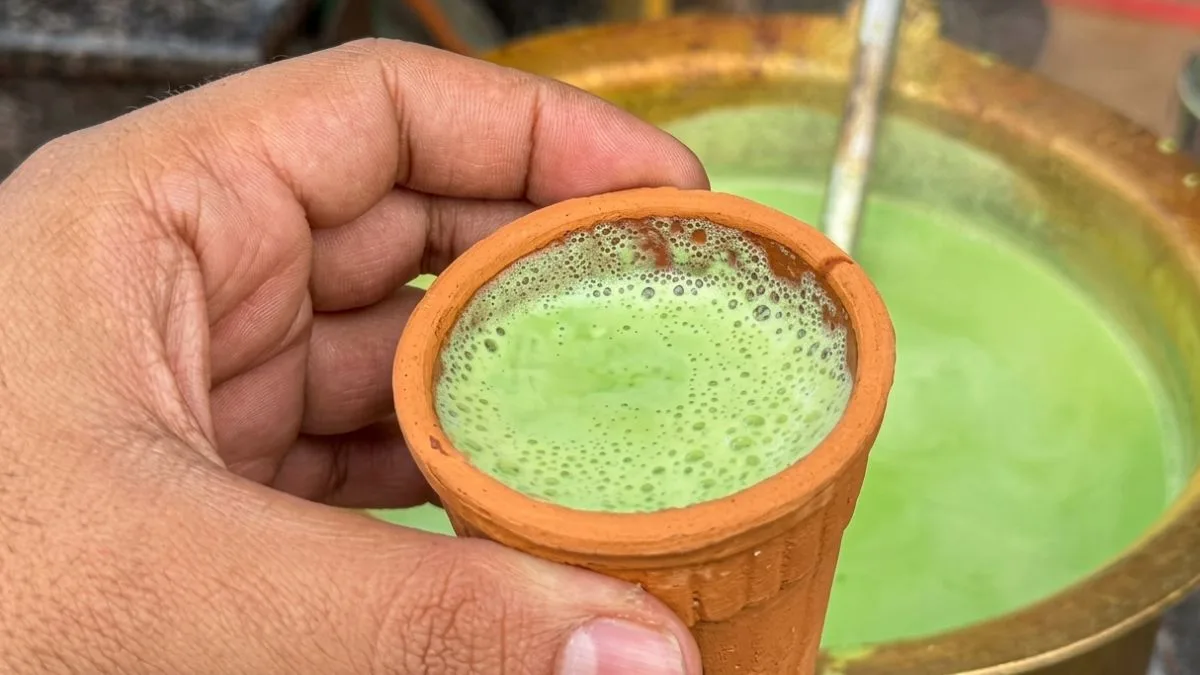
A digital creator named Ayan, who goes by @ayanahmad99_ on Instagram, posted a video that has since spread across the internet like a rash. In the video, he visits Shangri La Dhaba on the Barabanki-Lucknow highway and discovers what is being called “Garmatcha.” That is not a typo. Garmatcha. As in garam plus matcha. The vendor has coined it, rhymed it with “Matcha Ka Chacha,” and is now presumably serving it to confused truck drivers and confused food influencers alike.
The drink is prepared in a large traditional Indian vessel, the kind normally reserved for chai that can serve forty people at a wedding. The matcha is boiled, presumably with milk and sugar and whatever else the vendor felt like adding that morning. It is then poured into a kulhad and handed over to the customer, who is meant to drink it and feel things.
A brief history of India adopting things and making them unrecognisable
India has a long and proud tradition of taking something foreign, staring at it for three seconds, and reinventing it entirely. Pizza became pizza with paneer tikka and extra cheese. Pasta became pasta cooked until it apologised. Coffee became coffee with condensed milk, cardamom, and ambition.
Matcha was always going to meet the same fate.
Matcha, for those unfamiliar, is a finely ground Japanese green tea powder. In its homeland, it is prepared with near-religious precision. There is a specific bowl, a specific whisk, specific water temperature, and a specific mood. It takes time. It takes patience. And, it takes respect for the ingredient.
None of these things are available at a dhaba on the Barabanki-Lucknow highway at noon.
What is available is a giant bhagona, a gas flame, and the will to get things done. That is the Indian way. Garmatcha was always inevitable.
The internet reacts, as it always does
The comments section on Ayan’s video is functioning exactly as one might predict. It is a theatre of the confused and the concerned, with a few brave souls who are genuinely excited.
One commenter observed that the drink looks like “chicken tikka ki chutney”. Another user said, “yeh dharti phat kyun nahin jaati?”
Another user, blessed with vision, wrote: “I know someone somewhere in India is thinking about making matcha pani puri too.” This person is right. That person is already in a kitchen. The matcha pani puri is coming, and there is nothing any of us can do about it.
Someone simply wrote “Chemical lag raha hai,” which translates roughly to “this looks like chemicals,” and is perhaps the most honest review available for a drink that did not go through any traditional preparation process.
And then there was the comment that will live on in food history: “Matcha crying in the corner.” Somewhere in Kyoto, a tea ceremony master is having a bad feeling and does not know why.
What is the case for Garmatcha
Let us steelman this for a moment, because fairness demands it.
Matcha as a trend in India has largely been a product for a specific demographic. It lives in cafes in Bandra and South Delhi. It costs Rs 350 for a small glass. It’s sipped by people who own linen trousers and have opinions about oat milk. Matcha has, in short, been elitist.
The Shangri La Dhaba has democratised matcha. The vendor on the Barabanki-Lucknow highway has looked at this exclusive green beverage and said: no, this belongs to everyone. The truck driver deserves matcha too. The family on a road trip to Lucknow deserves matcha. They just deserve it in a kulhad, hot, from a big pot, for roughly a tenth of what the Bandra cafe charges.
This is a Robin Hood story, if Robin Hood stole from Japanese tea culture and gave to UP highway commuters.
The kulhad deserves recognition here
The kulhad is doing a lot of work in this story and nobody is talking about it. The unglazed clay cup has carried chai across generations and geographies. It has held lassi at Punjab dhabas, milk at railway stations, and now, apparently, matcha on a UP highway.
The kulhad does not discriminate. The kulhad has no opinion about terroir or umami. It simply holds the liquid and keeps it warm and gives it a faint earthy smell that no amount of ceremony can replicate. If anything, the kulhad might actually improve matcha. The clay adds a dimension. The earthiness offsets the bitterness. This is not something anyone planned, but it may be a happy accident.
Nobody will write a think piece about this, but they should.
Should you try it?
If you find yourself on the Barabanki-Lucknow highway, yes, absolutely. Not because Garmatcha is going to rival anything from a specialty cafe. But because it is genuinely one of a kind, for now. Because the vendor thought of a pun and then turned it into a business and that deserves support. Because the kulhad will be warm in your hand and the matcha will be strange and you will not quite know how to feel about it.
That confusion, that pleasant bewilderment, is the whole point. India does this with food constantly. It grabs something foreign and squeezes it through its own sensibility until something new comes out the other side. Sometimes the result is excellent. Sometimes it is merely interesting. And, sometimes it looks like ‘chicken tikka ki chutney’.
Garmatcha is probably interesting. Go find out.