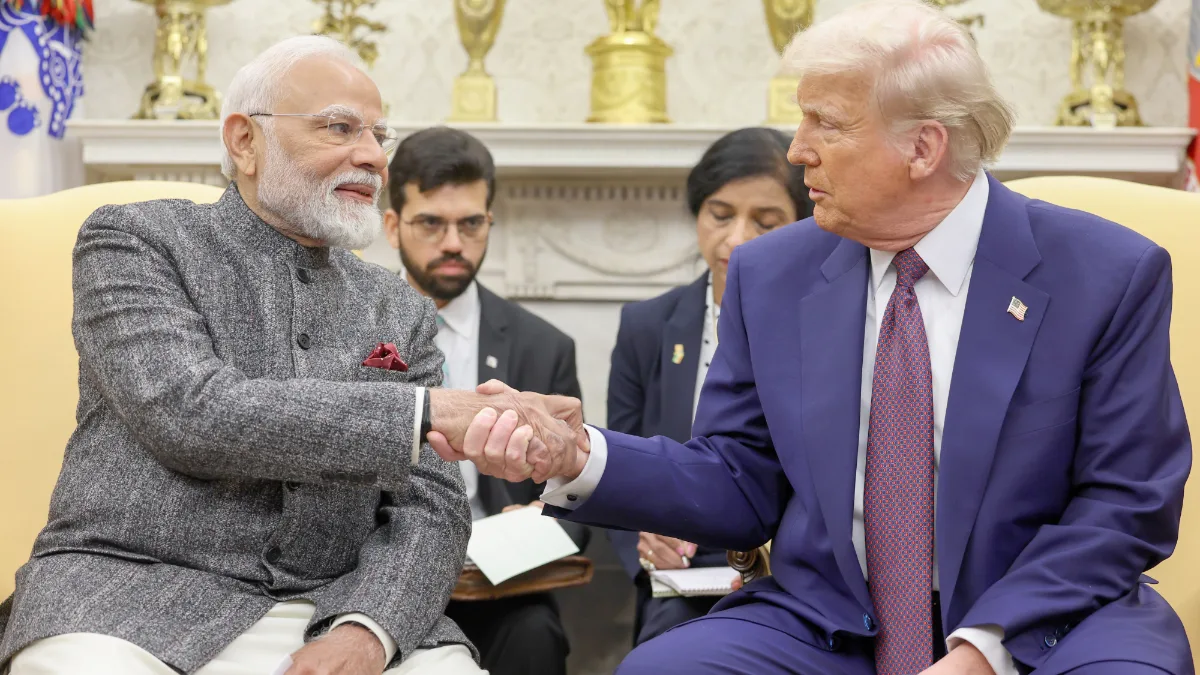
Amid growing trade negotiations between Washington and New Delhi, US President Donald Trump on Thursday voiced optimism about reaching a trade agreement with India, while describing Prime Minister Narendra Modi as a close friend with whom he shares a strong working relationship.
Trump’s remarks come at a time when the United States has unveiled a new set of tariff measures affecting several economies, including India, over what it says are shortcomings in curbing imports of goods produced through forced labour. The development has added a fresh dimension to ongoing trade discussions between the two countries.
Advertisement
Speaking to reporters at the White House, Trump said India and the United States would eventually arrive at a mutually acceptable arrangement despite past trade disagreements.
“For years, India took advantage of the United States. They charged us tremendous tariffs and paid nothing. Now it is the exact reverse, and we are making a lot of money with India. But we will get to a deal because I like your Prime Minister (Narendra Modi) a lot; he is a good friend of mine, and we get along well. We have a good relationship,” Trump said.
New US tariff measures target over 50 economies
Earlier this week, the United States announced additional tariff measures under Section 301 of the Trade Act of 1974, citing concerns related to the import of goods allegedly produced through forced labour.
The Office of the United States Trade Representative (USTR) identified 54 economies, including India, claiming they had failed to impose and effectively enforce prohibitions on imports linked to forced labour.
Countries named in the list include India, Singapore, South Korea, Australia, Taiwan, Thailand, China, Russia, Saudi Arabia, the United Arab Emirates, Sri Lanka, Switzerland, Turkiye, Israel, Japan, Qatar, and the United Kingdom.
According to the USTR, economies that already have some form of forced labour import prohibition, or have committed to implementing such measures through trade agreements, could face an additional tariff of 10 per cent. Others may be subject to an extra duty of 12.5 per cent.
Textile imports may get limited tariff relief
The proposed action also includes a textile mechanism that would allow a specified volume of apparel and textile imports from certain economies to enter the US market at a reduced Section 301 tariff rate.
The USTR said the measures are aimed at addressing what it termed “unreasonable” policies and practices related to the failure to prohibit imports of goods produced with forced labour, arguing that such practices place a burden on US commerce.
Separately, the trade body flagged six economies for allegedly failing to effectively enforce existing prohibitions on the import of goods produced through forced labour. Those named include the European Union, Pakistan and Canada.