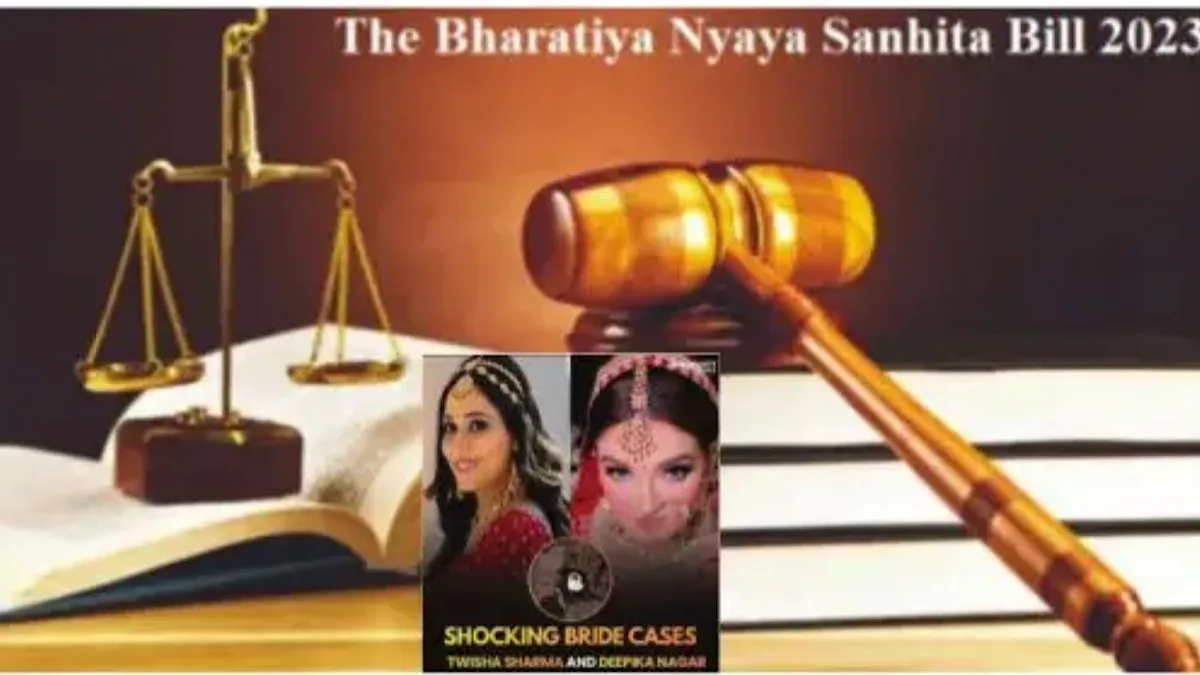
On 12 May 2026, Twisha Sharma, 33, was found hanging in her matrimonial home in Bhopal’s Katara Hills. The FIR named her husband and mother-in-law on allegations of dowry harassment. Within days the Supreme Court took suo motu cognisance of “alleged institutional bias and procedural discrepancies” in the handling of her unnatural death, AIIMS Delhi conducted a second autopsy, and the case was transferred to the Central Bureau of Investigation.
Six days later in Greater Noida, 25-year-old Deepika Nagar died after allegedly falling from the terrace of her three-storey matrimonial home, seventeen months into her marriage. Her father told police she had telephoned him minutes earlier saying she was being assaulted over dowry demands; the post-mortem found a brain bleed and multiple contusions. Police registered the case under Section 80(2) and Section 85 of the Bharatiya Nyaya Sanhita and Sections 3 and 4 of the Dowry Prohibition Act. The alleged demand was a Toyota Fortuner and around Rs 50 lakh in cash.
Advertisement
Both cases remain under investigation. That caveat matters. A republic governed by law must not convict through grief, television, or public fury. Yet it is also true that these names entered a queue already too long for innocence to be the only national posture. The Bharatiya Nyaya Sanhita defines dowry death as the unnatural death of a woman within seven years of marriage where cruelty or harassment connected with a dowry demand is shown to have occurred soon before her death; the punishment is a minimum of seven years and may extend to life imprisonment.
If the statute is precise, the social disease it addresses is older, more elusive, and far more difficult to prosecute. India’s tragedy is not that it lacks laws. It is that the law arrives after the daughter has already been culturally priced. The old phrase for this pricing is paraya dhan: another’s wealth. It sounds gentle when spoken in a courtyard, almost affectionate, as though a daughter is a guest whose departure must be prepared with tears and jewellery. In truth, it is one of the most efficient phrases patriarchy has invented. It converts a child into a transfer asset.
It tells parents that investment in her education, autonomy, and inheritance is generosity rather than duty. It tells the groom’s family that acceptance carries a price. It tells the daughter that her belonging is provisional from birth. This idea did not descend from nowhere. Manusmriti 9.3, in Ganganath Jha’s canonical translation, declares that the father guards her during virginity, the husband guards her in youth, the sons guard her in old age. The woman is never fit for independence.
It would be lazy to pretend that one verse explains a civilisation. India’s own traditions contain counter-memories of learned women, ruling women, argumentative women, and saint-poets who refused to be contained by domestic grammar. But the Manu-like imagination found a durable home in everyday custom because it served power. It made control look like protection. It made exclusion look like honour. That grammar survives in the numbers. The National Family Health Survey-5 put India’s sex ratio at birth at 929 girls per 1,000 boys, still below the natural range; Rajasthan stood at 891 and Punjab at 904.
Reuters, citing the United Nations Population Fund, reported in 2022 that India was losing approximately 5.9 lakh girl children to prenatal sex selection each year between 2015 and 2020, contributing to an estimated forty-six million women and girls “missing” from the population by 2020. A country does not arrive at such figures merely through medical misuse. It arrives there when son preference becomes household economics, ritual expectation, old-age insurance, lineage anxiety, and matrimonial bargaining combined. Dowry is not an aberration within this system.
It is its invoice. The legal architecture appears formidable. The Dowry Prohibition Act has existed since 1961. Section 80 of the Bharatiya Nyaya Sanhita criminalises dowry death. Section 85 punishes cruelty by the husband or his relatives, and Section 86 defines that cruelty to include wilful conduct likely to drive a woman to suicide or cause grave injury, and harassment tied to unlawful demands for property or valuable security. Yet the National Crime Records Bureau, in Crime in India 2023, recorded 6,156 dowry deaths in that year alone, with Uttar Pradesh accounting for 2,122 and Bihar for 1,143.
The provisional figure for 2024, since released, is 5,737. The decline is welcome. Survival is not victory when more than five thousand women are still dying each year at the intersection of marriage, money, and impunity. And the official count is itself a floor: under the NCRB’s “principal offence” rule, where an FIR carries multiple charges, only the most heinous is recorded, so dowry deaths are routinely subsumed within murder or abetment. Researchers have argued the true figure is plausibly two to three times the published one. The most frightening part of dowry violence is not always the fatal end.
It is the long normalisation before it: the first “small” demand, the comparison with another bride’s wedding gifts, the taunt about a car, the pressure on a father already in debt, the suggestion that a daughter must not “adjust” too loudly. By the time a case becomes a crime report, the family has usually passed through months or years of informal arbitration conducted by relatives whose first instinct is not justice but the preservation of marriage at any cost.
This is why the fashionable question ~ are dowry laws misused? ~ is too narrow to carry the moral burden placed upon it. Any criminal law can be misused; false implication is real, and due process is not a decorative principle. But the existence of misuse cannot become a solvent for the reality of use. A society that discusses false cases more eagerly than dead daughters has disclosed its priorities. The answer is not weaker law. The answer is better investigation, faster trials, forensic seriousness, protection for complainants, and penalties for both cruelty and fabrication when either is proved.
The discrimination does not end at marriage. It continues into the apparently respectable routines of labour and home. The Ministry of Statistics and Programme Implementation’s Time Use Survey of 2019 found that women who participated in unpaid domestic services spent an average of 299 minutes a day on such work, against 97 minutes for men. The Periodic Labour Force Survey for July 2023 to June 2024 put female labour-force participation in the usual status, for those aged fifteen and above, at 41.7 per cent; the male figure was 78.8 per cent.
The Indian woman is expected to study, earn, bear children, care for elders, preserve family honour, and remain grateful if she is permitted to do any of this with minimal obstruction. The paradox is brutal. The daughter is treated as temporary in her natal home, yet permanently available for service in her marital one. She is paraya dhan before marriage and family labour after it. Her labour is intimate enough to be demanded, but not economic enough to be counted. Her salary, where she has one, is often negotiable within the household. Her inheritance is frequently surrendered in the name of affection. Her body becomes the site where lineage, caste, class, and property anxieties settle their accounts.
The constitutional answer is not ambiguous. Equality before law, non-discrimination on grounds of sex, and the right to life with dignity are not ornamental promises to be recited on national days. They are instructions. But constitutional morality cannot survive as courtroom language alone. It has to enter the kitchen where a daughter is told not to study too far from home. It has to enter the marriage negotiation where “gifts” are itemised with plausible deniability. It has to enter the police station where a complaint is softened into compromise. It has to enter the family WhatsApp group where a son’s entitlement is still mistaken for parental duty.
The work ahead is therefore both administrative and intimate. Anti-dowry cells need trained investigators, not clerical desks. Deaths within seven years of marriage must be treated with forensic discipline, not local influence. Protection officers and women’s help desks must be resourced in practice, not merely announced. Daughters must inherit visibly. Schools must teach boys that household labour is not feminine destiny. Parents must stop calling dowry “customary gifts” when the price was negotiated before the priest arrived. The harder reform is linguistic. India must retire paraya dhan from the moral vocabulary of family life.
A daughter is not another household’s wealth. She is not a liability awaiting transfer, not a ritual expense, not a vessel for lineage, not a future apology to be packaged with furniture and gold. She is a citizen. Twisha Sharma and Deepika Nagar are still names in pending matters, and the courts must do their work carefully. But the country need not wait for final judgments to examine the culture that keeps producing such cases. The death of a daughter is not born on the day her body is found. It is rehearsed in every joke, blessing, bargain, and silence that teaches her she was born with a debt attached. A civilised society does not merely punish the last act. It abolishes the script.
(The writer has professional experience in human resource consulting and advisory services)