ByteDance’s Doubao loses 6 million users as paywall gamble ‘backfires’
Analysts have suggested that ByteDance could be risking throwing away its lead in artificial intelligence consumer race by monetising too early.
The three-time Oscar winner made his position clear on a podcast appearance with former First Lady Michelle Obama, drawing a firm boundary between technology and storytelling.




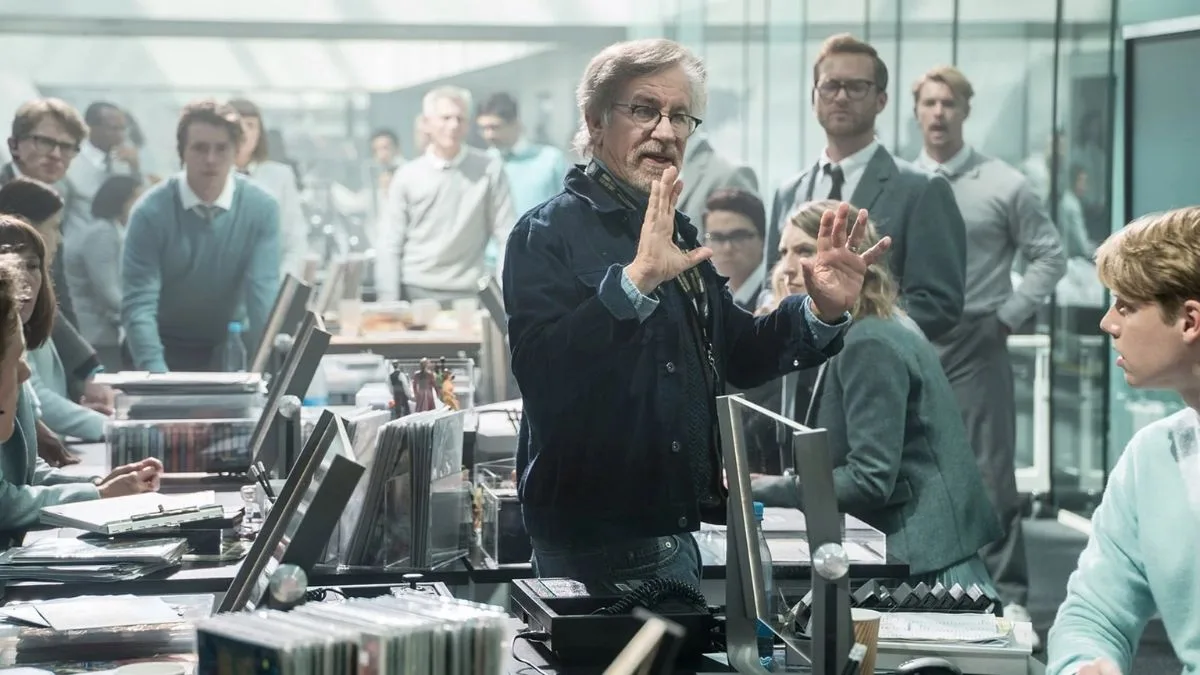
Image Source: Instagram
On May 27, 2026, director Steven Spielberg appeared on ‘IMO with Michelle Obama and Craig Robinson’, podcast hosted by former First Lady Michelle Obama and actor Craig Robinson. The episode also covered Spielberg’s new film ‘Disclosure Day’ and his broader legacy in Hollywood.
During the conversation, Spielberg was asked about artificial intelligence and its growing role in the entertainment industry. His response left little room for ambiguity.
Advertisement
Spielberg said he does not want AI taking a position at the creative table. “Where I don’t love AI is where it takes a position or there’s an empty chair at a writer’s table,” he said. “I’m not willing to substitute, you know, because I don’t really believe in sentience. I don’t believe there is any substitute for the soul.”
Advertisement
He went further, describing the idea of a machine simulating human feeling as something fundamentally at odds with how he works. “A computer that thinks it feels more than we feel is anathema to the way I was raised and how I’ll practice my own trade of producing and directing in the future,” he said.
Spielberg acknowledged that AI may have practical uses in film production. He said he could see a future where AI helps “save us a lot of legwork” by doing tasks like scouting locations. But he was clear that any usefulness ends there.
“Don’t tell me how to write my dialogue for this character. Don’t tell me where the camera has to go. And also don’t tell me what the set should look like, unless AI is simply a tool in a large tool chest of the production designer,” he said.
He closed that section of the conversation with a direct instruction to the industry: “Use AI as a tool, but do not use AI as the final word on anything creative. That’s where I draw the line.”
Spielberg’s comments on the podcast were consistent with a position he had expressed earlier in 2026. In March, speaking at SXSW in Austin, Spielberg revealed that he has never used AI in any of his films, a statement that drew enthusiastic applause from the audience.
At the SXSW Film and TV Festival, he used his own writers’ room as an example of his approach. “All the seats are occupied,” he said. “There’s not an empty chair with a laptop in front of it.”
That metaphor resurfaced in the podcast episode. He described a scenario in which six writers sit around a table, with a seventh “seat” occupied by a computer. He said he is not willing to treat that computer as a writer.
Spielberg did not dismiss artificial intelligence entirely. He said he thinks AI can be useful to “find solutions to medical issues.” His objection is specific: AI should not occupy a creative role that would otherwise belong to a human being.
He said he is “withholding judgment on AI” until he has a better understanding of how it is being used across the industry. That careful framing suggests he is watching the space, even if he has not changed his position on its use in his own work.
Spielberg’s comments arrived at a time when studios and unions across Hollywood are still working out the boundaries of AI in production. The issue has been a point of tension since the writers’ and actors’ strikes of 2023, and formal agreements on AI use remain a moving target.
Spielberg is not alone among major Hollywood figures in his position. Leonardo DiCaprio voiced similar concerns to Time magazine in December 2025, arguing that genuine art requires a human being at its centre.
DiCaprio used AI-generated music mashups as his example. He described such content as “absolutely brilliant” in the moment, before it “dissipates into the ether of other internet junk.” He said there is “no anchoring to it” and “no humanity to it, as brilliant as it is.”
Both Spielberg and DiCaprio arrived at the same conclusion: technical output from AI is not the same as art.
The podcast episode was partly a promotional appearance for ‘Disclosure Day’, Spielberg’s latest film. First reactions to the film praised the performance of Emily Blunt in the lead role and called it “Spielberg’s best film in 20 years.”
Spielberg has directed films for more than five decades. His credits include ‘Jaws’, ‘E.T. the Extra-Terrestrial’, ‘Schindler’s List’, ‘Saving Private Ryan’, ‘The Fabelmans’. He has won three Academy Awards.
Advertisement