US Secretary of State Marco Rubio onnTuesfay updated fellow Quad members – India, Japan and Australia – on the progress of crucial diplomatic negotiations with Iran over the volatile Strait of Hormuz.
Addressing reporters after the foreign ministers of the four members of the Quadrilateral grouping of countries met in New Delhi, Australian Foreign Minister Penny Wong on Tuesday stressed the importance of strategic necessity of keeping the vital trade chokepoint secure, pointing to a shared consensus within the four-nation grouping to avert a wider economic fallout.
Advertisement
“The first point is that Secretary Rubio did update us on the negotiations and the progress of those negotiations with Iran. Australia and others have been saying for some time that we need to see a diplomatic resolution,” Wong said.
With global maritime trade severely disrupted due to the ongoing conflict in West Asia, Wang said that reopening of the Strait of Hormuz was the shared strategic priorities of the four Quad members- India, the US, Japan and Australia.
“We need to see the Strait open. We need to see the supply flow. And I think that’s a consistent position of Quad members. So we were updated on that,” she noted.
The ripple effects of the ongoing friction in West Asia have pushed the grouping to actively address the vulnerabilities in global logistics and fuel corridors, ensuring that regional economies are insulated from sudden shocks.
Elaborating on how the Quad plans to address the direct fallout of the maritime deadlock, Wong connected the conflict to the tangible, collaborative frameworks emerging from their latest discussions.
“In terms of some of the consequences of the conflict and the closure of the Strait, you would see that there’s a discussion about energy security, and the Energy Security Initiative is one of the outcomes of our meeting,” the Australian Foreign Minister explained.
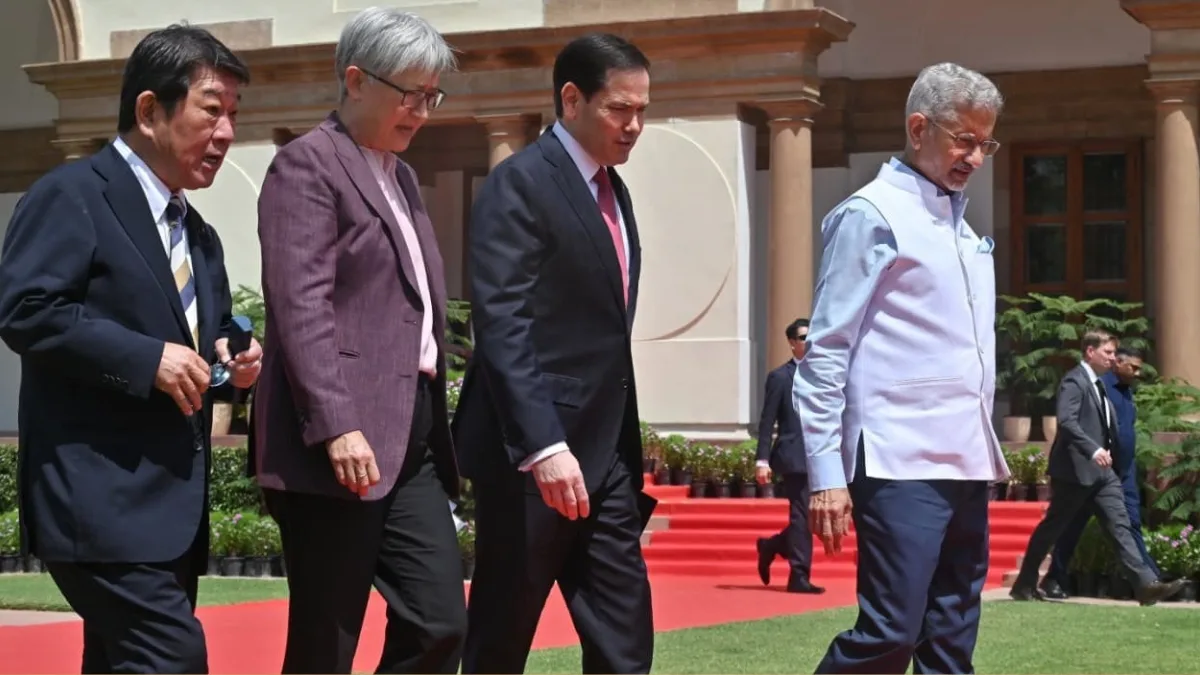
This crucial update emerged from the first Quad meeting of 2026 hosted by India- which brought together External Affairs Minister S Jaishankar, US Secretary of State Marco Rubio, Australian Foreign Minister Penny Wong and Japanese Foreign Minister Toshimitsu Motegi to confront a world economy reeling under acute economic stress and aggressive maritime blockades.
At the heart of the emergency deliberations was Iran’s recent closure of the critical strategic waterway, a move executed in response to a US-Israeli war that broke out on February 28, severely disrupting international energy markets. Tensions have since intensified as Tehran actively discusses formalising its chokehold over maritime traffic by establishing a permanent tolling system.
With inputs from agencies.